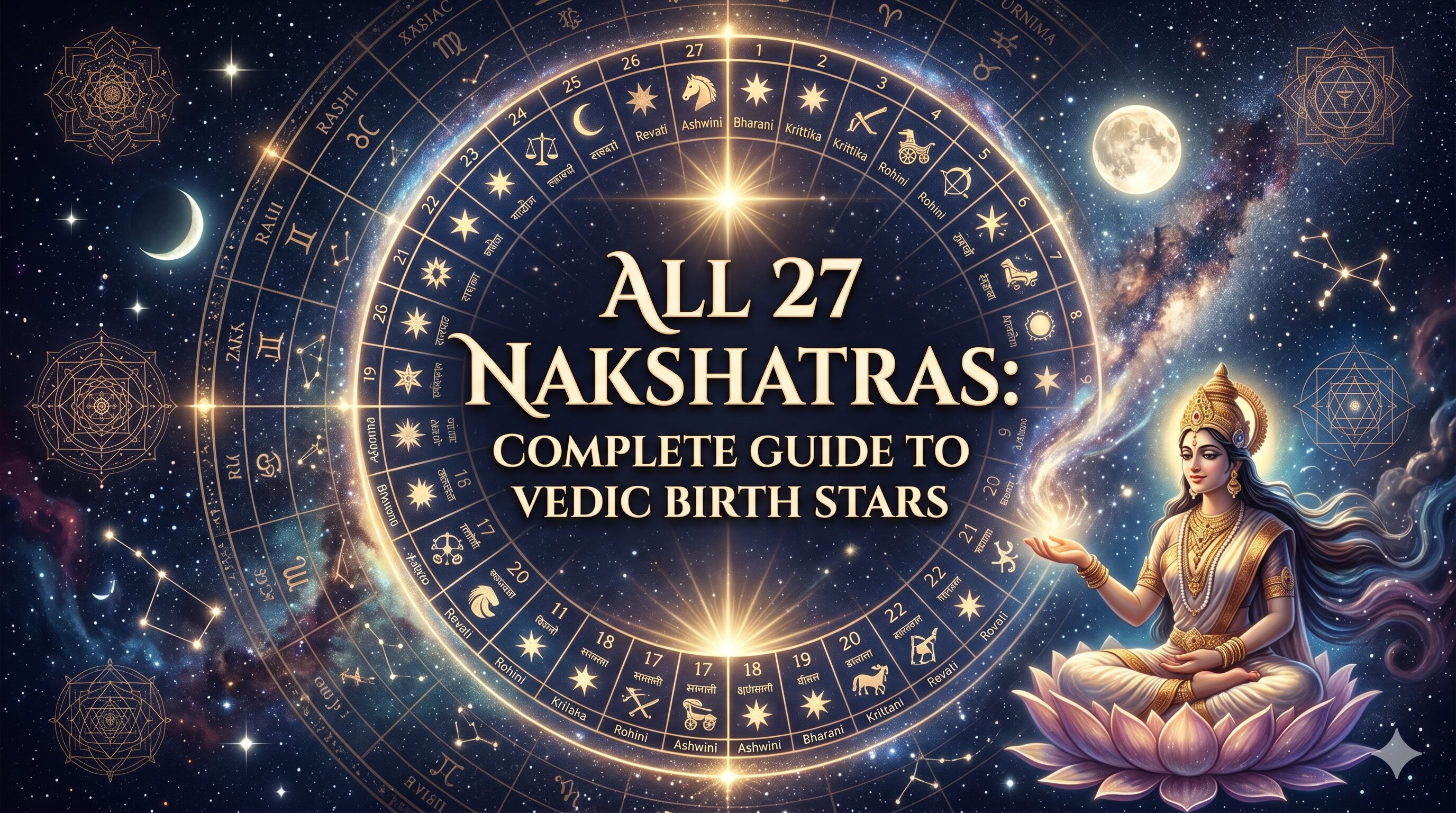
Quick Answer: What are the 27 Nakshatras in Vedic Astrology? The 27 Nakshatras are lunar mansions in Vedic astrology, each spanning 13°20' of the 360° zodiac. Your Janma Nakshatra (birth star) is determined by the Moon's position at the moment of your birth and is considered more revealing than your Sun sign in Jyotish. Each Nakshatra has a ruling planet, presiding deity, symbol, and unique set of personality traits that shape your emotional nature, life path, career aptitude, and marriage compatibility. The nine planets rule the 27 Nakshatras in a repeating three-fold sequence, forming the basis of the Vimshottari Dasha system - the 120-year planetary period cycle central to predictive Vedic astrology. 27 Nakshatra kaunse hain aur unka arth kya hai? 27 Nakshatras Vedic Jyotish ke woh chandra bhavan hain jo 360° zodiac ko 13°20' ke barabar hisson mein baantte hain. Aapka Janma Nakshatra - janam ke samay Chandra ki sthiti se nirdharit - aapke swabhav, bhavishya, aur vivah yogyata ka sabse sahee darpan hai. Har Nakshatra ka ek swami grah, adhishthatri devata, pratik chinh, aur vishesh gun hota hai. Nau grah teenbari aavritti mein 27 Nakshatras par shaasan karte hain, jo Vimshottari Dasha paddhati ka aadhar hai. |
In Vedic astrology, the Moon is the soul's lantern - and the Nakshatra it occupies at the moment of your birth is the precise star-field that lantern illuminates. More intimate than your Sun sign and richer in detail than your rising sign, your Janma Nakshatra (birth star) is the fingerprint of your inner world. It shapes how you feel, how you love, what profession calls to you, and which karmic lessons your soul has chosen to master in this lifetime.
This guide covers all 27 Nakshatras in Vedic astrology - their ruling planets, presiding deities, symbols, personality traits, marriage compatibility, and professional aptitudes - along with the deeper framework of how Nakshatras underpin the Vimshottari Dasha system and Kundali Milan (marriage matching). Whether you are new to Jyotish or deepening an existing practice, this is your complete reference.
Related Reading: If your birth chart carries a significant nodal configuration, explore our complete guide to Kaal Sarp Dosh - 12 Types, Formation, and Proven Remedies [internal link: /blog/kaal-sarp-dosh-complete-guide]
The word Nakshatra derives from the Sanskrit roots 'naksh' (to approach or attain) and a secondary derivation 'na' + 'kshatra' - meaning imperishable or indestructible - a reference to the eternal fixed stars that form these celestial divisions. The 27 Nakshatras divide the 360° zodiac into 27 equal segments of 13°20' each. Since the Moon completes its orbit of Earth in approximately 27.3 days, it spends roughly one day in each Nakshatra - making Nakshatras a Moon-based, lunar map of time and cosmic influence.
The earliest references to Nakshatras appear in the Rig Veda and the Taittiriya Brahmana, where they were revered as divine entities governing rituals, seasons, and celestial time-keeping. The Vedanga Jyotisha - among the oldest Vedic texts on astronomy - lists all 27 Nakshatras. Originally 28 Nakshatras were recognised, including Abhijit (corresponding to the star Vega), but by convention the system stabilised at 27 for astrological purposes.
In Vedic mythology, the 27 Nakshatras are personified as the 27 daughters of Daksha Prajapati, all of whom became the wives of Chandra (the Moon). The Moon's monthly journey through the sky is thus mythologised as his visits to each of his 27 consorts - a poetic encoding of the Moon's orbit that makes Nakshatras both an astronomical and devotional framework simultaneously.
Each Nakshatra spans 4 Padas (quarters) of 3°20' each, creating 108 total Padas - a number that corresponds to the 108 beads of a Japa mala and to the 108 names of Vishnu. This internal structure connects the Nakshatras to the Navamsha chart, one of the most important divisional charts in Jyotish, used for assessing marriage and dharma.
Your Janma Nakshatra (janma = birth) is the Nakshatra occupied by the Moon at the exact moment of your birth. In Vedic astrology, the Moon represents the mind, emotions, instincts, and the subconscious self. Because the Moon moves so rapidly - approximately one Nakshatra per day - your Janma Nakshatra is one of the most precise and personally revealing indicators in your birth chart.
Unlike the Sun sign (which changes only once a month and is shared by roughly one-twelfth of all humanity), the Janma Nakshatra changes approximately every 54 hours and reflects your moment-specific emotional blueprint. Two people born on the same day under the same Sun sign can have radically different Janma Nakshatras and therefore profoundly different emotional natures, relational instincts, and life trajectories.
The Janma Nakshatra determines:
To find your Janma Nakshatra, you need your precise date, time, and place of birth. Use the free Kundali generator at nakshatraai.ai/add-kundli to calculate your birth chart and instantly identify your birth Nakshatra.
In Vedic astrology, nine celestial bodies - the seven visible planets plus the two lunar nodes Rahu and Ketu - each govern three of the 27 Nakshatras. This three-fold rulership is also the basis of the Vimshottari Dasha system, where the Dasha periods of all nine planets sum to 120 years - a complete human life cycle in Jyotish cosmology.
The planet ruling your Janma Nakshatra is called the Nakshatra Adhipati (lord), and its condition in your birth chart - its sign, house, strength, and aspects - significantly colours how the Nakshatra's qualities manifest in your life.
| Planet | Nakshatras Ruled | Mahadasha Duration |
|---|---|---|
| Ketu (South Node) | Ashwini, Magha, Mula | 7 years |
| Venus (Shukra) | Bharani, Purva Phalguni, Purva Ashadha | 20 years |
| Sun (Surya) | Krittika, Uttara Phalguni, Uttara Ashadha | 6 years |
| Moon (Chandra) | Rohini, Hasta, Shravana | 10 years |
| Mars (Mangala) | Mrigashira, Chitra, Dhanishta | 7 years |
| Rahu (North Node) | Ardra, Swati, Shatabhisha | 18 years |
| Jupiter (Guru) | Punarvasu, Vishakha, Purva Bhadrapada | 16 years |
| Saturn (Shani) | Pushya, Anuradha, Uttara Bhadrapada | 19 years |
| Mercury (Budha) | Ashlesha, Jyeshtha, Revati | 17 years |
Note that the total of all Dasha periods is 120 years (7+20+6+10+7+18+16+19+17), representing the traditional maximum human lifespan in Jyotish. The sequence of Dashas begins from the planet ruling the Janma Nakshatra, calculated based on how far the Moon has already transited through that Nakshatra at birth.
The table below presents all 27 Nakshatras with their ruling planet, presiding deity, symbol, core personality traits, and professional aptitudes. For detailed profiles of each, see Section 5.
| No. | Nakshatra | Ruling Planet | Deity | Symbol | Key Traits | Professions |
|---|---|---|---|---|---|---|
| 1 | Ashwini | Ketu | Ashwini Kumaras (Divine Physicians) | Horse's Head | Swift, healing, pioneering, courageous, energetic | Medicine, athletics, military, entrepreneurship |
| 2 | Bharani | Venus | Yama (God of Death & Dharma) | Yoni (womb) | Determined, creative, sensual, responsible, intense | Arts, entertainment, law, psychology |
| 3 | Krittika | Sun | Agni (God of Fire) | Razor / Flame | Sharp, ambitious, purifying, fearless, disciplined | Military, engineering, cooking, leadership |
| 4 | Rohini | Moon | Brahma (The Creator) | Ox Cart / Chariot | Creative, sensual, fertile, eloquent, artistic | Arts, business, agriculture, fashion |
| 5 | Mrigashira | Mars | Soma (Moon God) | Deer's Head | Curious, gentle, romantic, restless, intelligent | Research, travel, writing, counselling |
| 6 | Ardra | Rahu | Rudra (Storm God) | Teardrop / Diamond | Transformative, intense, analytical, emotional depth | Science, research, technology, philosophy |
| 7 | Punarvasu | Jupiter | Aditi (Mother of Gods) | Bow & Quiver | Optimistic, wise, generous, versatile, philosophical | Education, spirituality, writing, counselling |
| 8 | Pushya | Saturn | Brihaspati (Jupiter) | Cow's Udder / Lotus | Nurturing, devoted, wise, patient, auspicious | Teaching, healing, social work, finance |
| 9 | Ashlesha | Mercury | Nagas (Serpent Deities) | Coiled Serpent | Mystical, perceptive, cunning, psychic, intense | Psychology, occult, research, legal work |
| 10 | Magha | Ketu | Pitrs (Ancestral Spirits) | Royal Throne | Regal, traditional, authoritative, proud, generous | Politics, administration, ancestral business |
| 11 | Purva Phalguni | Venus | Bhaga (God of Fortune) | Front legs of a bed / Hammock | Creative, romantic, pleasure-loving, charming | Entertainment, arts, music, luxury industries |
| 12 | Uttara Phalguni | Sun | Aryaman (God of Patronage) | Four legs of a bed / Hammock | Helpful, sociable, reliable, leadership, service | Healthcare, social services, business |
| 13 | Hasta | Moon | Savitar (Sun God as Vivifier) | Open Hand / Fist | Skilled, crafty, intelligent, witty, practical | Craftsmanship, medicine, commerce, journalism |
| 14 | Chitra | Mars | Tvashtar / Vishvakarma (Divine Architect) | Bright Jewel / Pearl | Creative, aesthetic, architect-minded, dynamic | Architecture, design, art, fashion, engineering |
| 15 | Swati | Rahu | Vayu (Wind God) | Young Shoot of a Plant / Coral | Independent, adaptable, diplomatic, business-minded | Business, trade, diplomacy, performing arts |
| 16 | Vishakha | Jupiter | Indra & Agni (King of Gods & Fire) | Triumphal Arch / Potter's Wheel | Goal-oriented, determined, intense, competitive | Politics, law, business, spirituality |
| 17 | Anuradha | Saturn | Mitra (God of Friendship) | Lotus / Triumphal Arch | Devoted, organised, compassionate, spiritually inclined | Foreign trade, organisational management, healing |
| 18 | Jyeshtha | Mercury | Indra (King of Gods) | Circular Amulet / Umbrella | Protective, ambitious, authoritative, complex, wise | Leadership, military, politics, technology |
| 19 | Mula | Ketu | Nirriti (Goddess of Dissolution) | Bundle of Roots / Elephant Goad | Investigative, transformative, philosophical, uprooting | Research, philosophy, medicine, occult sciences |
| 20 | Purva Ashadha | Venus | Apas (Goddess of Waters) | Elephant Tusk / Fan / Winnowing basket | Proud, ambitious, creative, persuasive, independent | Law, creative industries, teaching, politics |
| 21 | Uttara Ashadha | Sun | Vishvadevas (Universal Gods) | Elephant Tusk / Small bed | Noble, virtuous, patient, organised, humanitarian | Public service, military, humanitarian work |
| 22 | Shravana | Moon | Vishnu (The Preserver) | Ear / Three Footprints | Wise, perceptive, communicative, devoted, learned | Counselling, media, teaching, spirituality |
| 23 | Dhanishta | Mars | Ashta Vasus (Eight Elemental Gods) | Drum / Flute | Ambitious, musical, wealthy, generous, courageous | Music, real estate, military, management |
| 24 | Shatabhisha | Rahu | Varuna (God of Cosmic Waters) | Empty Circle / Thousand Stars | Secretive, healing, scientific, mystical, independent | Science, research, medicine, astrology |
| 25 | Purva Bhadrapada | Jupiter | Aja Ekapada (One-footed Serpent) | Front legs of funeral bed / Two-faced man | Intense, idealistic, visionary, eccentric, passionate | Philosophy, occult, finance, research |
| 26 | Uttara Bhadrapada | Saturn | Ahir Budhnya (Serpent of the Deep) | Back legs of funeral bed / Twin snakes | Wise, compassionate, stable, eloquent, spiritual | Counselling, teaching, legal, charitable work |
| 27 | Revati | Mercury | Pushan (Nurturer of Souls) | Fish / Drum | Nurturing, empathetic, artistic, spiritual, idealistic | Arts, healing, social work, spirituality |
Ruling Planet: Ketu | Deity: Ashwini Kumaras (Divine Physicians) | Symbol: Horse's Head
Ashwini, the first Nakshatra, carries the energy of new beginnings, speed, and healing. Named after the twin divine physicians of the Vedas, Ashwini natives possess a natural gift for medicine, emergency response, and pioneering action. They are fast starters - sometimes so swift that they leave projects incomplete - but their courage and vitality are unmatched. The horse's head symbol speaks to power directed toward swift movement and service. Ashwini natives thrive in professions that require quick thinking and physical excellence: medicine, surgery, athletics, military service, and entrepreneurship. In relationships, they seek independence alongside devotion and are most compatible with Bharani and Shatabhisha.
Ruling Planet: Venus | Deity: Yama (God of Death and Dharma) | Symbol: Yoni (Womb)
Bharani - 'the bearer' - carries the archetype of transformation, creation, and the courage to hold life's extremes. Ruled by Venus yet presided over by Yama, it bridges beauty and mortality, pleasure and responsibility. Bharani natives are intensely creative, sensually expressive, and deeply determined. They carry their burdens without complaint and often achieve what others consider impossible through sheer force of will. Suitable professions include the performing arts, psychology, law, and creative industries. In relationships, they form deeply passionate bonds and are most compatible with Rohini and Revati.
Ruling Planet: Sun | Deity: Agni (God of Fire) | Symbol: Razor or Flame
Krittika is the Nakshatra of fire, purification, and sharp discernment. Presided over by Agni and ruled by the Sun, it produces individuals of penetrating intellect, strong ambition, and fierce discipline. The razor symbol speaks to Krittika's power to cut through falsehood and distraction. Krittika natives are natural leaders and commanders, excelling in military service, engineering, cooking (Agni's domain), surgery, and administration. They can be critical and demanding, but their standards stem from genuine dedication to excellence. Most compatible with Rohini and Pushya.
Ruling Planet: Moon | Deity: Brahma (The Creator) | Symbol: Ox Cart or Chariot
Rohini is traditionally considered among the most auspicious of all 27 Nakshatras - and the Moon's favourite of its 27 celestial consorts, where it is also exalted. Ruled by the Moon and governed by Brahma the creator, Rohini natives embody beauty, fertility, eloquence, and creative abundance. They possess an innate aesthetic sensibility and a magnetic personal presence. The ox cart symbolises steady, fruitful movement. Rohini thrives in arts, business, agriculture, fashion, music, and any field requiring charm and creative expression. They are deeply romantic and most compatible with Mrigashira and Anuradha.
Ruling Planet: Mars | Deity: Soma (Moon God as nectar-bearer) | Symbol: Deer's Head
Mrigashira - the deer's head - is the Nakshatra of seeking: curious, gentle, and eternally searching. Ruled by Mars yet presided over by the gentle Soma, it produces individuals who are restless seekers of beauty, knowledge, and connection. Mrigashira natives are gifted communicators, researchers, and romantics who collect experiences as a deer collects new pastures. They excel in research, travel, writing, counselling, and all fields that reward curiosity. In relationships they are tender but can be emotionally elusive. Most compatible with Rohini and Chitra.
Ruling Planet: Rahu | Deity: Rudra (The Storm God) | Symbol: Teardrop or Diamond
Ardra, ruled by Rahu and governed by the fierce Rudra, is the Nakshatra of storms, transformation, and breakthrough. The teardrop symbol captures both grief and the diamond of clarity that can emerge from extreme pressure. Ardra natives experience life intensely - sharp emotional fluctuations, periods of apparent destruction followed by profound intellectual and personal renewal. They are gifted scientists, researchers, and unconventional thinkers. Technology, philosophy, psychology, and investigative fields suit them well. Most compatible with Punarvasu and Shravana.
Ruling Planet: Jupiter | Deity: Aditi (Mother of the Gods) | Symbol: Bow and Quiver
Punarvasu - 'the restorer of goods' - carries the energy of renewal, return, and regeneration. Ruled by Jupiter and presided over by Aditi, the boundless mother, Punarvasu natives are optimistic, generous, philosophically wise, and resilient. The bow and quiver symbolise readiness and purposeful direction. They recover naturally from setbacks and inspire those around them. Education, spirituality, counselling, writing, and humanitarian work are their natural domains. Most compatible with Pushya and Vishakha.
Ruling Planet: Saturn | Deity: Brihaspati (Guru of the Gods) | Symbol: Cow's Udder or Lotus
Pushya is widely regarded as the most auspicious Nakshatra in the entire system. Ruled by Saturn - a planet of discipline and structure - and governed by Brihaspati, the divine teacher, Pushya combines nourishment with wisdom. The cow's udder symbolises abundance freely given. Pushya natives are patient, nurturing, deeply devoted, and exceptionally wise advisors. Teaching, healing, social work, finance, and spiritual guidance are their natural vocations. Nearly all muhurta traditions consider Pushya highly auspicious for new ventures. Most compatible with Rohini and Punarvasu.
Ruling Planet: Mercury | Deity: Nagas (Serpent Deities) | Symbol: Coiled Serpent
Ashlesha - 'the embrace' - is the Nakshatra of the serpent's coil: mystical, perceptive, deeply strategic, and potentially transformative. Ruled by Mercury and governed by the Nagas, Ashlesha produces individuals of penetrating insight, occult knowledge, and natural psychological acuity. They can read situations and people with extraordinary precision. Psychology, research, medicine, law, and spiritual practices suit them well. Ashlesha natives should be mindful of using their perceptive gifts for service rather than manipulation. Most compatible with Punarvasu and Magha.
Ruling Planet: Ketu | Deity: Pitrs (Ancestral Spirits) | Symbol: Royal Throne
Magha - 'the bountiful' - is the Nakshatra of royalty, ancestry, and legacy. Ruled by Ketu and governed by the Pitrs (ancestors), it carries the weight of tradition and the privilege of leadership. Magha natives possess natural authority and a strong sense of heritage. They are drawn to positions of power, ancestral lineage businesses, politics, and administration. Performing ancestral rites (Pitru Tarpan) and honouring family karma is especially meaningful for Magha. Most compatible with Purva Phalguni and Uttara Phalguni.
Ruling Planet: Venus | Deity: Bhaga (God of Fortune and Marital Happiness) | Symbol: Front Legs of a Bed / Hammock
Purva Phalguni is the Nakshatra of rest, pleasure, creative expression, and marital happiness. Ruled by Venus and governed by Bhaga, it produces individuals who are naturally charming, artistically gifted, and oriented toward enjoyment, beauty, and partnership. The hammock symbol speaks to a life of ease and sensory appreciation - but also the creative repose from which great art emerges. Entertainment, music, luxury industries, and arts are natural domains. Most compatible with Magha and Uttara Phalguni.
Ruling Planet: Sun | Deity: Aryaman (God of Contracts and Patronage) | Symbol: Four Legs of a Bed / Hammock
Uttara Phalguni brings the social and relational creativity of Purva Phalguni into structure and service. Ruled by the Sun and governed by Aryaman, the deity of noble patronage and contracts, it produces reliable, socially responsible, and service-oriented individuals. They excel in healthcare, social services, business management, and public affairs. While Purva Phalguni rests, Uttara Phalguni works - though both share aesthetic sensibility. Most compatible with Hasta and Uttara Bhadrapada.
Ruling Planet: Moon | Deity: Savitar (The Sun as Vivifier) | Symbol: Open Hand or Fist
Hasta - 'the hand' - is the Nakshatra of skilled craftsmanship, dexterity, and intelligent application. Ruled by the Moon and governed by Savitar, the activating form of the Sun, Hasta natives are witty, practical, skilled with their hands, and commercially astute. The hand symbolises both creation and exchange. Medicine, craftsmanship, commerce, journalism, and healing arts suit them well. Hasta natives have a natural gift for acquiring wealth through skill and application. Most compatible with Ashwini and Swati.
Ruling Planet: Mars | Deity: Tvashtar / Vishvakarma (Divine Architect) | Symbol: Bright Jewel or Pearl
Chitra - 'the brilliant one' - is the Nakshatra of beauty, architecture, and creative brilliance. Ruled by Mars and governed by Vishvakarma, the divine architect of the cosmos, Chitra natives possess exceptional aesthetic vision, dynamic creative energy, and a drive to build and design. They are magnetic individuals who draw others through their distinctive personal style. Architecture, design, fashion, engineering, fine arts, and filmmaking are natural professions. Most compatible with Mrigashira and Vishakha.
Ruling Planet: Rahu | Deity: Vayu (God of Wind) | Symbol: Young Shoot of a Plant / Coral
Swati - 'the self-going' - is the Nakshatra of independence, adaptability, and the power of the breeze: gentle yet capable of bending the strongest tree. Ruled by Rahu and governed by Vayu, Swati natives are natural diplomats, business strategists, and performers. The young plant shoot symbolises flexibility and resilience - the ability to bend without breaking. Business, trade, diplomacy, law, and the performing arts are their natural vocations. Most compatible with Hasta and Anuradha.
Ruling Planet: Jupiter | Deity: Indra and Agni (King of Gods and God of Fire) | Symbol: Triumphal Arch / Potter's Wheel
Vishakha - 'forked branches' - is the Nakshatra of purpose, competitive drive, and eventual triumph. Ruled by Jupiter and governed by the dual deities Indra and Agni, Vishakha natives are goal-oriented, intensely determined, and willing to endure long periods of effort for ultimate success. The triumphal arch represents the victory that comes only after sustained striving. Politics, law, spiritual leadership, and business are their domains. Most compatible with Chitra and Anuradha.
Ruling Planet: Saturn | Deity: Mitra (God of Friendship and Covenants) | Symbol: Lotus / Triumphal Arch
Anuradha - 'following Radha' - is the Nakshatra of devoted friendship, organisational genius, and spiritual loyalty. Ruled by Saturn and governed by Mitra, deity of covenants and friendship, Anuradha natives are disciplined, compassionate, and gifted at building lasting communities and systems. Their lotus symbol speaks to beauty arising from difficult conditions. Foreign trade, organisational management, healing, and spiritual communities are their natural domains. Most compatible with Jyeshtha and Vishakha.
Ruling Planet: Mercury | Deity: Indra (King of the Gods) | Symbol: Circular Amulet / Umbrella / Earring
Jyeshtha - 'the eldest, most excellent' - is the Nakshatra of authority, protectiveness, and wisdom hard-won through experience. Ruled by Mercury and governed by Indra, Jyeshtha natives carry natural leadership, deep ambition, and a strong sense of responsibility for those under their care. They can be intensely protective and occasionally domineering, but their power is often used in service of collective welfare. Military, politics, technology, and leadership positions suit them. Most compatible with Anuradha and Mula.
Ruling Planet: Ketu | Deity: Nirriti (Goddess of Dissolution and Calamity) | Symbol: Bundle of Roots / Elephant Goad
Mula - 'the root' - is the Nakshatra of radical investigation, uprooting, and philosophical depth. Ruled by Ketu and governed by Nirriti, the goddess of dissolution, Mula natives are driven to go to the very root of things - no superficial answer satisfies them. This can manifest as profound research, philosophical brilliance, or disruptive life events that strip away the inessential. Medicine, research, philosophy, and the occult sciences call to them. Most compatible with Jyeshtha and Purva Ashadha.
Ruling Planet: Venus | Deity: Apas (Goddess of Cosmic Waters) | Symbol: Elephant Tusk / Fan / Winnowing Basket
Purva Ashadha - 'the early victory' - carries the energy of invincible pride, purification, and the power of persuasion. Ruled by Venus and governed by Apas, the goddess of primordial waters, it produces individuals who are proud, ambitious, creatively gifted, and highly persuasive. The winnowing basket symbolises the discernment to separate the true from the false. Law, creative industries, teaching, and politics suit them. Most compatible with Mula and Uttara Ashadha.
Ruling Planet: Sun | Deity: Vishvadevas (Ten Universal Gods) | Symbol: Elephant Tusk / Small Bed
Uttara Ashadha - 'the later victory' - is the Nakshatra of noble, lasting achievement. Ruled by the Sun and governed by the Vishvadevas - the collective assembly of ten universal principles - it produces individuals of exceptional virtue, patience, and humanitarian orientation. Unlike Purva Ashadha's early triumph, Uttara Ashadha's victory is enduring, built on genuine merit and service. Public service, military honour, humanitarian work, and spiritual leadership are their natural vocations. Most compatible with Shravana and Purva Ashadha.
Ruling Planet: Moon | Deity: Vishnu (The Preserver) | Symbol: Ear / Three Footprints
Shravana - 'hearing' - is the Nakshatra of deep listening, learning, and the preservation of wisdom. Ruled by the Moon and governed by Vishnu, the cosmic preserver, Shravana natives are exceptional listeners, teachers, and communicators. The ear symbol speaks to the power of receptive intelligence - the ability to truly hear what is said beneath what is spoken. Counselling, media, teaching, spiritual practice, and storytelling suit them. Most compatible with Uttara Ashadha and Dhanishta.
Ruling Planet: Mars | Deity: Ashta Vasus (Eight Elemental Gods) | Symbol: Drum or Flute
Dhanishta - 'the wealthiest' or 'most heard of' - is the Nakshatra of music, rhythm, abundance, and courageous expansion. Ruled by Mars and governed by the eight Vasus - elemental cosmic gods who represent abundance in all its forms - Dhanishta natives are ambitious, musically gifted, generous, and relentlessly industrious. The drum symbolises the rhythm that organises chaos into creation. Music, real estate, military service, and management are natural domains. Most compatible with Shravana and Shatabhisha.
Ruling Planet: Rahu | Deity: Varuna (God of Cosmic Waters and Hidden Truth) | Symbol: Empty Circle / Thousand Stars
Shatabhisha - 'the hundred healers' or 'possessing a hundred physicians' - is the Nakshatra of secret knowledge, scientific inquiry, and mysterious healing. Ruled by Rahu and governed by Varuna, the god who sees hidden truths from the depths of cosmic waters, Shatabhisha natives are independent, secretive, and profoundly drawn to the edges of knowledge. Science, medical research, astrology, technology, and mystical traditions are their domains. Most compatible with Dhanishta and Purva Bhadrapada.
Ruling Planet: Jupiter | Deity: Aja Ekapada (The One-Footed Serpent of Fire) | Symbol: Front Legs of a Funeral Bed / Two-Faced Man
Purva Bhadrapada is the Nakshatra of intense idealism, visionary passion, and the fire of transformation. Ruled by Jupiter and governed by Aja Ekapada - a mysterious, serpentine form of Rudra - it produces individuals who are passionate about their ideals to the point of eccentricity. The two-faced man symbol speaks to the tension between worldly life and transcendence. Philosophy, occult sciences, finance, and avant-garde art and research suit them. Most compatible with Shatabhisha and Uttara Bhadrapada.
Ruling Planet: Saturn | Deity: Ahir Budhnya (Serpent of the Deep Ocean) | Symbol: Back Legs of a Funeral Bed / Twin Snakes
Uttara Bhadrapada is the Nakshatra of deep wisdom, compassionate service, and spiritual eloquence. Ruled by Saturn and governed by Ahir Budhnya - the great serpent who dwells in the depths of the cosmic ocean - it produces individuals of extraordinary depth, stability, and capacity for compassionate speech. They are gifted storytellers, counsellors, and teachers whose wisdom emerges slowly and endures. Charitable work, teaching, legal practice, and spiritual guidance suit them. Most compatible with Revati and Purva Bhadrapada.
Ruling Planet: Mercury | Deity: Pushan (Nurturer and Guide of Souls) | Symbol: Fish / Drum
Revati - 'the wealthy' or 'the prosperous' - is the final Nakshatra, completing the cycle of the zodiac. Ruled by Mercury and governed by Pushan, the deity who guides souls safely through transitions, Revati carries the cumulative wisdom of all 27 Nakshatras. Its natives are deeply nurturing, empathetic, idealistic, and often blessed with artistic and spiritual gifts. The fish swimming through cosmic waters symbolises fluid, intuitive navigation. Arts, healing, social work, and spiritual service are their natural callings. As the 27th and final Nakshatra, Revati also connects to the completion of cycles and the threshold of new beginnings - just as the next step brings us back to Ashwini. Most compatible with Ashwini and Uttara Bhadrapada.
In Vedic astrology, Nakshatra-based marriage matching - Kundali Milan or Ashtakoota Milan - is the primary method for assessing relationship compatibility before marriage. The system evaluates eight categories (Kootas) of compatibility between the Janma Nakshatras of the prospective partners, generating a score out of 36 points. A score of 18 or above is generally considered acceptable; 27 or above is considered good; and 32 or above is considered exceptional.
The eight Kootas and their maximum scores are:
Certain Nakshatra combinations carry specific cautions regardless of overall score. Nadi Dosha (same Nadi between both partners) and Bhakoot Dosha are considered significant mismatches in classical tradition, though these can be mitigated by other chart factors. For a personalised compatibility assessment, consult an expert Jyotishi at nakshatraai.ai/astrologer.
Are you currently struggling with life phases like Astrology? Discover your precise chart insights now.
Each Nakshatra produces specific vocational inclinations based on its ruling planet, presiding deity, and symbolic resonance. The Moon's Nakshatra reveals the native's deepest motivational drives - what genuinely fulfils them rather than merely what they are capable of performing. Below are the broad vocational groupings by Nakshatra group:
The Vimshottari Dasha system is one of the most powerful predictive tools in Jyotish. It maps a 120-year cycle of nine planetary periods (Mahadashas), each of which is further subdivided into sub-periods (Antardashas), sub-sub-periods (Pratyantardashas), and beyond. The entire sequence is activated by the Janma Nakshatra - specifically by how far the Moon had already transited through the Nakshatra at birth, which determines the remaining duration of the first Mahadasha.
For example: if you were born with the Moon in Ashwini Nakshatra - ruled by Ketu - you begin life in Ketu Mahadasha (total 7 years). Depending on how far the Moon had travelled through Ashwini's 13°20' span, you may experience a shorter or longer initial Ketu period. The sequence then continues: Venus (20 years), Sun (6 years), Moon (10 years), Mars (7 years), Rahu (18 years), Jupiter (16 years), Saturn (19 years), Mercury (17 years) - and then restarts.
Understanding which Mahadasha you are currently operating under, and how it interacts with your natal Nakshatra placements, is central to timing major life decisions - career changes, marriage, relocation, and spiritual practice. Generate your Kundali at nakshatraai.ai/add-kundli to identify your current Dasha sequence.
Related Guides on Nakshatraai.ai • Kaal Sarp Dosh - Complete Guide, 12 Types, and Proven Remedies [internal link: /blog/kaal-sarp-dosh-complete-guide] • Vimshottari Dasha System - Complete Beginner's Guide [internal link placeholder] • Kundali Milan - How Nakshatra Compatibility is Calculated [internal link placeholder] • Rahu and Ketu in Vedic Astrology - The Nodal Axis Explained [internal link placeholder] |
What are the 27 Nakshatras in Vedic astrology? The 27 Nakshatras are lunar mansions that divide the 360° zodiac into equal segments of 13°20' each. In order, they are: Ashwini, Bharani, Krittika, Rohini, Mrigashira, Ardra, Punarvasu, Pushya, Ashlesha, Magha, Purva Phalguni, Uttara Phalguni, Hasta, Chitra, Swati, Vishakha, Anuradha, Jyeshtha, Mula, Purva Ashadha, Uttara Ashadha, Shravana, Dhanishta, Shatabhisha, Purva Bhadrapada, Uttara Bhadrapada, and Revati. Each has a ruling planet, presiding deity, symbol, and unique set of personality traits. |
Janma Nakshatra kya hota hai? (What is the birth Nakshatra?) Janma Nakshatra woh Nakshatra hai jisme aapke janam ke samay Chandra (Moon) sthit tha. Yahi aapka birth star hai - jo aapki bhavnaon, sochne ke tarike, aur jeevan ki dishaa ko sabse gehrai se darshata hai. Janam ki sahi date, time, aur jagah ke bina Janma Nakshatra sahi se nahin jaana ja sakta. Nakshatraai.ai par apni free Kundali generate karein. |
Which is the most auspicious Nakshatra? Pushya Nakshatra is traditionally considered the most auspicious of all 27 Nakshatras across nearly all schools of Jyotish and Muhurta (auspicious timing). It is governed by Brihaspati (Jupiter) and ruled by Saturn, combining wisdom with structure. However, auspiciousness in a birth chart also depends on the strength of the Ascendant, the Moon's condition, and the Dasha period operative at the time. |
How is Nakshatra different from Rashi (zodiac sign)? Rashi (zodiac sign) is a 30° division of the zodiac - there are 12 Rashis. Nakshatra is a 13°20' division - there are 27 Nakshatras. Each Rashi contains 2.25 Nakshatras. While Rashi reflects the general personality layer (especially the Sun sign in Western astrology, and the Moon sign in Vedic astrology), the Nakshatra provides a far more specific and precise emotional and karmic fingerprint. In Vedic astrology, the Janma Nakshatra is considered the primary indicator of inner nature and life path. |
27 nakshatra list mein kaun se nakshatras sabse lucky hote hain? Koi bhi Nakshatra universally lucky ya unlucky nahin hota - yeh aapki poori janam kundali, grah bal, aur operative Dasha period par nirbhar karta hai. Phir bhi, Pushya, Rohini, Shravana, Revati, aur Hasta ko muhurta mein vishesh shubh maana jaata hai. Anuradha aur Uttara Bhadrapada vyaktigat rishton aur aatmik vikaas ke liye shubh hain. Apni kundali ke hisaab se sahi vishleshan ke liye Nakshatraai.ai par ek Jyotishi se baat karein. |
At what age do Nakshatra effects peak? Nakshatra effects are most pronounced during the Mahadasha (major planetary period) of the planet ruling your Janma Nakshatra, and during transits of that same planet over sensitive natal points. For most individuals, the Rahu Mahadasha (18 years) and Saturn Mahadasha (19 years) tend to be the most transformative, regardless of Nakshatra. The Janma Nakshatra lord's Mahadasha typically produces the most personally distinctive experiences, as it resonates directly with the natal Moon's placement. |
The 27 Nakshatras are among the most precise and poetic instruments in the Vedic astrological tradition. Where the 12 zodiac signs offer broad strokes of character, the Nakshatras paint in fine detail - revealing the particular quality of light that illuminates your soul's journey in this incarnation. From the swift healer of Ashwini to the compassionate guide of Revati, each Nakshatra carries its own mythology, medicine, and mission.
Understanding your Janma Nakshatra is not about accepting a fixed fate. It is about knowing the material you have been given to work with - your emotional textures, your instinctive gifts, your shadow patterns, and the deeper purpose encoded in the moment of your birth. Vedic astrology has always maintained that awareness of karma accelerates its resolution. Knowing your Nakshatra is the first step toward conscious co-creation with the cosmic forces at work in your life.
The ancient seers who mapped these 27 star-fields were also mapping states of consciousness - 27 distinct ways the divine light of awareness can take form in a human being. In that sense, the Nakshatras are not merely a catalogue of character types. They are an invitation to recognise yourself in the stars.
Discover Your Janma Nakshatra Generate your free Kundali and instantly find your birth Nakshatra: nakshatraai.ai/add-kundli Speak with an expert Jyotishi for a personalised Nakshatra reading and life guidance: nakshatraai.ai/astrologer Also read: Kaal Sarp Dosh - Complete Guide, 12 Types, and Proven Remedies |
Disclaimer: This article is for educational and informational purposes only. Astrological guidance does not substitute for consultation with a qualified Jyotishi or Hindu priest who can evaluate your specific birth chart and circumstances. All factual information regarding Nakshatra names, ruling planets, deities, and symbols has been cross-referenced against classical Vedic astrological sources including Wikipedia's List of Nakshatras and peer-reviewed Jyotish references.