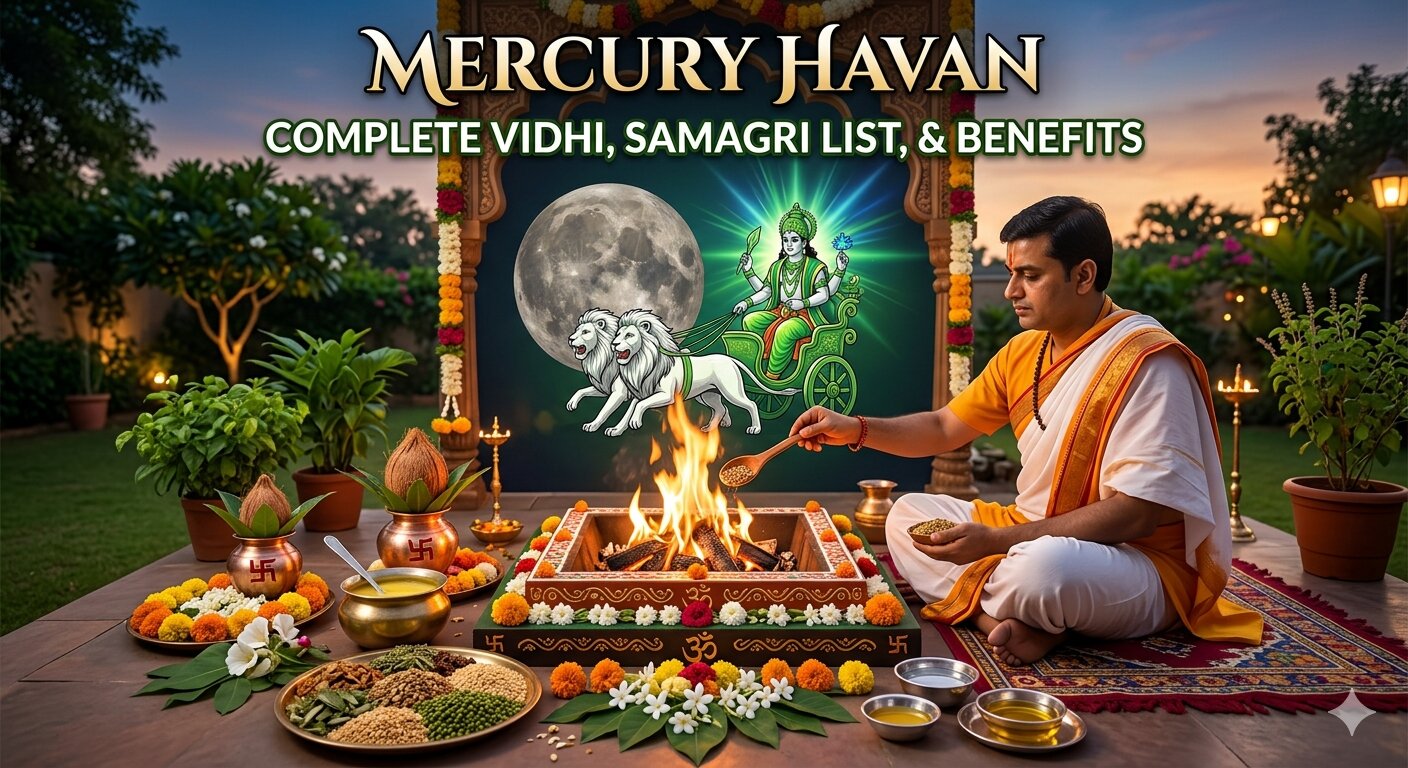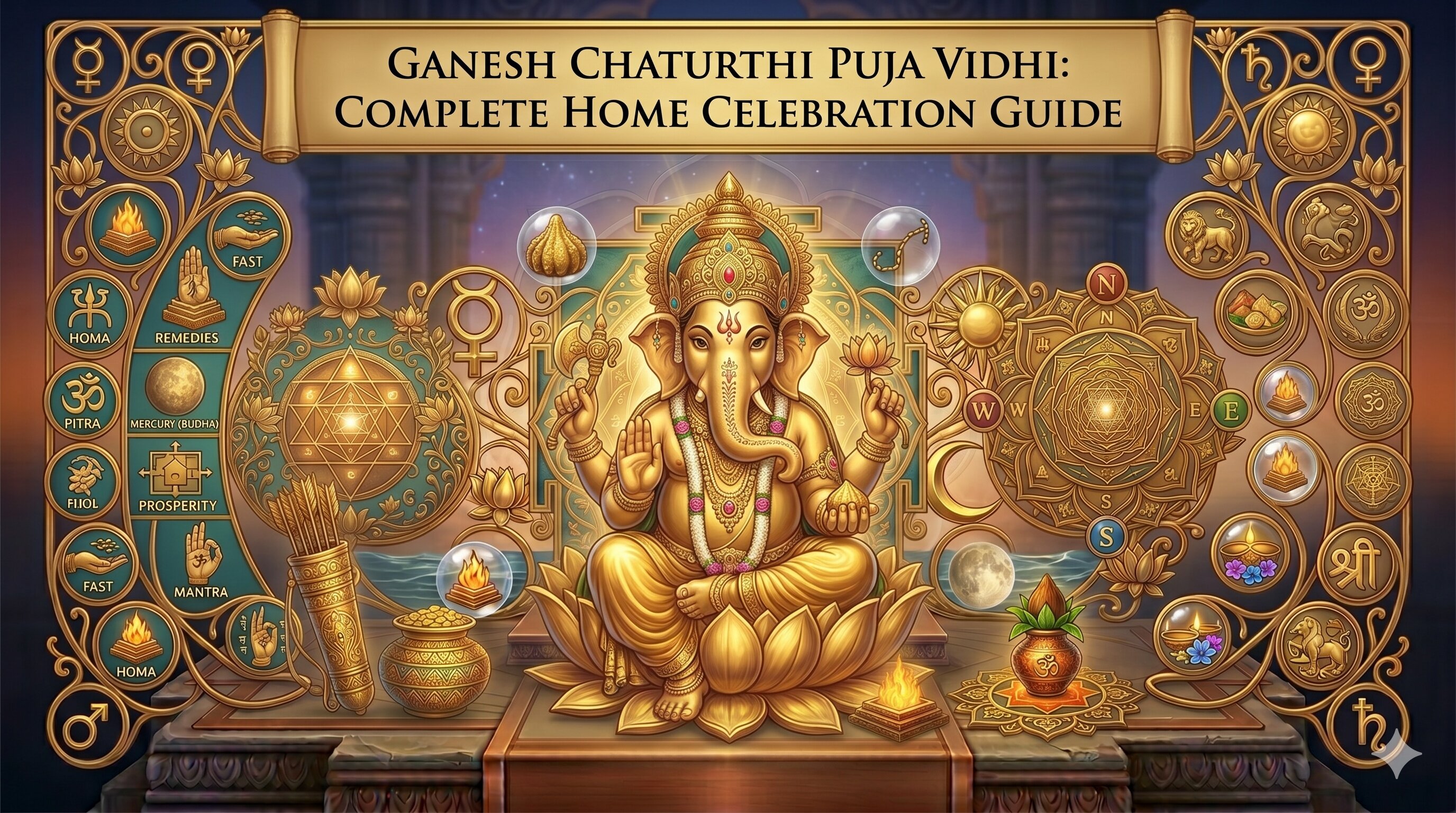
| Quick Answer: How to Perform Ganesh Chaturthi Puja at Home? |
How do I perform Ganesh Chaturthi Puja at home? To perform Ganesh Chaturthi Puja at home: (1) Install a clay Ganesha murti on a decorated platform during the Madhyahna Muhurat (midday window) on Chaturthi. (2) Perform Pranapratishtha - invoke the divine presence into the idol by sprinkling Gangajal and chanting the mantra Om Gam Ganapataye Namah. (3) Conduct the 16-step Shodashopachara Puja, offering the idol a seat (Asana), flowers, Durva grass, sandalwood paste, incense, a lamp, and 21 modaks as Naivedyam. (4) Recite the Ganesh Atharvashirsha and perform Aarti. (5) On your chosen Visarjan day, perform a final Aarti and immerse the idol - or use an eco-friendly bucket immersion at home. In 2026, Ganesh Chaturthi falls on Monday, 14 September. The most auspicious Puja window for New Delhi is approximately 11:02 AM – 1:31 PM IST.
घर पर गणेश चतुर्थी पूजा कैसे करें? Ganesh Chaturthi Puja ghar par karne ke liye: (1) Chaturthi ke din Madhyahna Muhurat mein mitti ki Ganesha murti ko sajaye hue asan par sthaapit karein. (2) Pranapratishtha karein - Gangajal chhidakkar 'Om Gam Ganapataye Namah' mantra jaap se bhagwan ka aahvaan karein. (3) Shodashopachar Puja karein - asana, pushpa, Durva ghaas, chandan, dhoop, deep aur 21 modak ka naivedya arpit karein. (4) Ganesh Atharvashirsha padhein aur Aarti karein. (5) Apne chune hue Visarjan ke din antim Aarti ke baad pratima visarjit karein ya ghar par hi bucket mein eco-friendly visarjan karein. 2026 mein Ganesh Chaturthi 14 September, Somvar ko hai. |
In Hindu dharma, Lord Ganesha is Pratham Pujya - the first deity worshipped before any sacred undertaking. Ganesh Chaturthi, the ten-day celebration of his birth, is one of the most joyful and spiritually potent festivals of the year. In 2026, it falls on Monday, 14 September - the Shukla Chaturthi (fourth day of the bright fortnight) of the month of Bhadrapada. Whether you are hosting a grand home celebration or performing a quiet, personal puja for the first time, this complete guide walks you through every step: from installing the clay idol (with important ecological guidance), to the full 16-step Shodashopachara Puja, the mantras and the Atharvashirsha, homemade modak prasad, and the Visarjan schedule for 2026.
| Ganesh Chaturthi 2026 - Quick Reference | |||
| Festival Date | Monday, 14 September 2026 | End (Visarjan) | Thursday, 24 September 2026 |
| Hindu Month | Bhadrapada Shukla Chaturthi | Duration | 10 days (Ganeshotsav) |
| Chaturthi Tithi Begins | 13 Sept 2026 at ~4:15 PM IST | Chaturthi Tithi Ends | 14 Sept 2026 at ~7:44 AM |
| Madhyahna Puja Muhurat | ~11:02 AM – 1:31 PM IST | Location | New Delhi (timings vary by city) |
| Avoid Moon Sighting | ~8:59 AM – 8:22 PM IST | Also Known As | Vinayaka Chaturthi / Ganeshotsav |
Ganesh Chaturthi commemorates the birth of Lord Ganesha - the elephant-headed son of Lord Shiva and Goddess Parvati, and the remover of all obstacles (Vighnaharta). According to the Shiva Purana and Mudgala Purana, Goddess Parvati created Ganesha from sandalwood paste (some accounts say turmeric and earth) and breathed life into him to serve as her guardian. When Lord Shiva unknowingly severed Ganesha's head, he replaced it with that of an elephant - and declared that henceforth, Ganesha would be worshipped before all other deities. This is why no auspicious beginning - a wedding, business launch, journey, or study - is undertaken without first invoking Ganesha.
The festival was celebrated publicly as early as the 17th century during the reign of Chatrapati Shivaji Maharaja. Its modern, community-scale form owes much to freedom fighter Bal Gangadhar Tilak, who in 1893 revived and popularised the ten-day Ganeshotsav in Pune as a platform for social unity and cultural pride.
| Core Epithets of Lord Ganesha |
|
Gathering your samagri (ritual materials) a day before Ganesh Chaturthi saves stress and ensures the puja flows smoothly. Below is the complete list, organised by category:
| Category | Items Required |
| Murti & Altar | Clay Ganesha idol (shaadu mitti), clean red/yellow cloth, wooden chowki/platform, Gangajal |
| Flowers & Nature | Red hibiscus (Jaswand), marigold garland, 21 blades of Durva grass (Cynodon dactylon), Tulsi |
| Puja Essentials | Kumkum (vermillion), chandan (sandalwood paste), haldi (turmeric), akshata (unbroken rice), sindoor |
| Light & Fragrance | Ghee diya, camphor (kapur), 3–5 agarbatti sticks (sandalwood/jasmine) |
| Panchamrita | Cow milk, curd (dahi), honey (madhu), ghee, sugar (shakkar) - for abhishek |
| Naivedyam (Offering) | 21 modaks (homemade or bought), coconut, seasonal fruits, betel leaf (paan), supari, cloves |
| Puja Thali | Copper/brass plate, small bowls (katoris), bell (ghanta), conch (shankh) if available |
| Mantra Support | Printed Ganesh Atharvashirsha text, 108-name stotra or phone app with audio |
| Eco Tip | Avoid Plaster of Paris (PoP) idols - choose shaadu mitti (natural clay) or seed-embedded idols |
Eco Note: The Brihanmumbai Municipal Corporation (BMC) and Central Pollution Control Board actively encourage devotees to avoid Plaster of Paris (PoP) idols, as they do not dissolve cleanly and release harmful chemicals into water bodies. Shaadu mitti (natural grey clay) idols dissolve fully within hours. Seed-embedded idols - which grow into plants after immersion - are an increasingly popular and deeply meaningful eco-friendly choice
Sthapana (installation) is the sacred act of welcoming Lord Ganesha into your home as a divine guest. Tradition treats Ganesha as an honoured family member arriving for a visit - every aspect of the welcome reflects that hospitality.
In 2026, bring the murti home on the morning of Monday, 14 September, ideally after the Chaturthi Tithi begins (approximately 4:15 PM on 13 September 2026). The Ganesh Sthapana - the formal installation with Pranapratishtha - should be performed during the Madhyahna Muhurat: approximately 11:02 AM – 1:31 PM IST (calculated for New Delhi; timings shift by a few minutes based on your city). This midday period symbolises the sun's full strength - clarity, energy, and the removal of obstacles - making it the ideal moment to invoke divine presence.
Avoid performing Sthapana during Bhadra Kaal (an inauspicious period) or during Rahu Kaal of that day. Consult your local panchang or the Drikpanchang.com city-specific calculator for exact Rahu Kaal timings on 14 September 2026.
| Important: Do NOT Look at the Moon on Chaturthi |
Sighting the moon on Ganesh Chaturthi creates Mithya Dosha - a curse of false accusation. According to Puranic legend, the Moon (Chandra) mocked Ganesha's appearance, for which Ganesha cursed him: anyone who sees the moon on Bhadrapada Shukla Chaturthi will be unjustly accused of wrongdoing. On 14 September 2026, the moon should NOT be sighted between approximately 8:59 AM and 8:22 PM IST. If you accidentally see the moon, chant this purifying mantra 108 times: सिंहः प्रसेनमवधीत्सिंहो जाम्बवता हतः। सुकुमारक मारोदीस्तव ह्येष स्यमन्तकः॥ |
The Shodashopachara Puja (षोडशोपचार पूजा - shodasha = 16, upachara = offering with devotion) is the complete and most auspicious form of Ganesh worship on Chaturthi. It treats the deity as a royal guest and offers all 16 forms of hospitality one would extend to an honoured visitor. Below is the full sequence:
| # | Step | Meaning | What to Do |
| 1 | Avahana (आवाहन) | Invocation | Welcome Ganesha with folded hands, chant 'Om Gam Ganapataye Namah, Avahanam Samarpayami' |
| 2 | Asana (आसन) | Offering a seat | Place the murti on a red cloth; symbolically offer a sacred seat |
| 3 | Padya (पाद्य) | Washing of feet | Sprinkle water near the murti's base while chanting |
| 4 | Arghya (अर्घ्य) | Offering water | Offer water for symbolic hand-washing |
| 5 | Achamana (आचमन) | Sipping water | Offer water to purify - three times |
| 6 | Madhuparka (मधुपर्क) | Honey offering | Offer honey and ghee for auspiciousness |
| 7 | Snanam (स्नान) | Ritual bath | Bathe the murti with Panchamrita (milk, curd, honey, ghee, sugar), then clean water |
| 8 | Vastra (वस्त्र) | Offering clothes | Offer new red/yellow cloth or sacred thread |
| 9 | Yagnopavita (यज्ञोपवीत) | Sacred thread | Offer the sacred jandhyam thread |
| 10 | Gandha (गन्ध) | Sandalwood paste | Apply chandan (sandalwood paste) and kumkum; then offer Durva grass (21 blades) |
| 11 | Pushpa (पुष्प) | Flower offerings | Offer red flowers, especially hibiscus (Jaswand); chant 108 names of Ganesha |
| 12 | Dhoop (धूप) | Incense | Wave incense sticks, chant 'Om Sri Mahaganapataye Namah, Dhupam Samarpayami' |
| 13 | Deepa (दीप) | Lamp lighting | Wave a lit diya; symbolises the removal of darkness |
| 14 | Naivedya (नैवेद्य) | Food offering | Offer 21 modaks, coconut, and seasonal fruits; do not taste beforehand |
| 15 | Tamboolam (ताम्बूलम) | Betel leaf & nut | Offer paan leaf with supari and coins as dakshina |
| 16 | Aarti (आरती) & Pradakshina | Closing ritual | Wave camphor flame in circular motion; circumambulate (pradakshina) the murti; chant Sukhakarta Dukaharta Aarti |
After the 16 steps: Perform Eka Vinshati Puja - the chanting of Ganesha's 21 names while offering 21 Durva blades and 21 modaks. Then recite the Ganesh Atharvashirsha in full (see Section 5). Conclude with Aarti, Pradakshina (circumambulation), and Namaskara (prostration).
Note: If you have a permanent Ganesha idol already installed in your home and worshipped daily, skip Avahana (Step 1) and Pranapratishtha - these are performed only for a newly acquired clay idol on Chaturthi.
| Ganesh Beej Mantra |
ॐ गं गणपतये नमः Om Gam Ganapataye Namah Recite 108 times daily during the 10-day festival - ideally in the morning before breakfast. This single-line beej mantra invokes Ganesha's core energy: Gam is his seed syllable, Ganapataye his name as Lord of the Ganas, and Namah expresses surrender and devotion. |
| Ganesh Gayatri Mantra |
ॐ एकदन्ताय विद्महे, वक्रतुण्डाय धीमहि, तन्नो दन्तिः प्रचोदयात्। Aum Ekadantaya Vidmahe, Vakratundaya Dheemahi, Tanno Dantih Prachodayat. Meaning: We meditate on the single-tusked Lord. May the curved-trunk one illuminate our minds. Recite 108 times, ideally during sunrise or the Madhyahna puja. |
The Ganapati Atharvashirsha (also called Ganapati Upanishad) is a late Vedic-period text from the Atharva Veda tradition, specifically devoted to Ganesha. It declares Ganesha as the supreme Brahman - the ultimate reality underlying all creation - and establishes his identity with Om (the primordial sound). Reciting the Atharvashirsha in full on Ganesh Chaturthi is considered one of the most potent acts of worship available to a householder.
The Atharvashirsha is not a long text - a full recitation takes approximately 10–15 minutes. It opens with the declaration:
| Opening Verse - Ganesh Atharvashirsha |
ॐ नमस्ते गणपतये। त्वमेव प्रत्यक्षं तत्त्वमसि। Om Namaste Ganapataye. Tvameva Pratyaksham Tattvamasi. Meaning: Salutations to Ganapati. You alone are the directly perceived ultimate reality.
Tradition recommends reciting the complete Atharvashirsha: once on the morning of Chaturthi after Sthapana; once daily throughout the 10-day festival (or at minimum on Chaturthi and Visarjan day); and 21 times continuously on the day of Visarjan for maximum benefit. Full text and audio are widely available - search for 'Ganapati Atharvashirsha' on YouTube for guided recitation. |
The traditional Marathi Aarti for Ganesha is Sukhakarta Dukhaharta - composed by Saint Samarth Ramdas in the 17th century. It is sung at every Aarti during the 10-day festival, accompanied by a camphor diya waved in a clockwise circular motion before the murti. Audio is universally available and most families sing along from memory. Conclude each Aarti by distributing the camphor flame to all present for Mangal Prasad.
Modak is Ganesha's absolute favourite offering - the reason he is called Modakapriya (lover of modak). The word modak itself derives from Sanskrit: moda (joy/happiness) + ka (that which gives). The traditional form is Ukadiche Modak - steamed rice dumplings with a sweet coconut-jaggery filling - as made in Maharashtra.
| 💡 Quick Tip - Can't Make Ukadiche Modak? |
| Talniche Modak (fried sweet dumplings) or commercially prepared modaks are perfectly acceptable as Naivedya. The intention and devotion behind the offering matter most. As the Bhagavad Gita 9.26 teaches: even a leaf, flower, fruit, or water offered with sincere love is received by the Divine. |
Are you currently struggling with life phases like Spirituality? Discover your precise chart insights now.
Visarjan - the immersion of the Ganesha idol - is the emotional and spiritual climax of the festival. It represents the cycle of creation and dissolution: Lord Ganesha, welcomed as a divine guest, is now bid farewell with the faith that he returns to Kailash Parvat carrying with him all obstacles, sorrows, and burdens of the household. The farewell chant across India is:
| The Farewell Chant |
गणपति बप्पा मोरया, पुढच्या वर्षी लवकर या! Ganpati Bappa Morya, Pudhchya Varshi Lavkar Yaa! (O Father Ganesha, come again early next year!) |
| Duration | Visarjan Date (2026) | Notes | Auspiciousness |
| 1.5 Days | Evening of 15 Sept 2026 (Tuesday) | Most common in North India; symbolises quick but devoted farewell | Moderate |
| 3 Days | 17 Sept 2026 (Thursday) | Brief home celebrations | Moderate |
| 5 Days | 19 Sept 2026 (Saturday) | Panchamruta Visarjan - a deeply auspicious middle path | High ★ |
| 7 Days | 21 Sept 2026 (Monday - Somvar) | Monday amplifies Shiva's blessings; highly auspicious for moksha | Very High ★★ |
| 10 Days | 24 Sept 2026 (Thursday - Anant Chaturdashi) | Grand finale - most traditional; followed across Maharashtra | Most Auspicious ★★★ |
Traditional river immersion is encouraged where accessible and government-approved. However, for smaller clay idols and urban households, the home bucket visarjan is equally valid, significantly more ecological, and is now actively promoted by the Maharashtra government and BMC:
| Why Eco-Friendly Visarjan Matters |
| PoP (Plaster of Paris) idols contain calcium sulphate, which does not dissolve and releases toxic elements that deplete oxygen in water bodies, harming aquatic life. Chemical paints add further pollutants. A clay idol returns to earth as it came - and is itself a form of worship of nature, which is Ganesha's domain as the lord of creation's elemental forces. |
Performing the Ganesh Chaturthi Puja Vidhi with sincere devotion and correct procedure is said to confer the following blessings - these are drawn from classical Ganesha texts including the Mudgala Purana, Ganesh Purana, and the Atharvashirsha itself:
For devotees who have been advised about planetary afflictions in their birth chart - including Kaal Sarp Dosh or Rahu-Ketu related challenges - Ganesha worship is particularly potent. Ganesha governs the root chakra and all beginnings, and his blessings ease the Rahu energy by providing clarity and removing the shadow of confusion that Rahu creates.
Internal Link: For a complete guide to Kaal Sarp Dosh, its 12 types, and remedies including mantras and puja vidhi, read: [INTERNAL LINK: /blog/kaal-sarp-dosh-complete-guide | Kaal Sarp Dosh: Complete Guide, 12 Types, and Proven Remedies]
| Element | Key Practice |
| Mantra | Om Gam Ganapataye Namah - 108x daily; Ganesh Atharvashirsha - recite in full on festival day |
| Puja | Shodashopachara (16-step) Puja during Madhyahna Muhurat (11:02–1:31 PM IST, New Delhi) |
| Key Offering | 21 modaks + 21 blades of Durva grass - the most sacred and specific Ganesha offerings |
| Prasad | Modak (coconut-jaggery stuffed rice flour dumpling) - Ganesha's beloved sweet |
| Visarjan | Day 1.5, 3, 5, 7, or 10 - most auspicious is Day 10 (Anant Chaturdashi, 24 Sept 2026) |
| Eco-Friendly | Use clay (shaadu mitti) idol; bucket visarjan at home; donate water to plants after immersion |
| Do NOT do | Look at the moon on Chaturthi Tithi - triggers Mithya Dosha (false accusation curse) |
Yes, absolutely. While a pandit ensures the precise pronunciation of Vedic mantras and ritual sequence, Ganesha is among the most accessible and forgiving of deities. Householders across India perform home puja independently. Use this guide as your step-by-step reference, use a printed or audio version of the Atharvashirsha, and offer the ritual with sincere bhava (devotion). The Bhagavad Gita 9.26 is clear: even the simplest offering made with love is perfectly received.
Tradition offers flexibility - 1.5 days, 3, 5, 7, or 10 days are all honoured options. The 10-day celebration culminating on Anant Chaturdashi is the most traditional and spiritually complete. However, a 1.5-day or 5-day celebration is equally valid and commonly followed by working families. What matters is the quality of daily puja - an Aarti and mantra recitation each morning and evening - rather than the duration alone.
Ganesh Chaturthi (Bhadrapada Shukla Chaturthi) is the annual birth anniversary - the grand, festive, 10-day Ganeshotsav. Sankashti Chaturthi is the monthly observance on every Krishna Paksha (waning moon) Chaturthi, observed with fasting and Ganesha worship for the removal of obstacles. Both are important; Ganesh Chaturthi is the larger annual celebration, Sankashti is the regular monthly practice.
No. Fasting is a personal spiritual choice, not a mandatory requirement. Many devotees observe a partial fast - avoiding grains and eating only fruits, milk, and sweets like modak throughout the day until after the evening Aarti. Others eat normally while observing the puja vidhi with full devotion. The ritual itself - performed with correct procedure and sincere heart - is the essential practice.
Ganesh Chaturthi Puja ka sahi tarika: Subh muhurat mein (14 September 2026 ko 11:02 AM – 1:31 PM IST) mitti ki murti sthaapit karein. Gangajal aur 'Om Gam Ganapataye Namah' se Pranapratishtha karein. Shodashopachara ke 16 steps follow karein - asana, Panchamrita snana, chandan, Durva, pushpa, dhoop, deepa, aur 21 modak ka naivedya arpit karein. Ganesh Atharvashirsha padhein. Aarti karein. Roz ek baar subah aur ek baar shaam aarti zaroor karein. Apne chune hue din visarjan karein - eco-friendly bucket visarjan ghar par sabse behtar vikalp hai.
The most auspicious time is the Madhyahna Muhurat: approximately 11:02 AM to 1:31 PM IST on Monday, 14 September 2026 (calculated for New Delhi; consult Drikpanchang.com for your specific city). This midday window - called Madhyahna Kaal - is when Lord Ganesha is believed to be most receptive to welcome and worship. Avoid Bhadra and Rahu Kaal periods on the same day.
Ganesh Chaturthi is not merely a festival - it is a ten-day immersion in the principle of Vighnaharta: that every obstacle, when met with wisdom, devotion, and grace, reveals itself as a gateway. Lord Ganesha's image teaches this perfectly: an elephant's unwavering strength married to a mouse's nimble intelligence; a broken tusk offered as a pen to record the Mahabharata; a rotund form that holds the universe in his cosmic belly. He is the god of beginnings and the remover of what blocks them.
Perform the Shodashopachara Puja on the morning of 14 September 2026 with full presence. Offer your 21 modaks. Recite the Atharvashirsha. Light the diya. Bring the family together. And on Visarjan day, release the clay form back to earth with gratitude - knowing that what was welcomed into your home as a sacred guest has left behind his blessings, and carries your burdens back to Kailash.
Ganpati Bappa Morya. Pudhchya Varshi Lavkar Yaa.
Connect with a Jyotishi on Nakshatraai.ai Generate your Kundali and check for Ganesha's planetary blessings in your birth chart: nakshatraai.ai/add-kundli Speak with an expert Jyotishi for a personalised Ganesh Chaturthi puja muhurat assessment and annual festival guidance: nakshatraai.ai/astrologer Read our complete guide on Kaal Sarp Dosh and remedies: nakshatraai.ai/blog/kaal-sarp-dosh-complete-guide |
Disclaimer: This article is for educational and informational purposes only. Puja timings provided are calculated for New Delhi, India - actual timings vary by city and should be verified against your local panchang. Ritual procedures may vary by regional tradition, family sampradaya, and community practice. For personalised guidance, consult a qualified pandit or Jyotishi.