| Quick Answer: How Does Ganesh Yantra Help Remove Obstacles and Start New Ventures? |
| How does Ganesh Yantra help remove obstacles and start new ventures? |
| Ganesh Yantra is a sacred geometric diagram (yantra) energised by the consciousness of Lord Ganesha -the Vighnaharta (remover of obstacles) and Prathamapujya (first to be worshipped). When ritually activated and correctly placed, the yantra acts as a continuous point of divine energy that dissolves blockages in new beginnings -whether a business launch, home purchase, educational pursuit, or any new endeavour. It is particularly recommended before any significant life transition because the Vedic tradition holds that no undertaking succeeds without Ganesha's grace. The yantra's geometric structure (yantra-mandala) encodes the vibrational frequency of Lord Ganesha in a form that lasts indefinitely, unlike a fresh flower offering that wilts. |
| Ganesh Yantra baadhaon ko door karne aur naye kaaryon ki shuruaat mein kaise madad karta hai? |
| Ganesh Yantra ek pavitra geometric diagram hai jo Bhagwan Ganesha -Vighnaharta aur Prathamapujya -ki shakti se energised hota hai. Jab ise sahi vidhi se activate karke sahi jagah rakha jaata hai, yah yantra naye kaaryon mein aane wali baadhaon ko door karta hai -chahe naya business ho, ghar ho, padhai ho ya koi bhi naya aarambh. Yeh vishesh roop se tab upyogi hota hai jab koi bada kadam uthane wale ho, kyunki Vedic parampara kehti hai ki Ganesha ki kripa ke bina koi bhi kaarya safal nahi hota. |
In Vedic tradition, before any significant undertaking -the launch of a business, the laying of a foundation stone, the commencement of studies, or the purchase of a new home -one name is invoked before all others: Ganesha. He is Prathamapujya, the first to be worshipped, and Vighnaharta, the remover of obstacles. The Ganesh Yantra carries this invocation in permanent, geometric form -a sacred diagram that encodes the divine frequency of Ganesha and keeps his energy active in any space, continuously and without interruption.
This guide covers everything you need to know about Ganesh Yantra: its scriptural basis, the specific benefits it bestows, how and where to place it, how to activate it, the correct mantra, and how it differs from -and complements -a Ganesh idol (murti). Whether you are starting a business, moving into a new home, preparing for an important exam, or seeking to clear persistent obstacles from your path, this is your authoritative reference.
A yantra (Sanskrit: यन्त्र, instrument or device) is a geometric diagram used as a focus of meditation and worship in the Tantric and Vedic traditions. Unlike a mantra, which is auditory, or a murti (idol), which is sculptural, a yantra is the visual-geometric expression of a deity's energy -a map of divine consciousness rendered in lines, triangles, lotus petals, and a central focal point called the bindu.
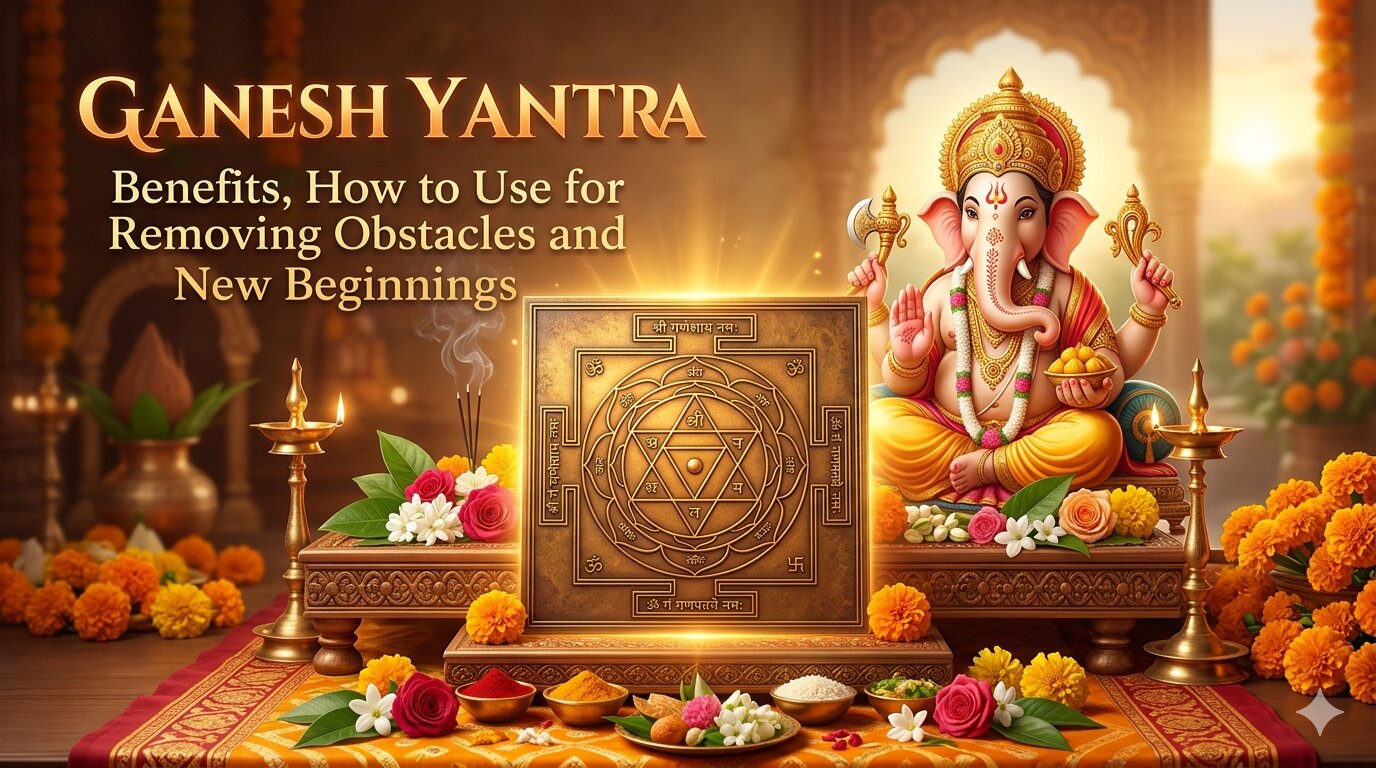
The Ganesh Yantra specifically encodes the vibrational signature of Lord Ganesha through a combination of triangles pointing upward and downward (representing the balance of Shiva and Shakti energies), an eight-petalled lotus (Ashtadala Padma, representing the eight directions Ganesha protects), and the outer square frame (Bhupura) representing the earthly domain into which divine energy is anchored. The central bindu represents the unmanifest point from which all of Ganesha's creative and protective power radiates outward.
Yantras are described in classical Tantric texts including the Mantra Mahodadhi, the Tantrasara, and the Sharada Tilaka Tantra. The Mudgala Purana and Ganesha Purana -the two principal Puranas dedicated to Ganesha -establish his role as the supreme lord of beginnings, the master of intellect (Buddhi), and the remover of all Vignas (obstacles). The yantra is one of the three primary modes of his worship: Mantra (sound), Tantra (ritual), and Yantra (geometric form).
Classical Note: Yantras are considered by the tradition to be more enduring than flowers or offerings, which decay -the geometric structure of a yantra, once consecrated, is said to hold its shakti indefinitely when treated with reverence and regular worship.
The Ganesh Yantra is among the most broadly beneficial yantras in the Vedic system precisely because Ganesha himself governs the widest range of human endeavours. His domain includes intellect, new beginnings, business success, education, creative arts, travel, and the removal of both inner and outer obstacles. The following are the core benefits recognised across classical and contemporary Jyotish traditions:
The primary and most celebrated function of the yantra. Ganesha as Vighnaharta actively dissolves blockages -whether material (financial delays, property disputes, bureaucratic hurdles), interpersonal (communication failures, conflict), or internal (fear, self-doubt, procrastination). Natives with challenging planetary configurations -including Kaal Sarp Dosh [INTERNAL LINK: /kaal-sarp-dosh-complete-guide], Mangal Dosh, or a weak Mercury -often find significant relief when Ganesh Yantra is installed alongside the prescribed dosh remedies, because Ganesha's energy clears the path for other remedial energies to act.
Ganesha is the deity of new beginnings par excellence. The yantra is especially potent at the commencement of business activities: at registration, at the opening of new premises, at the launch of products, or at the beginning of a new financial year. It invites prosperity (Riddhi) and auspiciousness (Siddhi) -both are depicted as Ganesha's consorts in iconography, indicating that these blessings flow directly through him.
As Buddhipriya (lover of intellect) and the lord of Buddhi (intelligence), Ganesha's yantra enhances concentration, memory retention, analytical ability, and the capacity to solve complex problems. Students preparing for competitive examinations, lawyers structuring arguments, and writers seeking clarity all benefit from the yantra placed at the study or workspace.
In the Vedic tradition, Ganesha is the protector of thresholds and doorways (Dvarapala). The Ganesh Yantra placed at or near the main entrance of a home creates an energetic barrier against negative influences, envy (nazar), and inauspicious energies that might enter. This function is why traditional homes in Maharashtra, Tamil Nadu, and Karnataka place Ganesha images or symbols above their main doors.
In Lal Kitab remedial astrology, Ketu -one of the two shadow planets -is directly associated with Ganesha (see the Kaal Sarp Dosh guide [INTERNAL LINK: /kaal-sarp-dosh-complete-guide]). Installing a Ganesh Yantra and carrying a Ganesha Yantra is one of the prescribed Lal Kitab remedies for a troubled Ketu, making it doubly valuable for individuals with nodal axis afflictions.
Ganesha's association with the arts -he is said to have scribed the Mahabharata himself, writing it at the dictation of Veda Vyasa -makes his yantra beneficial for writers, artists, musicians, designers, and all creative professionals seeking flow and originality.
Ganesh Yantra Benefits -Summary Table
| Benefit | Details |
| Vigna Nivaran | Removes material, interpersonal, and internal obstacles from all life areas |
| Business Success | Invites Riddhi (prosperity) and Siddhi (accomplishment) into new ventures |
| Intellectual Clarity | Enhances memory, concentration, and problem-solving -ideal for students and scholars |
| Home Protection | Guards thresholds and living spaces from negative energies and envy (nazar) |
| Ketu Remediation | Lal Kitab-prescribed remedy for troubled Ketu in the birth chart |
| Creative Flow | Supports artists, writers, designers, and musicians in accessing inspiration |
The Ganesh Yantra is not limited to a single purpose or phase of life. The tradition holds that Ganesha's presence is especially critical at moments of transition -when one threshold is crossed and another opened. The following are the primary life situations in which installing or carrying a Ganesh Yantra is specifically recommended:
Correct placement is essential for the yantra to function optimally. The following placement guidelines are consistent with classical Vastu Shastra principles and the Tantric tradition of yantra placement (yantra-sthapana):
The most classical placement. The yantra should be installed above or beside the main entrance, facing inward into the home -so that the energy flows into the living space rather than outward. It should be installed at eye level or higher, never below waist level. In Vastu, the north-east (Ishanya) corner of the entrance wall is considered the most auspicious direction for Ganesha's installation.
On the business owner's or manager's desk, facing the seated person. Alternatively, at the main entrance of the office, shop, or clinic. For factories or warehouses, place at the main gate or in the reception area. The yantra should be visible to the person working, not hidden in a drawer.
If a dedicated prayer room or altar exists, the Ganesh Yantra should be placed to the left of the central deity (or centrally, if Ganesha is the primary deity of worship). The yantra should face east, so that when you sit in prayer facing east, the yantra faces you directly.
For students, the yantra placed on the study table, facing the student while studying, is particularly beneficial. The north or east wall of the study room is the preferred placement direction.
A yantra purchased from a shop is an energetically neutral geometric form until it is consecrated (prana pratishtha). Activation -also called prana pratishtha or yantra shuddhi -awakens the yantra's latent power and establishes a living connection between the geometric form and the deity's consciousness. The following is the classical activation sequence suitable for householders:
Ongoing Maintenance: Wipe the yantra clean with a soft cloth on Wednesdays. Re-offer Durva grass and fresh flowers on Chaturthi tithis. Re-recite the mantra 108 times monthly, ideally on Ganesh Chaturthi of each month.
The Ganesh mantra is the sonic counterpart of the yantra -where the yantra encodes Ganesha's energy in visual-geometric form, the mantra encodes it in sound. Together, they form the complete invocation. The following are the principal mantras used with the Ganesh Yantra:
| Primary Beej Mantra -Ganesh Yantra Ka Mantra |
| ॐ गं गणपतये नमः |
| Om Gam Ganapataye Namah |
| Recitation: 108 times daily -ideally at Brahma Muhurta (pre-dawn) or early morning, seated facing east or north, using a Rudraksha mala to count repetitions. |
| Meaning: 'Gam' is the Beej (seed) mantra of Ganesha -the single-syllable sonic form that most directly invokes his energy. 'Ganapataye Namah' means 'I bow to the Lord of Ganas (celestial beings).' Together, the mantra is a complete invocation of Ganesha's protective and obstacle-removing power. |
| For New Business Specifically: Recite 1,008 times on the day of business inauguration for accelerated effect. |
Additional mantras recommended for use with the Ganesh Yantra:
Are you currently struggling with life phases like Astrology? Discover your precise chart insights now.
A common question among devotees is whether the Ganesh Yantra and the Ganesh murti (idol) serve the same purpose or different ones. The tradition is clear: both are valid, both are sacred, and they complement each other rather than substitute. Here is the essential distinction:
| Aspect | Ganesh Yantra | Ganesh Murti (Idol) |
| Form | Geometric diagram -abstract, energetic | Sculptural representation -anthropomorphic, devotional |
| Primary Function | Continuous, static energy field -works passively once activated | Focal point of active worship -requires daily puja, bhog, and aarti |
| Maintenance | Weekly cleaning and monthly mantra renewal sufficient | Daily ritual care (abhishek, flowers, prasad, aarti) ideally required |
| Best For | Office, business premises, entrance -spaces requiring constant protection | Home prayer room, personal devotional practice, festivals |
| Portability | Can be engraved on a small copper plate or coin -carried as a personal talisman | Usually fixed; smaller murtis can be portable |
| Tradition | Tantric and Jyotish tradition (yantra shastra) | Agamic and Puranic tradition (murti puja) |
| Complementarity | Place the yantra at the entrance; place the murti at the altar -both active simultaneously | Same |
The ideal household arrangement, endorsed by the Tantra Shastra tradition, is to have both: the murti in the puja room as the central devotional form, and the yantra at the entrance or workspace as the continuous energetic anchor. They do not conflict -they amplify each other.
Because the most common query about Ganesh Yantra relates specifically to new business, this section provides a dedicated, practical guide for entrepreneurs, business owners, and professionals:
In Vedic business tradition, no enterprise -from the smallest shop to the largest corporation -is auspiciously inaugurated without first invoking Ganesha. The Sanskrit phrase 'Shri Ganeshaya Namah' written at the beginning of business ledgers, legal documents, and invitation cards is not merely ceremonial: it is a declaration that this undertaking is placed under Ganesha's protection and that the obstacles inherent in any new venture are acknowledged and surrendered to divine resolution.
For business owners with specific planetary afflictions in their birth chart -particularly a weak or afflicted Mercury (Budha, which governs commerce and communication), a troubled 10th house (career), or the presence of Kaal Sarp Dosh [INTERNAL LINK: /kaal-sarp-dosh-complete-guide] -the Ganesh Yantra is recommended as a primary remedy but should be assessed in conjunction with a full Kundali reading. A qualified Jyotishi can determine whether additional remedies (specific navagraha shanti, gemstones, or dosh-specific pujas) are needed alongside the yantra. Consult a Jyotishi on Nakshatraai.ai [INTERNAL LINK: /nakshatraai-astrologer] for a personalised assessment.
Daily use is simple: each morning, light a diya or incense near the yantra, take a moment to acknowledge Ganesha's presence with folded hands, and recite Om Gam Ganapataye Namah at least 11 times (108 times on Wednesdays). This brief daily acknowledgment keeps the connection active. On Wednesdays and Chaturthi tithis, perform a fuller puja with flowers and Durva grass.
Copper (Tamra) is the most widely recommended material in the classical tradition -it is an excellent conductor, durable, and traditionally associated with the sun's energy, which aligns with auspicious beginnings. Silver (Rajat) is preferred for home prayer rooms and for women. Gold (Suvarna) is the most powerful but also the most expensive; typically reserved for very significant installations. Paper yantras printed with correct geometry are valid for temporary use or travel but should ideally be replaced with a metal yantra for permanent installation.
Yes -a sincere householder can perform the activation vidhi described in Section 5 without a pandit. The tradition consistently holds that devotion (bhakti) is the primary requirement, not ritual expertise. However, for significant business inaugurations or for persons with complex astrological challenges, a pandit's assistance ensures the vidhi is performed in full and adds the additional power of a trained practitioner's intention.
The tradition does not specify a fixed timeline, as results depend on the specificity of the obstacle, the consistency of practice, and the native's overall astrological condition. Many devotees report perceptible shifts in clarity and opportunity within 40 days of sincere daily practice. The 40-day (Chalisa) cycle is a traditional minimum for evaluating spiritual remedies. For chronic or deep-rooted blockages, three to six months of consistent practice is a more realistic expectation.
Yes -a small copper Ganesh Yantra engraved on a coin or laminated card is specifically intended for this purpose. This is the personal talisman form of the yantra. It is carried for personal protection, especially before examinations, interviews, travel, or important meetings. Keep it clean and treat it with respect -do not place it alongside shoes or in pockets where it will be crushed or soiled.
Yes -a significant one. In the Lal Kitab system, Lord Ganesha is directly associated with Ketu (the south node of the Moon), and carrying or installing a Ganesha yantra is one of the prescribed remedies for a troubled Ketu. Since Kaal Sarp Dosh involves the Rahu-Ketu axis hemming all planets [INTERNAL LINK: /kaal-sarp-dosh-complete-guide], the Ganesh Yantra forms a complementary layer of remediation alongside the Kaal Sarp Shanti puja, especially for clearing path-related obstacles that the dosh tends to produce.
The Ganesh Yantra is one of the most accessible, versatile, and powerful tools in the Vedic remedial tradition. Its accessibility lies in its simplicity: a single copper plate, correctly activated, placed at the right location, and supported by a daily mantra of 108 repetitions, is sufficient to invoke Ganesha's continuous protection and obstacle-removing grace.
Its power lies in its depth: the same deity who a child invokes with a modak before an exam is the deity whom great kings, merchants, scholars, and saints have placed at the threshold of their most ambitious undertakings. Ganesha does not discriminate by scale. He meets every sankalpa -every sincere intention -with the same fullness.
Begin where you are. Install the yantra with the vidhi described here. Recite Om Gam Ganapataye Namah 108 times with sincerity. Offer Durva grass on Chaturthi. The obstacles in your path -whether visible or invisible, material or karmic -are not permanent features of your landscape. They are thresholds waiting to be crossed. And Ganesha, as he has for the entirety of the tradition, stands at every one of them, ready to swing the door wide open.
| Connect with a Jyotishi on Nakshatraai.ai |
| Generate your Kundali and check for planetary obstacles: nakshatraai.ai/add-kundli |
| Speak with an expert Jyotishi for personalised Ganesh Yantra guidance, placement advice, and astrological obstacle assessment: nakshatraai.ai/astrologer |
Disclaimer: This article is for educational and informational purposes only. Astrological and spiritual guidance does not substitute for consultation with a qualified Jyotishi or Hindu priest who can evaluate your specific birth chart and circumstances. Ritual procedures should ideally be performed under the guidance of a qualified pandit.