| Quick Answer: Who Should Wear Hessonite (Gomed) for Rahu Benefits? | Hessonite Stone Kaun Pahan Sakta Hai? |
| Hessonite (Gomed) is the primary gemstone for Rahu in Vedic astrology. It is most beneficial for Aquarius (Kumbh) and Capricorn (Makar) ascendants, where Saturn and Rahu share a natural compatibility. Virgo (Kanya) ascendants can also benefit because Rahu acts as a yogakaraka in this chart. Those under Rahu Mahadasha (18-year cycle) or Rahu Antardasha with a well-placed Rahu in the 3rd, 6th, 10th, or 11th house are the strongest candidates. Aries, Cancer, Leo, and Scorpio ascendants must generally avoid Gomed, as Rahu is particularly malefic for these lagnas. This is the most powerful and most dangerous stone in the Navaratna system - never wear it without a qualified Jyotishi reviewing your full birth chart. |
| Hessonite stone kaun pahan sakta hai? |
| Gomed (Hessonite) Rahu ka ratna hai. Kumbh aur Makar lagna walon ke liye yeh sabse zyada faydeman hai - kyunki Shani aur Rahu mitra hain. Kanya lagna ke liye bhi yeh shubh ho sakta hai. Jo log Rahu Mahadasha mein hain aur jinke chart mein Rahu teesre, chhatte, dasve ya gyarahve ghar mein hai, unhe iska sabse zyada laabh milta hai. Mesh, Karka, Singh aur Vrishchik lagna walon ko Gomed se bachna chahiye - inke liye Rahu kroora ho jaata hai. Yeh sabse shaktishali aur sabse jyada sawdhani maangne wala ratna hai - bina kundli dekhaye bilkul mat pahane. |
In Vedic astrology, every planet in the Navagraha system has a corresponding gemstone - a physical crystalline bridge between cosmic energy and human experience. For Rahu, the North Node of the Moon and one of the most intense forces in Jyotish, that gemstone is Hessonite, known in Sanskrit and Hindi as Gomed or Gomedhikam. Honey-coloured, heavy, and unmistakable in its swirling internal character, Gomed carries the full weight of Rahu's transformative power.
It is also the most misunderstood stone in Indian gemology. Millions of people wear Gomed based on generic sun-sign advice, a friend's recommendation, or an online quiz - without any consultation with a qualified astrologer. This is a serious error. Because Rahu is simultaneously capable of producing extraordinary success and intense suffering depending on its chart placement, a Gomed worn incorrectly can amplify the very problems the wearer hopes to solve. This guide is written to ensure you approach the Hessonite stone with the precision and respect it demands.
For those who already carry Kaal Sarp Dosh - a configuration where all seven planets are hemmed between Rahu and Ketu - Gomed can be one of the most powerful remedial tools available, but only after proper chart analysis. [INTERNAL LINK: Read our complete guide on Kaal Sarp Dosh, 12 Types, and Proven Remedies]
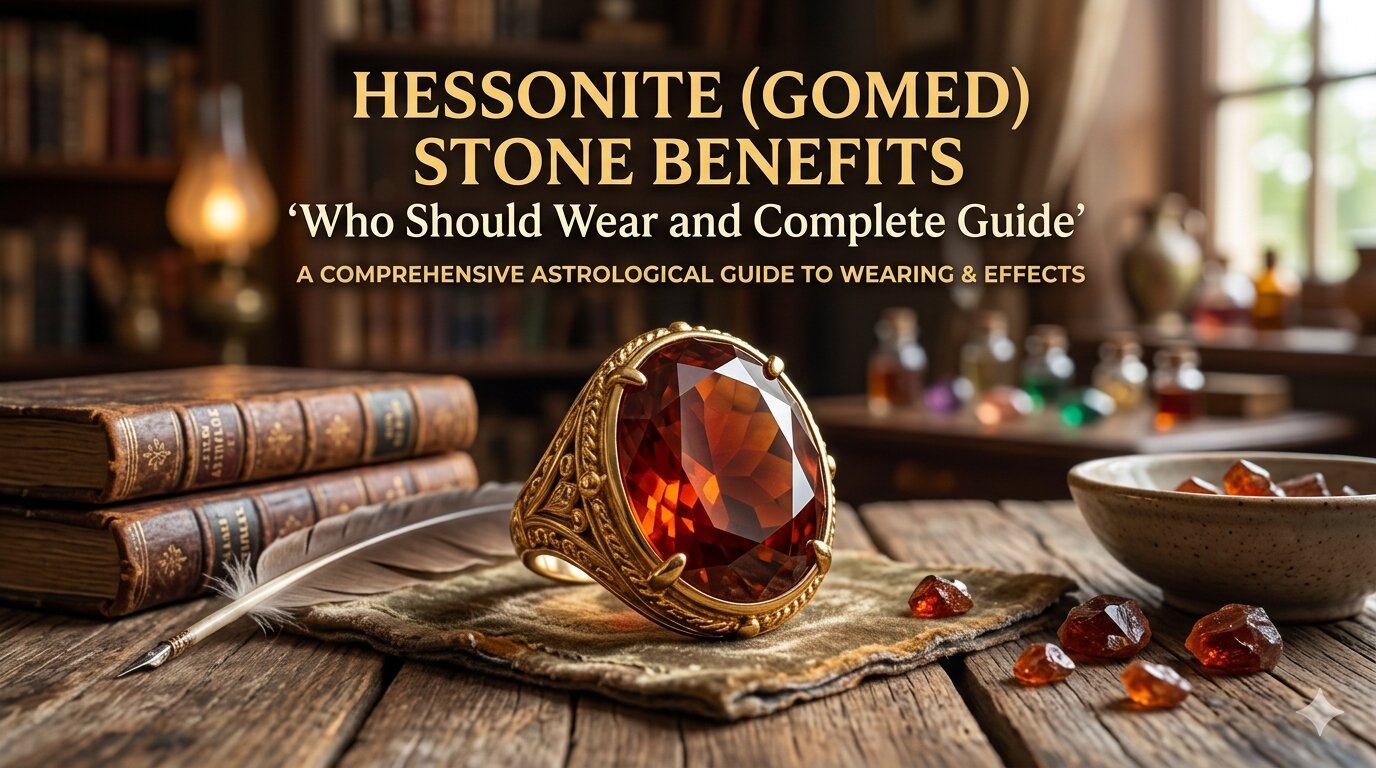
Hessonite is a variety of grossular garnet, a silicate mineral belonging to the garnet family. Its colour ranges from light honey-yellow to rich cinnamon-brown, and in classical Vedic texts it is described as resembling gomutra - the colour of cow's urine - a specific golden-amber hue considered most astrologically potent. The name Hessonite derives from the Greek word hesson, meaning 'inferior,' a reference to its lower density compared to other garnets, though this descriptor says nothing about its astrological significance, which is considerable.
Hessonite scores 7 to 7.5 on the Mohs hardness scale - durable enough for daily wear in a ring or pendant. It is most famously sourced from Sri Lanka (Ceylon), which produces the finest gem-quality stones with exceptional clarity and the characteristic 'treacle effect' - a swirling, honey-like internal appearance caused by the stone's unique growth inclusions. African and Indian Hessonite are also used in astrology, at generally lower price points.
| Property | Details |
| Sanskrit / Hindi Name | Gomed / Gomedhikam / Gomedha |
| Mineral Family | Grossular Garnet (Silicate) |
| Mohs Hardness | 7 to 7.5 |
| Colour Range | Honey-yellow to cinnamon-brown (gomutra) |
| Best Source | Sri Lanka (Ceylon) - most prized astrologically |
| Other Sources | Africa, India |
| Planetary Ruler | Rahu (North Node of the Moon) |
| Element | Air / Vata-Kapha |
| Key Characteristic | Treacle effect - swirling internal appearance |
Rahu is not a physical planet but a mathematical point - the North Node of the Moon, where the lunar orbit intersects the ecliptic. Despite being a Chaya Graha (shadow planet), its influence in Vedic astrology is as powerful as any of the seven visible planets. Rahu governs ambition, material desire, illusion, unconventional paths, foreign connections, mass influence, technology, and sudden reversals of fortune.
Classical Jyotish texts including the Garuda Purana and Agni Purana identify Gomed as the ratna (gemstone) of Rahu. The stone is said to carry Rahu's energy in crystalline form, creating a direct channel between the cosmic node and the wearer's energy field. When worn correctly - meaning when Rahu is well-placed or when its Mahadasha is active and its energy needs to be channeled productively - Gomed acts as an amplifier and stabiliser of Rahu's positive attributes: ambition, innovation, and the drive to break conventional limitations.
Rahu's Mahadasha (major planetary period) runs for 18 years - longer than any other planet in the Vimshottari Dasha system. During this period, Rahu's placement, strength, and relationship with other planets in the natal chart defines the quality of the native's experience. Gomed is considered particularly potent during Rahu Mahadasha and Rahu Antardasha (sub-period), as the stone reinforces the channel between the native and Rahu's cosmic influence.
| Rahu's Key Associations in Vedic Astrology |
| Domains: Ambition, foreign lands, technology, mass media, politics, research, occult sciences, sudden wealth, and karmic intensity. |
| Friendly Signs / Lagnas: Aquarius (Kumbh), Capricorn (Makar), Gemini (Mithun), Virgo (Kanya), Libra (Tula), Taurus (Vrishabh) |
| Enemy Signs / Lagnas: Aries (Mesh), Cancer (Karka), Leo (Singh), Scorpio (Vrishchik) |
| Mahadasha Duration: 18 years (longest in Vimshottari Dasha) |
| Auspicious Houses for Rahu (generally): 3rd, 6th, 10th, 11th - Upachaya houses, where Rahu tends to grow and deliver results over time. |
The benefits attributed to Hessonite in Vedic tradition are extensive, but they must be understood as conditionally available - meaning they manifest when the stone is worn correctly, by the right person, at the right time. These are not universal benefits that apply to everyone who purchases a Gomed.
Note: The health benefits listed above are based on traditional Vedic astrological belief and are not a substitute for medical diagnosis or treatment. Always consult a qualified medical professional for health concerns.
Classical texts describe Gomed as conferring the Panchavidha Phala - five fruits of human life: Dhyana (meditation and inner clarity), Artha (financial prosperity), Dharma (righteous living), Kama (fulfillment of desires), and Moksha (liberation and spiritual growth). This positions Hessonite not merely as a career-enhancement tool but as a stone intended to support the full arc of human development.
The single most important factor in Gomed prescription is the Ascendant (Lagna) - not the sun sign or moon sign. The Lagna determines Rahu's functional nature in the chart. The following guide provides lagna-wise compatibility. It is a general framework; always validate against your specific birth chart with a qualified Jyotishi.
| Ascendant (Lagna) | Rahu's Nature | Gomed Recommendation |
| Aquarius (Kumbh) | Highly Favourable - Rahu and Saturn co-rule; natural synergy | Strongly Recommended - Wear during Rahu Dasha/Antardasha when Rahu is in 3rd, 6th, 10th, 11th |
| Capricorn (Makar) | Favourable - Saturn-ruled; Rahu acts as a functional ally | Recommended - Especially when Rahu is in 4th, 5th, 9th, or 11th house |
| Virgo (Kanya) | Beneficial - Mercury and Rahu share a friendly relationship; Rahu as karaka | Recommended with consultation - Rahu in 1st, 6th, 9th, 10th, or 11th is favourable |
| Gemini (Mithun) | Moderately Favourable - Mercury rules, and Rahu is a natural ally | Conditionally recommended - Rahu in 1st, 5th, 6th, 10th after 3-day trial |
| Libra (Tula) | Favourable - Venus-ruled lagna; Rahu and Venus are compatible | Conditionally recommended - Rahu in 1st, 6th, or 10th house |
| Taurus (Vrishabh) | Moderately Favourable - Venus rules; Rahu-Venus compatibility | Conditionally recommended - Rahu in 3rd, 6th, 9th, 10th, 11th; 3-day trial advised |
| Pisces (Meen) | Neutral to Cautious - Jupiter rules; Rahu is Jupiter's enemy | Only with Rahu Dasha active; restricted to Rahu in 3rd, 7th, 8th, or 11th; trial mandatory |
| Sagittarius (Dhanu) | Cautious - Jupiter-ruled; Rahu hostile to ascendant lord | Consult only - very restricted; 3-day trial essential |
| Aries (Mesh) | Malefic - Mars rules; Rahu creates disruption for this lagna | Generally NOT recommended - avoid unless chart is exceptional |
| Cancer (Karka) | Malefic - Moon rules; Rahu is an enemy of the Moon | NOT recommended - can intensify confusion, emotional distress, and health problems |
| Leo (Singh) | Malefic - Sun rules; Rahu is a declared enemy of the Sun | NOT recommended - can damage authority, health, and relationships |
| Scorpio (Vrishchik) | Malefic - Mars rules; Rahu particularly intense and disruptive | NOT recommended - one of the most dangerous combinations |
Important: The above table represents general classical guidelines. Individual charts can have exceptions - for example, if Rahu is exalted (in Taurus/Gemini per some schools) and the Ascendant lord is strong, recommendations may differ. An in-depth birth chart analysis from a qualified Jyotishi is essential before wearing Gomed.
| CRITICAL WARNING: The Most Dangerous Stone to Wear Without Consultation |
| Hessonite (Gomed) is widely regarded by senior Vedic astrologers as the single most dangerous stone to wear without proper astrological consultation. Because Rahu is already an amplifying force - intensifying whatever house it occupies - wearing Gomed incorrectly does not merely fail to help; it actively amplifies Rahu's malefic effects. This can manifest as sudden career reversals, intensified confusion and anxiety, damaged relationships, financial losses, or worsened health conditions. |
| Gomed galat tarike se pahenna = Rahu ke bure prabhaav ko aur badha dena. Yeh koi fashion stone nahi hai - yeh ek astrological instrument hai. |
| NEVER wear Gomed: based on a friend's recommendation, because of your sun sign alone, without knowing your Rahu Mahadasha status, or without a qualified Jyotishi reviewing your complete birth chart. |
Aries (Mesh Lagna): Mars rules Aries, and Rahu is inimical to Mars. For this ascendant, Rahu generally occupies houses that create conflicts between the native's core identity, relationships, and finances. Gomed can intensify these conflicts, creating instability in career and health.
Cancer (Karka Lagna): The Moon rules Cancer, and Rahu is the Moon's declared enemy in classical Jyotish. Rahu's placement for Cancer ascendants tends to create confusion, emotional volatility, and disruption of domestic peace. Gomed amplifies these tendencies significantly. Classical texts specifically advise Cancer ascendants to wear Gomed only temporarily during Rahu Dasha and only in houses 3, 10, or 11 - and even then, a 3-day trial is mandatory.
Leo (Singh Lagna): The Sun rules Leo, and Rahu is in a state of mutual enmity with the Sun. Rahu destabilises the Sun's core attributes - authority, self-confidence, vitality, and professional status - for Leo ascendants. Wearing Gomed can damage the native's leadership qualities, create health problems related to the Sun (heart, eyes), and create unexpected career reversals.
Scorpio (Vrishchik Lagna): Mars co-rules Scorpio (along with Ketu in some systems), making Rahu particularly disruptive. The Rahu-Mars combination for this ascendant creates intensity that, when amplified by Gomed, can produce rash decisions, confrontations, legal problems, and health crises. This is considered one of the most unsafe combinations in Gomed prescriptions.
The method of wearing Hessonite is as important as the decision to wear it. Classical Vedic tradition provides specific prescriptions that ensure the stone's energy is properly activated and channeled.
| Parameter | Classical Prescription | Notes |
| Metal | Silver (Chandi) or Panchdhatu (five-metal alloy) | Avoid gold - gold strengthens the Sun, which is antagonistic to Rahu. Some texts also permit white gold or platinum. |
| Finger | Middle finger (Madhyama) of the working hand | Some practitioners recommend the right hand for most people; left hand for left-handed individuals. Consult your Jyotishi. |
| Day | Saturday (Shanivar) | Saturday is Rahu's auspicious day in many schools, as Shani and Rahu share compatibility. |
| Time | Early morning - ideally 5:00 AM to 7:00 AM (Brahma Muhurta window) | During the Shukla Paksha (waxing moon fortnight) for maximum potency. |
| Nakshatra | Auspicious on Swati, Arudra, or Shatabhisha Nakshatras | These three Nakshatras are directly ruled or associated with Rahu. |
| Minimum Weight | 5 to 6 Ratti (approximately 4.5 to 5.5 carats) | Many practitioners recommend a minimum of 6 Ratti. A general guideline: one-tenth of body weight in kilograms (e.g., 60 kg = 6 carat stone). Original recommendation of 7+ carats for stronger Rahu. |
| Setting | The stone must touch the skin on the inner side of the ring | An open-back (kundan) setting is traditional, ensuring direct skin contact. |
| Trial Period | 3-day trial before full commitment (for cautious ascendants) | Wear for 3 days; observe for any negative signs. If no adverse effects, continue wearing. |
Are you currently struggling with life phases like Astrology? Discover your precise chart insights now.
| Primary Gomed Activation Mantra - Rahu Beej Mantra |
| ॐ रां राहवे नमः |
| Om Raam Rahave Namah |
| Recitation: 108 times daily, especially during the activation ritual and on every Saturday morning. |
| Why this mantra: The Beej (seed) mantra directly invokes Rahu's core energy through its vibrational signature. The syllable 'Raam' is the Beej sound of Rahu; 'Rahave Namah' is an honorific salutation to the planet. |
| Note on mantra variation: Some traditions use 'Om Rahave Namaha' (a shorter form). Both are valid - use whichever your Jyotishi or pandit recommends. Consistency matters more than variation. |
| Additional Supporting Mantras: |
| Rahu Gayatri Mantra: Om Sookdantaya Vidmahe, Ugraroopaya Dheemahi, Tanno Rahu Prachodayat - 108 times on Saturdays |
| Om Namah Shivaya - 1,008 times daily. Lord Shiva is Nagadhipati (lord of serpents) and directly governs Rahu's energy. This mantra, recommended also in Kaal Sarp Dosh remedies, forms an excellent complement to Gomed wearing. [INTERNAL LINK: Kaal Sarp Dosh Remedies and Puja Guide] |
The most distinctive characteristic of natural Hessonite is the treacle effect - a swirling, honey-like internal appearance visible under magnification. It looks like dense syrup slowly moving within the stone and is caused by the stone's unique growth inclusions. This effect is present in natural Hessonite and absent in glass and synthetic imitations. It is the primary indicator of authenticity.
| Test | Original Gomed | Fake / Glass |
| Treacle Effect | Present - swirling honey-like internal appearance | Absent - uniform, clear interior |
| Weight | Noticeably heavy for its size (high specific gravity) | Lighter - glass has lower density |
| Temperature | Cool to touch initially; warms slowly | Warms rapidly to room temperature |
| Air Bubbles | None under magnification | Often present in glass imitations |
| Scratch Test | Scratches glass (hardness 7–7.5) | Glass cannot be scratched by glass |
| Lab Certificate | Certified as 'Natural Hessonite Garnet' by GIA, IGI, or GRS | No certification or fraudulent certificates |
| Colour | Natural honey-amber to cinnamon-brown; slightly uneven | Too perfect, too uniform, overly saturated |
For complete certainty, always obtain a laboratory certificate from a recognized gemological institute such as GIA (Gemological Institute of America), IGI (International Gemological Institute), or GRS (GemResearch Swisslab) confirming the stone is 'Natural Hessonite Garnet' with no heat treatment or artificial enhancement. Hessonite is one of the few gemstones that is rarely treated - its colour is natural - making certification relatively straightforward.
Ceylon (Sri Lankan) Gomed commands the highest premium and is considered most effective for astrological use due to its superior gomutra colour and transparency. African and Indian stones are valid alternatives at lower price points.
There is a specific and important connection between Gomed and Kaal Sarp Dosh. When all seven planets are hemmed between Rahu and Ketu in the birth chart - the condition defining Kaal Sarp Dosh - Rahu becomes an especially dominant force in the native's life. [INTERNAL LINK: Complete Guide to Kaal Sarp Dosh - 12 Types and Proven Remedies]
In some chart configurations, particularly when Rahu is placed in the 3rd, 6th, 10th, or 11th house and the Ascendant is compatible (Aquarius, Capricorn, or Virgo), a qualified Jyotishi may prescribe Gomed as part of the Kaal Sarp Dosh remediation alongside the classical Kaal Sarp Shanti Puja at Trimbakeshwar. The stone is believed to provide the native with greater resilience during the intense karmic pressure of this configuration.
However, this dual prescription - Kaal Sarp Dosh + Gomed - must never be self-initiated. The combination of a malefic nodal configuration and an amplifying Rahu gemstone is potentially powerful in both directions. A senior Jyotishi's guidance is non-negotiable in this context.
| Key Principle for Kaal Sarp Dosh Natives |
| If you have Kaal Sarp Dosh and are considering Gomed: first complete the Kaal Sarp Shanti Puja and begin regular mantra practice (Om Namah Shivaya, Om Raam Rahave Namah). Only after this foundation is established - and only after a detailed chart consultation - should Gomed be considered. The puja addresses the root karmic configuration; the stone amplifies the subsequent period of correction. Reversing this sequence is not advised. |
Gomed stone ke mukhya fayde hain: Rahu ke bure prabhaav ka shaman, mansik spashthata aur focus mein sudhar, career mein pragati - khaaskar unconventional fields mein, hidden enemies aur legal problems se suraksha, aur Rahu Mahadasha ke dauran jeevan mein clarity aur confidence. Yeh fayde tab milte hain jab Gomed sahi kundli dekhkar pahana jaye.
Mesh (Aries), Karka (Cancer), Singh (Leo), aur Vrishchik (Scorpio) lagna wale logo ko generally Gomed nahi pahenna chahiye. In lagnas mein Rahu kroora (malefic) hota hai. Yadi in lagnas ke log Gomed pahante hain bina sahi guidance ke, toh Rahu ke bure prabhaav aur zyada bad jaate hain - career, swasthya, aur rishton mein nuksan ho sakta hai.
Gomed pahanne ka sabse shubh samay hai: Shanivar (Saturday) ki subah, Brahma Muhurta mein (sunrise se pehle, approximately 5:00 AM to 7:00 AM), Shukla Paksha (waxing moon) ke dauran, aur Swati, Arudra, ya Shatabhisha Nakshatra mein. Ring ko pahanne se pehle 108 baar Rahu Beej Mantra - Om Raam Rahave Namah - ka jaap karein.
Classical Vedic astrology advises against setting Gomed in gold. Gold is the metal of the Sun, and Rahu is the Sun's declared enemy. Setting Rahu's stone in the Sun's metal creates an internal astrological contradiction. Silver or Panchdhatu (five-metal alloy including silver, copper, zinc, iron, and gold in trace amounts) is the prescribed metal. Some contemporary practitioners permit white gold or platinum as alternatives.
The classical minimum is 5 Ratti (approximately 4.5 carats). Most experienced Jyotishis recommend at least 6 Ratti for a meaningful astrological effect, with some specifying 7 Ratti or more for strong Rahu placements. A practical guideline used by many practitioners is one-tenth of body weight in kilograms - so a person weighing 60 kg would ideally wear a 6-carat stone. A stone below 5 Ratti is generally considered astrologically insufficient.
Gomed should not be worn simultaneously with Ruby (Manikya - Sun's stone) or Pearl (Moti - Moon's stone), as Rahu is inimical to both the Sun and Moon. It can be worn alongside Blue Sapphire (Neelam - Saturn's stone) if both are prescribed, since Saturn and Rahu share a friendly relationship. Cat's Eye (Lahsuniya - Ketu's stone) can also be considered alongside Gomed in specific chart configurations. Any combination must be validated by a qualified Jyotishi.
Gomed is not a lifetime stone for most people. It is most specifically prescribed during Rahu Mahadasha (18 years) or Rahu Antardasha. Once the relevant Dasha period ends, the Jyotishi should re-evaluate whether continued wearing is beneficial. Some practitioners recommend a minimum of 3 years; others tie the duration strictly to the active Dasha period. The stone should be re-evaluated every 3 to 4 years regardless.
A Gomed that is not suited to the native's chart may produce: increased anxiety and mental confusion within the first few weeks, disturbed sleep or vivid unsettling dreams, sudden professional or financial setbacks, or a general feeling of unease and heaviness. If any of these signs appear within the 3-day trial period or the first few weeks, remove the stone immediately and consult your Jyotishi. Do not persist in wearing an unsuitable stone.
Hessonite (Gomed) is Rahu's stone - and Rahu is astrology's most complex, most powerful, and most uncompromising teacher. The stone does not soften Rahu's intensity; it channels it. Worn correctly - by the right ascendant, during the right Dasha period, with the right mantra and ritual activation - Gomed can be genuinely life-changing: enhancing career trajectory, mental clarity, and protection from the hidden adversaries that Rahu's placement so often creates.
Worn incorrectly, it amplifies exactly what the wearer hoped to escape.
The ancient tradition's message on Gomed is identical to its message on Rahu itself: approach with respect, preparation, and clear-eyed understanding. Rahu rewards those who work with its intensity rather than against it. A properly prescribed Gomed is not a shortcut to success - it is a precise astrological tool that requires the same careful deployment as any powerful instrument.
Do not let enthusiasm override discernment. Generate your Kundali, verify Rahu's placement and functional nature in your specific chart, confirm your operative Dasha, and consult a qualified Jyotishi before making this decision. When all conditions are right, wear Gomed with devotion, activate it with the mantra, and observe the results with an open and patient mind.
| Connect with a Jyotishi on Nakshatraai.ai |
| Generate your Kundali and check Rahu's placement in your chart: nakshatraai.ai/add-kundli |
| Speak with an expert Jyotishi for a personalised Gomed prescription, Rahu Mahadasha assessment, and complete remedy plan: nakshatraai.ai/astrologer |
| Also read: Kaal Sarp Dosh Complete Guide, 12 Types, and Proven Remedies [INTERNAL LINK] | Rahu Mahadasha - Effects, Duration, and Remedies [INTERNAL LINK] |
Disclaimer: This article is for educational and informational purposes only. Astrological guidance does not substitute for consultation with a qualified Jyotishi or medical professional. Gemstone prescriptions should be made by a qualified pandit or Jyotishi who can evaluate your specific birth chart and circumstances.