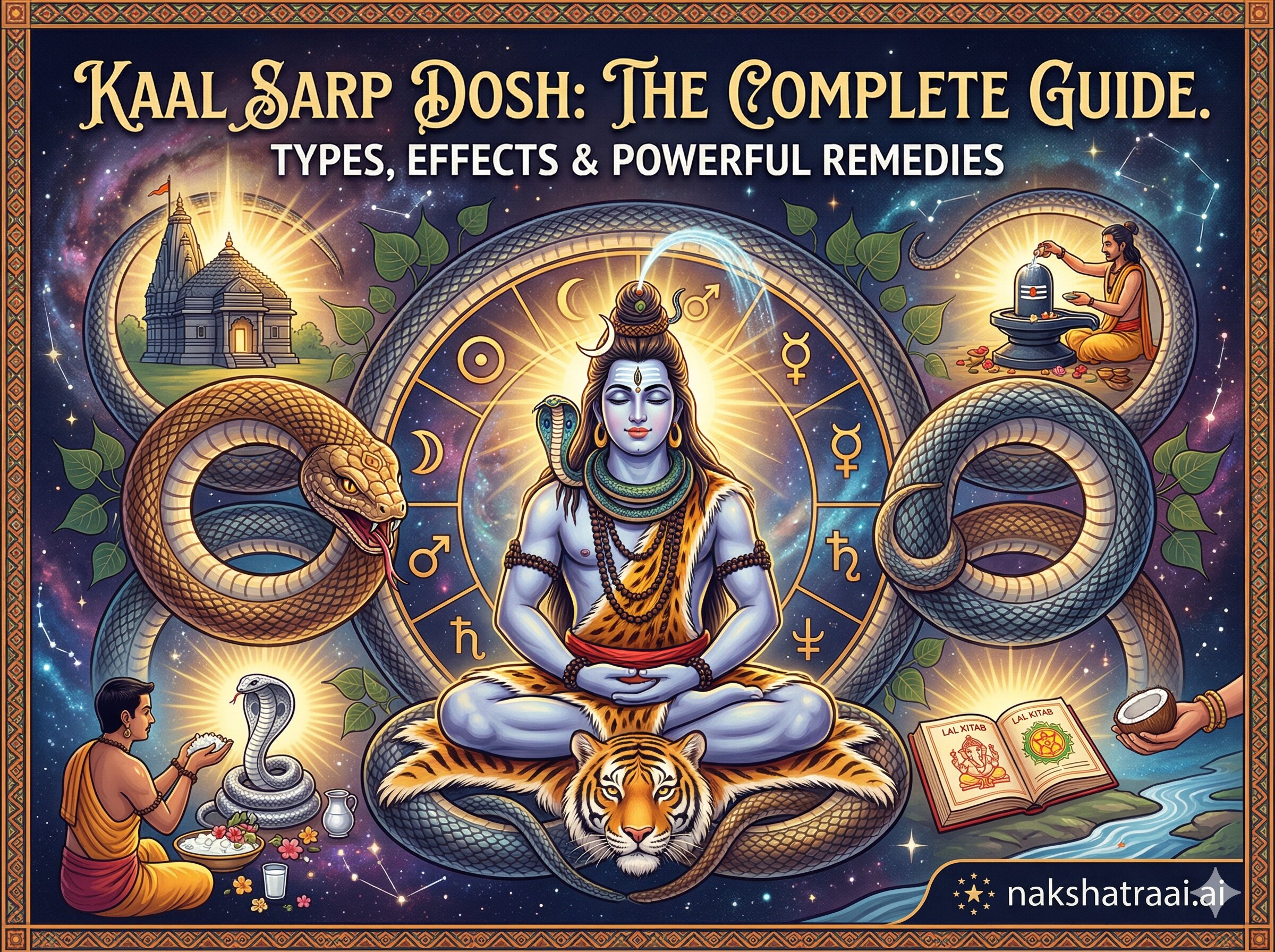
What is Kaal Sarp Dosh and how many types are there?
Kaal Sarp Dosh is a planetary configuration in Vedic astrology where all seven major planets- Sun, Moon, Mars, Mercury, Jupiter, Venus, and Saturn, are hemmed between the shadow planets Rahu (North Node) and Ketu (South Node) in the birth chart.
There are 12 types, each named after a divine serpent from Hindu mythology and corresponding to the 12 houses of the zodiac through which the Rahu–Ketu axis passes. The dosh is considered one of the most significant yogas in Jyotish, associated with intense karmic lessons, delayed success, and spiritual urgency, but also with the potential for extraordinary achievement when properly understood and remediated.
Kaal Sarp Dosh kya hota hai aur ye kitne prakaar ke hote hain?
Kaal Sarp Dosh tab banta hai jab janam kundli mein saatey graha (Surya, Chandra, Mangal, Budh, Guru, Shukra, Shani) Rahu aur Ketu ke beech aa jaate hain. Iske 12 prakar hote hain- Anant, Kulik, Vasuki, Shankhapal, Padma, Mahapadma, Takshak, Karkotaka, Shankhnaad, Paatak, Vishyakta, aur Sheshanaag, jo 12 bhaavon ke anusar alag-alag prabhaav dete hain. Yah dosh jeevan mein kashton aur vilamb ke saath-saath, sahi drishtikon aur upaayon se, asadharan safaltaa bhi de sakta hai.
In Vedic astrology, few configurations carry the weight of Kaal Sarp Dosh. The name combines three Sanskrit words: Kaal (time or death), Sarp (serpent), and Dosh (affliction), together describing a condition where the native’s horoscope lies within the coils of the cosmic serpent formed by the lunar nodes Rahu and Ketu. It is among the most discussed yogas in Jyotish, frequently misunderstood as an unbreakable curse when it is more accurately a karmic configuration demanding resolution, one that, approached correctly, yields extraordinary life transformation.
Kaal Sarp Dosh forms when all seven visible planets are confined to one half of the birth chart, entirely hemmed between Rahu and Ketu. Not a single planet must appear on the opposite side of the Rahu–Ketu axis for the full dosh to apply. Partial configurations, where one or two planets escape the hemming, are considered milder and are sometimes called partial Kaal Sarp Dosh.
The 12 types are named after the divine serpents (nagas) said to have attended the churning of the cosmic ocean (Samudra Manthan) in Hindu mythology. Rahu and Ketu represent the severed head and tail of the demon Svarbhanu, who temporarily swallowed the sun, giving these nodes their permanent association with karmic shadow, past-life debt, and intensity of experience. The house in which Rahu sits determines which of the 12 types is present in the chart.
Classical Note: While the Kaal Sarp configuration is not explicitly named in the oldest classical texts such as the Brihat Parashara Hora Shastra, it is well-established in the medieval and post-classical Jyotish tradition. Contemporary scholars evaluate it as a significant nodal axis yoga when assessed in conjunction with the overall strength of the chart, the Ascendant lord, and the operative Dasha period.
Kaal Sarp Dosh is not exclusively malefic. A number of historically significant leaders, scholars, and spiritual figures carried this yoga. What it consistently produces is intensity, a life of sharp challenges followed by equally sharp breakthroughs, and a persistent inner drive that, if channeled correctly, produces exceptional outcomes.
Each of the 12 types is determined by Rahu’s house position. The table below summarises the serpent name, the Rahu–Ketu house axis, and the core life domains and effects associated with each type.
| No. | Name | Rahu–Ketu Axis | Core Effects |
| 1 | Anant | Rahu 1st / Ketu 7th | Identity crises, turbulent marriage, health challenges; drives remarkable self-determination |
| 2 | Kulik | Rahu 2nd / Ketu 8th | Financial instability, family disharmony, harsh speech; sudden unexpected losses or gains |
| 3 | Vasuki | Rahu 3rd / Ketu 9th | Sibling conflicts, obstructed fortune, unconventional spirituality; courage tested repeatedly |
| 4 | Shankhapal | Rahu 4th / Ketu 10th | Domestic instability, property disputes; career rises followed by sharp reversals |
| 5 | Padma | Rahu 5th / Ketu 11th | Delayed children, obsessive thinking, speculation losses; potential for exceptional creativity |
| 6 | Mahapadma | Rahu 6th / Ketu 12th | Hidden enemies, chronic expenditure; perseverance ultimately conquers debts and adversaries |
| 7 | Takshak | Rahu 7th / Ketu 1st | Deceptive partnerships, marital turbulence; profound inner awareness when turned inward |
| 8 | Karkotaka | Rahu 8th / Ketu 2nd | Inherited debts, life-altering crises; grants deep occult knowledge and transformative power |
| 9 | Shankhnaad | Rahu 9th / Ketu 3rd | Estrangement from guru and father; delayed fortune; exceptional philosophical depth possible |
| 10 | Paatak | Rahu 10th / Ketu 4th | Career instability, inner emptiness despite outward success; produces exceptional self-made individuals |
| 11 | Vishyakta | Rahu 11th / Ketu 5th | Unreliable social networks, creative blocks; potential to become a revolutionary innovator |
| 12 | Sheshanaag | Rahu 12th / Ketu 6th | Mysterious expenditures, unconscious self-undoing; strong pull toward liberation and spiritual mastery |
A critical point of interpretation: no type is inherently destructive without reference to the full chart. Astrologers must weigh the strength of the Ascendant lord, the presence or absence of benefic aspects on Rahu and Ketu, and the native’s operative Mahadasha before pronouncing the dosh’s severity.
The dosh is cancelled (Bhang) or significantly reduced in intensity under several classical conditions recognised across Vedic astrological schools:
Cancellation of the dosh does not erase the karmic lessons of the Rahu–Ketu axis. It means the native is better equipped to integrate those lessons rather than being overwhelmed by them.
The most celebrated classical remedy is the Kaal Sarp Shanti Puja performed at Trimbakeshwar Jyotirlinga, near Nashik in Maharashtra. Trimbakeshwar is one of the 12 Jyotirlingas, among the most sacred Shiva shrines in India, and is specifically renowned as a site for Naga propitiation and ancestral (Pitru) rites.
The ritual is conducted by qualified Brahmin priests trained in this specific vidhi and follows a prescribed sequence:
The puja is most auspiciously performed on Nag Panchami, Purnima, Amavasya, or during Rahu Kaal, as advised by a qualified Jyotishi.
Nag Panchami, the fifth day of the bright fortnight in Shravan (July–August), is the most auspicious annual day for serpent propitiation. For those with Kaal Sarp Dosh, observing Nag Panchami with full devotion significantly appeases the naga energy in the birth chart. The observance includes offering milk, turmeric, and flowers to a silver or gold serpent idol; fasting until after sunset puja; reciting the Nag Stotram and Maha Mrityunjaya Mantra 108 times; and visiting a Shiva temple for Abhishek with milk and Bilva leaves.
Primary Kaal Sarp Dosh Mantra ओम् नमः शिवाय Om Namah Shivaaya Recitation: 1,008 times daily, ideally at Brahma Muhurta (the hour before sunrise). Why Shiva: Lord Shiva is the supreme lord of serpents (Nagadhipati), the Naga Pasha adorns his neck and wrists. Daily recitation gradually reduces dosh intensity and accelerates karmic resolution. Additional Mantras: • Om Raam Rahave Namah - Rahu propitiation, 108 times daily • Om Sraam Sreem Sraum Sah Ketave Namah - Ketu propitiation, 108 times daily • Maha Mrityunjaya Mantra - 108 times on Mondays, especially during Rahu Kaal |
Are you currently struggling with life phases like Astrology? Discover your precise chart insights now.
The Lal Kitab, composed by Pt. Roop Chand Joshi in the early 20th century, offers a unique stream of remedial astrology distinct from classical Parashari Jyotish. Its approach to Rahu and Ketu treats them as house-anchored entities and prescribes tangible, earthly remedies grounded in karma and service, making it a valuable complementary system for Kaal Sarp Dosh mitigation.
For Kaal Sarp Dosh specifically, the Lal Kitab prescribes a 43-day coconut ritual: keep an intact whole coconut (with water) in the home for 43 consecutive days, then immerse it in a river. This symbolically contains and dissolves the serpent energy hemming the planetary configuration. Additionally, releasing live fish into a river as an act of jeevan daan (life-giving) is prescribed as a powerful combined Rahu–Ketu remedy, as both nodes respond strongly to acts that restore rather than harm life.
| Remedy Category | Key Practices |
| Mantra | Om Namah Shivaya (1,008x daily); Rahu Beej Mantra (108x daily); Maha Mrityunjaya on Mondays |
| Puja | Kaal Sarp Shanti Puja at Trimbakeshwar; Rudrabhishek (11 consecutive Mondays) |
| Annual Observance | Nag Panchami: milk offering to serpent idol, fast, Nag Stotram recitation |
| Daan | Black sesame, blanket, silver on Saturdays; feed crows and cows on Amavasya |
| Lal Kitab | Feed chapati with mustard oil to crows; float coriander in river; 43-day coconut ritual |
| Gemstone | Gomed (Rahu) and Cat’s Eye (Ketu) — only after qualified Jyotishi consultation |
| Pilgrimage | Trimbakeshwar, Rameswaram, Ujjain Kaal Bhairav; Sarpa Kavus in Kerala |
No. Many accomplished individuals, political leaders, scholars, and spiritual figures, have carried this configuration. The dosh consistently produces intensity: delayed but eventual success, karmic testing followed by breakthroughs, and often a powerful spiritual awakening. It should be approached with understanding, not fear.
Vedic tradition holds that no dosh is ‘permanently removed’ through ritual alone, because it represents karma carried across lifetimes. Remedies reduce intensity and accelerate resolution of the underlying karma. Consistent spiritual practice, seva (selfless service), and mantra discipline are more enduring than any single puja, though Kaal Sarp Shanti Puja at Trimbakeshwar is the most powerful ritual intervention available.
The dosh tends to peak during the Mahadasha (major period) of Rahu (18 years) or Ketu (7 years), and may also be triggered when transiting Rahu or Ketu aspects sensitive natal positions. Many natives experience its most intense expression between ages 27 and 45.
Pitra Dosh arises from unresolved ancestral karma, identified primarily through the Sun, the 9th house, and the Rahu–Sun conjunction. Kaal Sarp Dosh is a broader nodal configuration involving all planets and relates to past-life karmic intensity rather than ancestral-lineage debt specifically. Both can coexist in the same chart and both respond to ancestral propitiation; however, they have distinct astrological signatures and require separate remedial approaches.
Kaal Sarp Dosh is one of Vedic astrology’s most vivid teachings on the nature of karma, time, and liberation. The image of all planets hemmed within the serpent’s coils speaks to a life where the native cannot easily escape the themes their soul has chosen to resolve. Yet the very pressure this configuration creates is also its gift, it produces intensity that, when channeled with awareness and discipline, can yield extraordinary achievement.
The ancient tradition’s message is ultimately one of hope: Shesha Naga himself supports the entire weight of creation. The serpent in Hindu cosmology is not merely a symbol of danger but Shiva’s ornament, Vishnu’s bed, and Ganesha’s belt. Approached with devotion, correct practice, and genuine understanding, the Kaal Sarp configuration becomes an invitation to shed the skin of limitation and transform.
Perform the recommended remedies not from fear but from understanding. Recite Om Namah Shivaya with sincerity. Observe Nag Panchami with devotion. Seek the Kaal Sarp Shanti Puja at Trimbakeshwar when ready. The cosmic serpent loosens its coil not when threatened, but when the native demonstrates the wisdom and compassion the Rahu–Ketu axis was always asking them to develop.
Connect with a Jyotishi on Nakshatraai.ai Generate your Kundali and check for Kaal Sarp Dosh: Speak with an expert Jyotishi for a personalised Kaal Sarp Dosh assessment and remedy plan: |
Disclaimer: This article is for educational and informational purposes only. Astrological guidance does not substitute for consultation with a qualified Jyotishi or Hindu priest who can evaluate your specific birth chart and circumstances. Ritual procedures should ideally be performed under the guidance of a qualified pandit.