Quick Answer: What Is the Most Effective Remedy for Kaal Sarp Dosh?
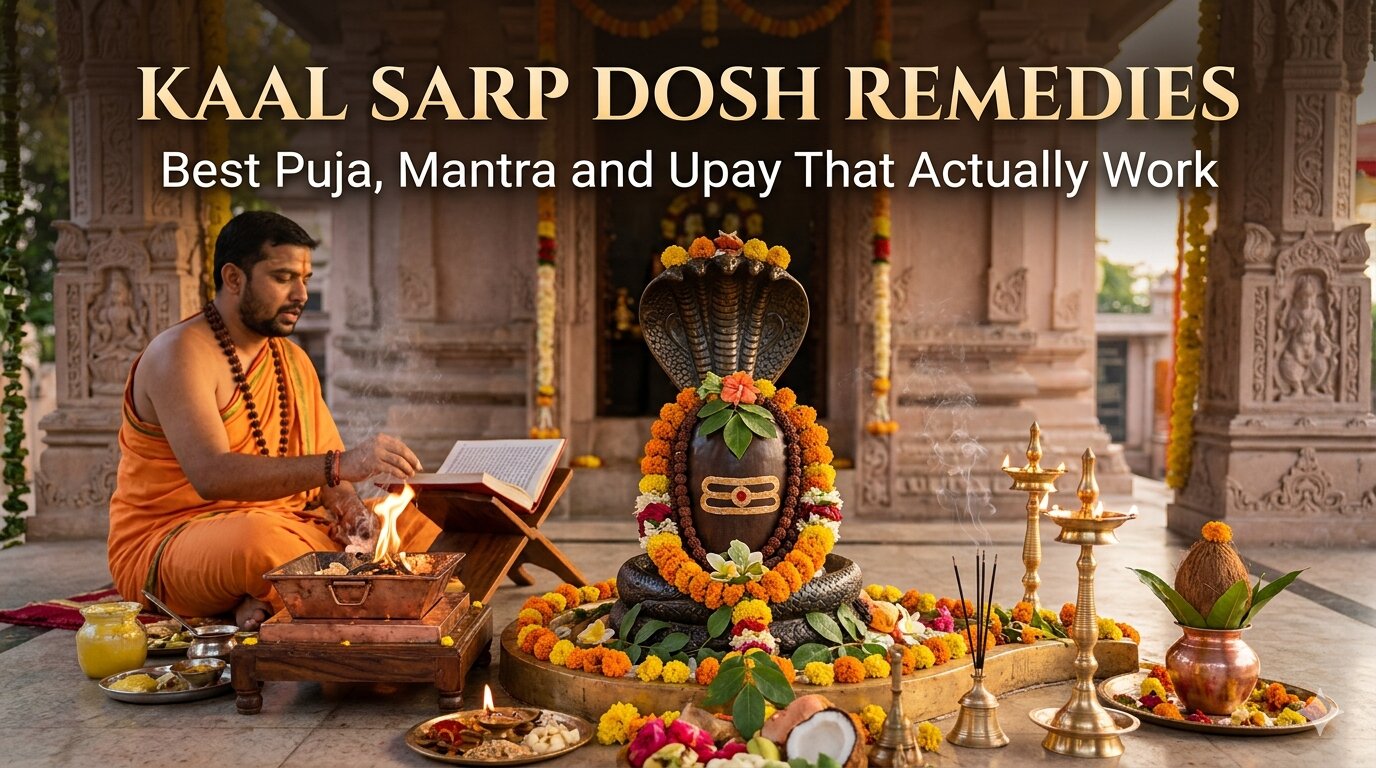
The single most effective remedy for Kaal Sarp Dosh is the Kaal Sarp Shanti Puja performed at Trimbakeshwar Jyotirlinga, near Nashik, Maharashtra - one of the 12 sacred Jyotirlingas of Lord Shiva. This ritual, conducted by trained Vedic priests using prescribed Rahu-Ketu mantras, Navagraha Shanti, Homa, and Pitru Tarpan, is widely regarded as a once-in-a-lifetime remedy. It is best performed on Nag Panchami, Amavasya, or Purnima under a qualified Jyotishi's guidance.
काल सर्प दोष के प्रमुख उपाय और निवारण:
Kaal Sarp Dosh ke sabse prabhavshali upay mein Trimbakeshwar Jyotirlinga mein Kaal Sarp Shanti Puja, Maha Mrityunjaya Mantra ka 108 baar jaap (40 din tak), aur Nag Panchami ka vidhi-poorvak palan shamil hain. Ghar par bhi Naag Devta ki puja, chandi ke saanp ki murti ki sthapana, aur Lal Kitab ke upay kiye ja sakte hain.
If your Kundali carries Kaal Sarp Dosh, you are not alone - and you are not without recourse. In Vedic astrology, this powerful nodal configuration arises when all seven planets (Sun, Moon, Mars, Mercury, Jupiter, Venus, Saturn) are hemmed between Rahu and Ketu in the birth chart. The result is intensity: delayed milestones, recurring obstacles, and a persistent sense that life requires far more effort than it should. Yet the tradition is equally clear that this dosh carries potent remedies - and that when these remedies are practiced sincerely, they produce real transformation.
This guide covers every proven Kaal Sarp Dosh remedy - from the most powerful classical puja at Trimbakeshwar Jyotirlinga to daily mantras, Nag Panchami rituals, home upay, gemstones, and Lal Kitab cures. It is designed as a companion to our [internal link: Kaal Sarp Dosh Complete Guide] - if you need to first confirm whether you have the dosh and which of the 12 types affects you, read that article first.
Among all known remedies, the Kaal Sarp Shanti Puja performed at Trimbakeshwar Jyotirlinga stands alone as the most potent classical intervention. Trimbakeshwar, located 28 km from Nashik city in Maharashtra on the banks of the Godavari River, is one of the 12 sacred Jyotirlingas of Lord Shiva. Its unique three-faced Shiva Lingam (Trayambaka) - representing Brahma, Vishnu, and Mahesh as one divine presence - makes it cosmically charged for the propitiation of Rahu, Ketu, and ancestral (Pitru) karma. The puja is typically completed in a single day, lasting approximately 2.5 to 3 hours, and is recommended as a once-in-a-lifetime remedy when performed with full sincerity.
The full puja vidhi at Trimbakeshwar follows this prescribed sequence:
The puja is most powerfully performed on the following muhurats:
Important: Consult Before You Travel Always confirm the presence of an authentic Tamprapatra-holding pandit at Trimbakeshwar before visiting. Book your muhurat in advance and confirm your kundali details (name, date, time, and place of birth) so the pandit can identify which of the 12 types of Kaal Sarp Dosh requires specific vidhi. Plan for a 2-3 hour puja window, early in the morning. See your Kundali and the 12 types explained in detail in our [internal link: Kaal Sarp Dosh Complete Guide]. |
Nag Panchami falls on the fifth day (Panchami Tithi) of the bright fortnight in the month of Shravan (typically July–August). It is the most sacred annual day dedicated to the Naga Devtas (serpent deities) in Hindu tradition, and for those with Kaal Sarp Dosh, observing it with full devotion is one of the most powerful yearly upay available.
Note: While some folk traditions involve offering milk to live snakes in the wild, this practice should not be pursued. The silver or gold Nag Pratima (idol) is the appropriate and safe ritual substitute - equally efficacious according to all classical sources.
Mantra is the most accessible and consistently recommended remedy across all astrological traditions for Kaal Sarp Dosh. Because the dosh is fundamentally connected to Rahu and Ketu - which are governed spiritually by Lord Shiva (as Nagadhipati, the supreme lord of serpents) - Shiva mantras are the primary prescriptions.
Primary Remedy: Maha Mrityunjaya Mantra
ओम् त्रयम्बकं यजामहे सुगन्धिं पुष्टिवर्धनम्। उर्वारुकमिव बन्धनान् मृत्योर्मुक्षीय माभ्तत्।।
Om Tryambakam Yajamahe Sugandhim Pushtivardhanam, Urvarukamiva Bandhanan Mrityor Mukshiya Maamritat.
Recitation: 108 times daily for a minimum of 40 consecutive days Best Time: Brahma Muhurta (before sunrise) or during Rahu Kaal on Mondays Method: Use a Rudraksha mala; face East or North; sit on a clean mat Why This Mantra: Originates in the Rig Veda (RV 7.59.12) and is dedicated to Lord Shiva as Tryambaka (the three-eyed one, lord of serpents). Daily recitation systematically reduces the malefic intensity of Rahu-Ketu and builds karmic momentum toward resolution. |
Supporting Mantras
Om Namah Shivaya (ओम् नमः शिवाय) Minimum 108 times daily. The Panchakshara (five-syllable) mantra of Lord Shiva is the simplest and most universally recommended daily sadhana for Kaal Sarp Dosh.
Rahu Beej Mantra: Om Raam Rahave Namah 108 times daily. Specifically propitiates Rahu and reduces its separative, obstructive energy in the birth chart.
Ketu Beej Mantra: Om Sraam Sreem Sraum Sah Ketave Namah 108 times daily. Pacifies Ketu’s isolating, detached energy and supports the resolution of past-life karmic patterns.
Nag Gayatri Mantra: Om Navakulaya Vidmahe Vishadantaya Dhimahi Tanno Sarpah Prachodayat 11 or 21 times daily, especially on Nag Panchami and Mondays. |
Not everyone can travel to Trimbakeshwar immediately. The following home-based remedies are well-established in Vedic tradition and can be practiced daily or weekly to progressively reduce the dosh’s intensity while formal puja is being planned.
Performing Rudrabhishek (the sacred bathing of the Shivalingam with milk, honey, curd, ghee, and gangajal while reciting the Rudrashtadhyayi or Om Namah Shivaya) on 11 consecutive Mondays is a powerful classical remedy. This can be done at a Shiva temple near you. The 11-Monday commitment builds cumulative spiritual momentum and significantly propitiates the Naga-Shiva energy in the birth chart.
Critical Advisory: Read Before Wearing Gemstones Gemstones amplify planetary energies in both directions. Wearing the wrong gemstone, or wearing the right gemstone in the wrong metal or at the wrong time, can intensify Kaal Sarp Dosh effects rather than reduce them. NEVER wear Gomed or Cat’s Eye based solely on general advice, including from this article. ALWAYS consult a qualified Jyotishi who has examined your full birth chart, including the strength of the Ascendant lord, the dasha period, and whether Rahu or Ketu are functionally malefic or benefic in your specific chart. |
When prescribed after proper chart examination, the following gemstones are used:
For Kaal Sarp Dosh specifically, some Jyotishis prescribe both stones together after confirming both nodes are afflicted and the chart can support dual gemstone therapy. This combined prescription should only be followed under expert guidance.
The Lal Kitab, composed by Pt. Roop Chand Joshi in the early 20th century, offers a complementary stream of remedial astrology distinct from the Parashari tradition. Its approach to Rahu and Ketu is grounded in tangible, karma-based actions rather than elaborate ritual, making its remedies highly accessible for daily practice. For Kaal Sarp Dosh, the Lal Kitab upay address both nodes simultaneously.
For Kaal Sarp Dosh specifically, the Lal Kitab prescribes a 43-day coconut ritual: keep an intact whole coconut (with its water intact) in the home’s puja space for 43 consecutive days, then immerse it in a river. This symbolically contains and gradually dissolves the serpent energy hemming the planetary configuration.
Additionally, releasing live fish into a river as an act of Jeevan Daan (life-giving service) is prescribed as a powerful combined remedy, as both Rahu and Ketu respond strongly to acts that restore rather than take life. This can be performed at any river on a Monday or Saturday.
Are you currently struggling with life phases like Astrology? Discover your precise chart insights now.
Beyond Trimbakeshwar, the classical tradition identifies several other sacred sites specifically potent for Kaal Sarp Dosh and Naga propitiation:
| Remedy Category | Key Practices |
|---|---|
| Puja (Ritual) | Kaal Sarp Shanti Puja at Trimbakeshwar Jyotirlinga, Nashik - the most powerful classical remedy |
| Mantra | Maha Mrityunjaya Mantra - 108 times daily for 40 daysOm Namah Shivaya - 108 times dailyRahu Beej Mantra - 108 times daily |
| Annual Observance | Nag Panchami: milk offering to serpent idol, fast, Nag Stotram recitation |
| Home Upay | Silver Nag-Nagin idol in puja ghar; milk + saffron daily worship; Rudrabhishek on 11 Mondays |
| Lal Kitab | Feed chapati with mustard oil to crows on Saturdays; 43-day coconut ritual; release live fish in river |
| Gemstone | Gomed (Hessonite) for Rahu + Cat's Eye (Lahsuniya) for Ketu - only after qualified Jyotishi consultation |
| Daan | Black sesame, blanket, iron, silver on Saturdays; feed crows and cows on Amavasya |
| Pilgrimage | Trimbakeshwar (Nashik), Kalahasti (Andhra Pradesh), Mahakaleshwar (Ujjain), Rameswaram (Tamil Nadu) |
| Question | Answer |
|---|---|
| How to remove Kaal Sarp Dosh permanently? | Vedic tradition holds that the dosh cannot be 'permanently removed' through ritual alone, as it represents karma carried across lifetimes. Remedies reduce its intensity and accelerate resolution. The most powerful ritual intervention is the Kaal Sarp Shanti Puja at Trimbakeshwar. Consistent mantra practice and ethical living are the most enduring long-term remedies. |
| Kaal Sarp Dosh puja - how many times must it be done? | The Trimbakeshwar puja is generally considered a once-in-a-lifetime remedy when performed correctly and sincerely. In severe cases or during a Rahu or Ketu Mahadasha, some Jyotishis recommend repeating it. Annual Nag Panchami observance serves as the yearly reinforcement. |
| Can Kaal Sarp Dosh remedies be done at home? | Yes. Daily mantra practice (Maha Mrityunjaya 108 times, Om Namah Shivaya 108 times), Naag Devta puja with a silver idol, Rudrabhishek on Mondays, and Lal Kitab upay can all be performed at home. The Trimbakeshwar puja requires physical presence at the temple with a qualified pandit. |
| Kaal Sarp Dosh mantra - which is best? | The Maha Mrityunjaya Mantra (108 times daily for 40 days) is the most universally recommended primary mantra. The Rahu and Ketu Beej Mantras (108 times each daily) are the complementary nodal mantras. Om Namah Shivaya (108 times daily) is the simplest and most accessible daily practice. |
| Kaal sarp se kaise bachein - can I prevent its effects? | You cannot prevent a dosh present in your birth chart, but you can significantly reduce its impact through consistent practice. Early awareness (having your kundali checked by a qualified Jyotishi), timely puja, regular mantra sadhana, and ethical conduct are the four pillars of effective Kaal Sarp Dosh management. |
| Kaal Sarp ka prabhaav kya hai - when is it most intense? | Effects typically peak during the Mahadasha (major period) of Rahu (18 years) or Ketu (7 years), and when transiting Rahu or Ketu aspects sensitive natal positions. Most natives experience the dosh's most intense expression between ages 27 and 45. See our [internal link: Kaal Sarp Dosh Complete Guide] for the specific effects of all 12 types. |
| Is Kaal Sarp Dosh and Kaal Sarp Yoga the same thing? | Yes. The terms are used interchangeably in contemporary Jyotish practice. 'Yoga' emphasises the planetary configuration; 'Dosh' emphasises its potentially challenging effects. Some astrologers prefer 'Yoga' to counter the fearful connotations of 'Dosh,' and there is merit in this framing - many accomplished individuals have carried this configuration. |
| Gomed or Cat's Eye - which gemstone to wear first? | This depends entirely on which node is more prominently afflicted in your chart and which Mahadasha you are running. There is no universal answer. Always consult a qualified Jyotishi before purchasing or wearing either gemstone. Wearing either without proper consultation can amplify both the positive and negative effects of the respective node. |
Kaal Sarp Dosh is not a sentence - it is an invitation. The image of all planets hemmed within the cosmic serpent’s coils points to a life with specific karmic themes that require resolution. But in Hindu cosmology, the serpent is also Shiva’s ornament, Vishnu’s bed, and Ganesha’s belt. The very symbol of the dosh points toward its remedy: Lord Shiva, Naga Devta, and devotion.
The remedies outlined in this guide are not superstition. They are time-tested practices rooted in Vedic understanding of how karma, intention, mantra, and pilgrimage interact to create genuine transformation. Perform them not from fear, but from understanding and sincerity.
Begin with what you can do today: recite the Maha Mrityunjaya Mantra 108 times at sunrise. Plan for the Kaal Sarp Shanti Puja at Trimbakeshwar when the timing is right. Observe Nag Panchami this Shravan with full devotion. The cosmic serpent loosens its coil not when threatened, but when the native demonstrates the wisdom and compassion the Rahu-Ketu axis was always asking them to develop.
Connect with a Jyotishi on Nakshatraai.ai Generate your Kundali and confirm your Kaal Sarp Dosh type: nakshatraai.ai/add-kundli Speak with an expert Jyotishi for a personalised Kaal Sarp Dosh remedy plan: nakshatraai.ai/astrologer 📖 Internal Links: [Kaal Sarp Dosh Complete Guide] | [12 Types of Kaal Sarp Dosh] | [Pitra Dosh: Meaning, Effects and Remedies] | [Rahu-Ketu in Your Horoscope: A Complete Guide] |
Disclaimer: This article is for educational and informational purposes only. Astrological guidance does not substitute for consultation with a qualified Jyotishi or Hindu priest who can evaluate your specific birth chart and personal circumstances. Ritual procedures should be performed under the guidance of a qualified pandit. Gemstone recommendations require individual chart analysis before adoption.