Quick Answer: How to Perform Ketu Graha Shanti Puja? How to perform Ketu Graha Shanti Puja? Ketu Graha Shanti Puja is a Vedic ritual performed to appease the shadow planet Ketu and reduce the malefic effects of its placement or Mahadasha in the birth chart. The puja begins with a Sankalpa (ritual resolve), followed by Ganapati Puja, Navagraha Shanti, the Ketu Graha Havan, and concludes with Daan (charitable donation). The prescribed Ketu Beej Mantra, Om Sraam Sreem Sraum Sah Ketave Namah, is chanted 108 times daily as the individual's personal practice, while a full puja performed by qualified pandits involves 17,000 mantra recitations. The puja is most auspiciously performed on Tuesdays or during the native's Ketu Nakshatra, Ashwini, Magha, or Moola. केतु ग्रह को शांत करने के लिए क्या करना चाहिए? Ketu Graha Shanti Puja mein sabse pehle Sankalp liya jaata hai, phir Ganapati Puja aur Navagraha Shanti ki jaati hai. Iske baad Ketu Havan mein til, jau, ghee aur Ketu se sambandhit samagri ki aahuti di jaati hai. Vyaktigat sadhana ke liye 'Om Sraam Sreem Sraum Sah Ketave Namah' mantra 108 baar rozana japa jaata hai. Tuesdays aur Ketu Nakshatra (Ashwini, Magha, Moola) ka din is puja ke liye sabse shubh maana jaata hai. Ketu ki shanti ke liye aawara kutton ko bhojan dena, til aur kambal ka daan karna, aur Lord Ganesha ki upasana karna bhi vishesh phal deta hai. |
In Vedic astrology, Ketu is among the most misunderstood and feared of the nine grahas. Described as a Chaya Graha, a shadow planet with no physical form, Ketu represents the severed tail of the celestial serpent Svarbhanu, whose head is the node Rahu. Where Rahu is associated with worldly desire and obsessive craving, Ketu represents the precise opposite: detachment, past-life accumulated wisdom, and the relentless pull toward liberation (moksha). Classical texts describe Ketu as a spiritually benefic but materially malefic influence, one that causes loss and confusion at the worldly level precisely because it is guiding the native away from illusory attachments and toward the soul's deeper purpose.
Ketu Graha Shanti Puja is the Vedic ritual tradition that has developed over centuries to appease, balance, and harmonise Ketu's energy in the birth chart. Unlike the pujas of purely material-realm planets, the Ketu puja carries a distinctly spiritual and liberatory dimension. It is not merely a remedy for worldly suffering, it is an invitation to consciously participate in the soul's journey toward Ketu's highest promise: moksha and spiritual enlightenment.
This guide provides a complete, fact-verified resource on Ketu Graha Shanti Puja , when it is needed, how to perform it correctly, which samagri (materials) are required, the most effective mantras, and the proven classical and Lal Kitab remedies that support its effects.
Ketu is the South Node of the Moon, the point where the Moon's orbital path crosses the ecliptic from north to south. In the Vimshottari Dasha system of Vedic astrology, Ketu rules a 7-year Mahadasha period. Unlike the 18-year Rahu Mahadasha that precedes it, Ketu's period is characterised by internalisation, stripping away of ego, and an often painful but ultimately liberating dissolution of material attachments.
The Sanskrit root of Ketu's name relates to brightness, flame, and a comet-like apparition, consistent with its role as a disruptive, transformative force that enters life suddenly. In the body, Ketu governs the ears, spine, and the Muladhara (root) chakra. It is associated with spirituality, psychic ability, occult knowledge, moksha, and in classical texts, with the paternal grandmother's lineage.
The Ketu Graha Shanti Puja is required when Ketu's energy in the birth chart has become imbalanced , either through malefic placement, conjunction with a challenging planet, or the activation of its Mahadasha or Antardasha period. The puja does not fight Ketu's energy but rather seeks to align the native consciously with what Ketu is asking them to release, learn, and transcend.
Classical Note: Ketu is described in the Brihat Parashara Hora Shastra as giving good results in the 3rd, 9th, and 12th houses, and challenging results in the 1st, 2nd, 7th, and 8th. Its effects are always modified by the house lord's strength, the nakshatra it occupies, and the overall chart context. Blanket pronouncements about Ketu being 'always harmful' reflect incomplete analysis.
A qualified Jyotishi should be consulted to determine whether a Ketu Graha Shanti Puja is indicated. The following are the most common classical triggers:
Astrological Triggers:
Life-Experience Indicators:
The following materials (samagri) are required for a complete Ketu Graha Shanti Puja. For a home puja with daily mantra practice, the essential items are multi-coloured flowers, kusha grass, black sesame, a Ketu Yantra, and ghee. For a full ritual performed by qualified pandits, the complete list below applies.
| Samagri Item | Purpose / Significance |
| Multi-coloured flowers (especially blue and grey) | Offerings to Ketu; multi-colour reflects Ketu's smoke-like, variegated nature |
| Kusha grass (Darbha) | Sacred grass used in all Vedic rituals; purifies the ritual space |
| Black sesame (Kala Til) | Primary Ketu offering; sesame is the grain associated with Ketu |
| Ketu Yantra (silver or copper) | Geometric representation of Ketu's energy; energised during the puja |
| Ghee (clarified butter) | Havan offering; purifies and amplifies the fire ritual |
| Barley (Jau) | Havan samagri associated with Ketu Graha |
| Incense (Dhoop) and Diya (lamp) | Creates auspicious atmosphere; Ketu is a planet of light and fire |
| Gangajal (holy water) | Used for Abhishek and purification throughout the ritual |
| Camphor (Kapur) | Offered during Aarti; symbolises the burning away of karma |
| Roli, Akshat (rice), Kumkum | Standard Vedic puja offerings |
| Grey or multi-coloured cloth | Ketu's associated colour; offered during Daan at puja's conclusion |
| Coconut (whole, with water) | Offered to Ketu and Ganesha; represents life and abundance |
| Betel leaves and betel nut (Pan-Supari) | Traditional Vedic puja item; used in Navagraha worship |
Note on Ketu's Associated Colours: Ketu's classical colour is described variously as smoke-grey, multi-coloured, or dark variegated hues. Smoke grey and multi-coloured combinations are most widely accepted. Avoid pure white or gold, which are associated with the Sun and Moon respectively.
The complete Ketu Graha Shanti Puja , when conducted by a qualified pandit or Acharya , follows the sequence below. The full ritual typically takes 8-10 hours and should be performed on an auspicious Tuesday (mangalvaar) or on the native's Ketu Nakshatra day (Ashwini, Magha, or Moola nakshatra). The shubh muhurat should be confirmed by a Jyotishi.
Step 1 Shuddhi and Preparation
The puja space is purified with Gangajal. The native takes a ritual bath, ideally before sunrise. The native wears clean, preferably grey or multi-coloured clothing. A clean wooden platform (paat) is arranged facing east, on which the Ketu Yantra, Shiva lingam (if available), and puja items are placed.
Step 2 Sankalpa (Ritual Resolve)
The Sankalpa is the formal statement of intention. The pandit or native declares the full name, father's name, gotra (lineage), and the purpose of the puja, specifically, Ketu Graha Shanti and the cessation of Ketu's malefic effects. This step binds the ritual to the specific native and their karmic context.
Step 3 Ganapati Puja and Invocation
Lord Ganesha is invoked first, as he is the remover of obstacles and , critically , is directly associated with Ketu in the Lal Kitab tradition. The Ganapati Puja begins with the chanting of Om Gan Ganapataye Namah 108 times. Modak, flowers, and durva grass are offered. This step is considered essential before approaching Ketu's energy.
Step 4 Navagraha Shanti
A brief Navagraha worship is performed, offering each planet their associated grain, colour, and mantra. This establishes the cosmic context for Ketu's propitiation and ensures no other graha is offended or bypassed in the process.
Step 5 Ketu Graha Puja and Mantra Jaap
The Ketu Yantra is placed centrally. The Ketu Mool Mantra , Om Sraam Sreem Sraum Sah Ketave Namah , is recited by a team of pandits 17,000 times. (This is the standard count for a full Ketu Graha Shanti; some traditions prescribe 7,000 or a full Anushthan of 72,000 for severe doshas.) Throughout the jaap, black sesame, multi-coloured flowers, and Ketu-associated items are offered to the Yantra.
Step 6 Ketu Graha Havan (Fire Ritual)
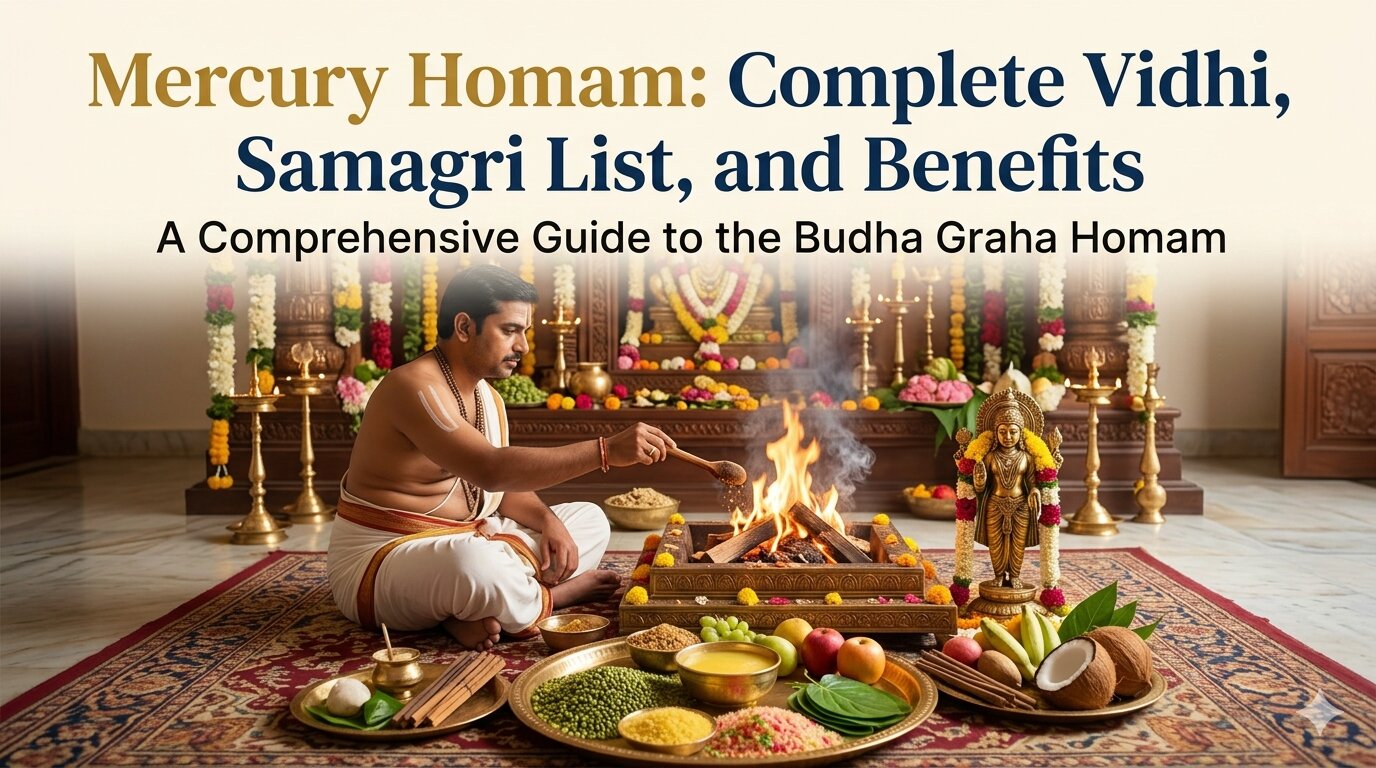
A havan kund (fire pit) is prepared using kusha grass as the base. Sacred herbs, ghee, barley, black sesame, and prescribed Ketu-associated samagri are offered into the fire with each round of mantra chanting. The smoke of the havan is believed to carry the accumulated karma up and away. The count of havan aahutis (offerings) is traditionally one-tenth of the mantra jaap count.
Step 7 Abhishek and Aarti
The Ketu Yantra and Shiva lingam are bathed (abhishek) with milk, Gangajal, honey, and curd. Camphor is lit for the concluding Aarti, accompanied by the blowing of the shankha (conch). The Maha Mrityunjaya Mantra is chanted 108 times at this stage.
Step 8 Daan (Charitable Donation)
The puja concludes with the prescribed Daan. The classical Ketu Daan consists of donating a black sesame + blanket (kambhal) combination to a poor or needy person, ideally on a Tuesday. Iron objects, grey cloth, and sesame oil lamps are also given. This act of giving is considered the most powerful external action to appease Ketu's energy, because Ketu responds most deeply to acts of selfless release rather than ritual alone.
Primary Ketu Beej Mantra ॐ स्रां स्रीं स्रौं सः केतवे नमः Om Sraam Sreem Sraum Sah Ketave Namah Recitation: 108 times daily, ideally at Brahma Muhurta (the hour before sunrise) or during Ketu's hora. Additional Ketu Mantras: Ketu Puranokta Mantra: Palaasha Pushpa Sankaasham Taaraka Graha Mastakam | Raudram Raudraaatmakam Ghoram , Tam Ketum Pranamaamyaham || Ketu Gayatri: Om Ashwadhwajaaya Vidmahe Soola Hastaaya Dheemahi | Tanno Ketuh Prachodayaat || Maha Mrityunjaya Mantra: Chanted 108 times on Tuesdays and during Ketu Mahadasha for added protection. |
For individual daily practice (personal sadhana), the Ketu Beej Mantra is chanted 108 times using a rudraksha or crystal mala (rosary). The native should be seated facing south (Ketu's direction) or east, on a red or brown cloth. The best time is the Brahma Muhurta (approximately 4:00–6:00 AM) or during the evening sandhya. The sadhana can begin on any Tuesday.
For a full classical Ketu Graha Shanti performed by qualified pandits, the Vedic Ketu Mantra count is 17,000 recitations. For severe doshas, particularly in cases of long-term Ketu affliction, a full Ketu Graha Shanti Anushthan involving 72,000 Vedic mantra recitations can be commissioned at specialised Vedic ritual centres.
The Ketu Graha Shanti Puja is the central ritual remedy, but its effects are significantly deepened when supported by consistent daily and weekly practices throughout the Ketu Mahadasha period. The following are the most important supporting remedies:
Daily Practices:
Weekly Practices (Tuesdays):
Gemstone, Cat's Eye (Lahsuniya):
Cat's Eye (Chrysoberyl Lahsuniya) is the classical gemstone prescribed for Ketu. It is worn on the middle finger of the right hand in a silver ring, set on a Tuesday. However, this gemstone must only be worn after rigorous birth chart analysis by a qualified Jyotishi. Cat's Eye amplifies Ketu's energy in both directions, if Ketu is benefic in the chart, it significantly enhances intuition, spiritual progress, and protection; if Ketu is malefic, wearing it without proper guidance can dramatically worsen its afflictions. Never wear Cat's Eye without professional astrological consultation.
Are you currently struggling with life phases like Astrology? Discover your precise chart insights now.
The Lal Kitab, composed by Pt. Roop Chand Joshi in the early 20th century, treats Ketu as strongly associated with dogs, Lord Ganesha, and the paternal grandmother's lineage. Its remedies are earthly, practical, and highly effective when practised with consistency. These complement, and do not replace, the classical Vedic puja.
Lal Kitab Remedies for Ketu:
Of all the nine grahas, Ketu alone is explicitly described in classical Jyotish texts as a moksha karaka, a significator of liberation. No other planet carries this distinction as its primary attribute. This makes the Ketu Graha Shanti Puja fundamentally different in spirit from, say, a Shani Shanti Puja (which seeks relief from hardship) or a Rahu Shanti Puja (which seeks to redirect ambition and desire). Ketu puja is not asking the planet to stop being itself, it is asking the native to become ready to receive what Ketu is genuinely offering.
What Ketu is offering, at its highest expression, is nothing less than freedom: freedom from the ego's false certainties, from the compulsive repetition of past-life patterns, from the desperate attachment to outcomes that the soul has already outgrown. Ketu's 7-year Mahadasha, though often deeply painful in its first half, is considered by many classical scholars to be among the most spiritually productive periods a native can experience, if they are willing to release rather than resist.
The mantras prescribed for Ketu puja, particularly the Maha Mrityunjaya Mantra and the Ketu Gayatri, are not merely planetary pacifiers. They are invocations of the deepest Shiva energy: the consciousness that transcends time, death, and the material world. Lord Shiva wears serpents on his body, and Ketu, as the tail of the cosmic serpent, is intimately connected to Shiva's role as the lord of moksha and transformation.
Ketu's Classical Association: The Moksha Karaka In Vedic astrology, Ketu is called the moksha karaka (significator of liberation) and is also associated with: deep occult knowledge and healing abilities, past-life wisdom and intuition, psychic perception and mystical experience, the kundalini energy (Muladhara chakra), and complete detachment from material desire. Performing Ketu puja with the intention of spiritual awakening, rather than merely worldly relief, is considered far more effective and aligned with Ketu's true nature. As the Vedic tradition teaches: one does not fight the current of a river; one learns to swim with it. |
The necessity and urgency of Ketu Graha Shanti Puja varies significantly based on where Ketu sits in the natal chart. The following table summarises the most important placements and their puja priority, always to be read in the context of the full chart, the Ascendant lord's strength, and the operative Dasha period.
| House | Ketu Placement , Key Effects | Puja Priority |
| 1st House | Identity confusion, health concerns, spiritual intensity; strong pull toward self-inquiry | High |
| 7th House | Relationship turbulence, detachment in marriage, unconventional partnerships | High |
| 8th House | Sudden losses, deep occult inclinations, unexpected life transformations | High |
| 2nd House | Speech issues, family disharmony, dissatisfaction with accumulated wealth | Moderate |
| 4th House | Restlessness at home, property issues, urge to be away from domestic life | Moderate |
| 12th House | Strong moksha pull, foreign connections, spiritual retreat; most favourable for liberation | Moderate |
| 3rd / 6th / 11th | Mixed; courage tested (3rd), health issues (6th), network disruptions (11th) | Situational |
| 5th / 9th | Delayed children or creativity (5th); philosophical inclination, pilgrimages (9th) | Situational |
Important: No house placement is inherently damning. Ketu in the 8th house, for example, often produces exceptional healers, researchers, and occult scholars. Ketu in the 12th house , while causing expenditure and isolation at the worldly level , is one of the strongest placements for spiritual progress and eventual liberation. Always seek a comprehensive chart reading from a qualified Jyotishi before determining puja priority.
Can I perform Ketu Graha Shanti Puja at home?
A simplified home puja with the Ketu Beej Mantra (108 times daily), Ganesha worship, and the offering of black sesame and flowers to the Ketu Yantra is entirely valid and beneficial as a daily practice. A full Ketu Graha Shanti Puja involving a Havan and 17,000 mantra recitations should ideally be conducted by trained pandits to ensure the ritual is performed with the correct vidhi (procedure) and sankalpa.
How many times should the Ketu mantra be chanted?
For a personal daily sadhana, the Ketu Beej Mantra is chanted 108 times. For a full Ketu Graha Shanti Puja performed by qualified pandits, the standard count is 17,000 recitations. For a Maha Anushthan intended to address severe or long-standing Ketu doshas, the count is 72,000. The 10% havan rule applies: for every 17,000 mantra recitations, 1,700 havan aahutis are offered into the fire.
Which day is best for Ketu puja?
Tuesday (Mangalvaar) is most widely considered the most auspicious day for Ketu puja, as Mars and Ketu share a fire-based and transformative energy. Additionally, performing the puja on the day of the native's Ketu Nakshatra, Ashwini, Magha, or Moola, is considered ideal. Sundays are also observed by some traditions as suitable for Ketu worship.
Is Ketu Mahadasha always negative?
No, though it is consistently one of the more internally challenging Mahadasha periods. Ketu Mahadasha is best understood as a 7-year spiritual detox: what is released during this period, attachments, false identities, outgrown relationships and careers, creates the space for the Venus Mahadasha that follows, which is one of the most materially and emotionally rewarding periods in the Vimshottari cycle. The first half of Ketu Mahadasha tends to be more disruptive; the second half, once the ego has adjusted to Ketu's demands, often brings unexpected clarity and a sense of deep inner freedom.
What is the difference between Ketu puja and Kaal Sarp Dosh Shanti?
Ketu Graha Shanti Puja addresses the specific placement and effects of Ketu in the birth chart. Kaal Sarp Dosh Shanti Puja , most powerfully performed at Trimbakeshwar, Nashik , addresses the broader configuration where all planets are hemmed between the Rahu–Ketu axis. Both can be performed, and in many cases both are indicated when a native has Kaal Sarp Dosh. The Ketu puja focuses on the tail node specifically; the Kaal Sarp Shanti addresses the entire serpent configuration.
Ketu Graha Shanti Puja is, at its heart, a practice of conscious surrender. Where most planetary pujas are performed to secure material well-being, health, wealth, relationships, career success, the Ketu puja asks something more demanding and more profound: the willingness to release what no longer serves the soul's evolution, and to trust the deeper intelligence that Ketu represents.
The Vedic tradition's insight into Ketu is timeless: it is not the planet's afflictions that cause suffering, but the native's resistance to what those afflictions are pointing toward. Ketu reveals false foundations, strips away comfortable illusions, and redirects the native toward their authentic karmic purpose. Every loss it brings is, from the soul's perspective, a gain in the direction of freedom.
Perform the Ketu Graha Shanti Puja not from fear but from understanding. Chant Om Sraam Sreem Sraum Sah Ketave Namah with daily sincerity. Feed the dogs. Serve the saints. Make the donation not as a transaction, but as a genuine act of release. Worship Lord Ganesha, Ketu's highest expression of wisdom that overcomes all obstacles. And above all, approach the 7-year Ketu Mahadasha , if you are in it , as the invitation it truly is: an invitation to shed the skin of who you thought you were, and discover who you actually are.
Connect with a Jyotishi on Nakshatraai.ai Generate your Kundali and check for Ketu Dosh: nakshatraai.ai/add-kundli">nakshatraai.ai/add-kundli |
Disclaimer: This article is for educational and informational purposes only. Astrological guidance does not substitute for consultation with a qualified Jyotishi or Hindu priest who can evaluate your specific birth chart and circumstances. Ritual procedures should ideally be performed under the guidance of a qualified pandit.