Quick Answer: How Does Kundali Matching Work in Vedic Astrology? Kundali Matching - also called Guna Milan or Kundli Milan for marriage - is a classical Vedic astrology method that compares the birth charts of a prospective bride and groom across eight weighted compatibility categories called Kootas. These eight Kootas, together called the Ashtakoota system, assess dimensions ranging from spiritual alignment and physical attraction to genetic compatibility and financial harmony. Each Koota carries a fixed maximum score; the total adds up to 36 Gunas (points). A score of 18 or above is the classical minimum for marriage; 24 and above is considered strong; 32 and above is rare and auspicious. Beyond the score, specific Doshas - particularly Nadi Dosha and Bhakoot Dosha - must be assessed separately.
वैदिक ज्योतिष में कुंडली मिलान कैसे काम करता है? Kundali Milan ek Vedic Jyotish paddhati hai jisme do logon ki janam kundli ko aath vibhinn pahluon (Kootas) par compare kiya jaata hai - Varna, Vashya, Tara, Yoni, Graha Maitri, Gana, Bhakoot, aur Nadi. Yeh Ashtakoota pranali 36 ankon mein dono ki compatibility maapti hai. 18 ya usse adhik ank ko shadi ke liye theek maana jaata hai. Nadi aur Bhakoot sabse mahatvapurn Kootas hain - inke Doshas ko alag se jaanchna zaroori hai. |
In Vedic astrology, few practices carry the social and spiritual weight of Kundali Matching. Across India, before a marriage is finalised, families consult a Jyotishi to compare the birth charts of the prospective bride and groom - not as mere ritual, but as a systematic framework for evaluating long-term compatibility across eight essential dimensions of life. This framework is the Ashtakoota system (Ashta = eight, Koota = category or aspect), rooted in the Brihat Parashara Hora Shastra (BPHS), the foundational classical text of Vedic astrology, and refined in the Muhurta Chintamani by Rama Daivagnya (c. 17th century CE), the standard marriage compatibility reference in the North Indian tradition.
This guide explains every component of the Ashtakoota system in complete detail - the eight Kootas, their points, their purpose, the critical Doshas, cancellation conditions, scoring interpretation, and the classical remedies where the match falls short. Whether you are exploring kundali milan kaise karein, shadi ke liye kundali kaise milaye, or want to understand the classical system behind every online kundali matching tool, this is your definitive reference.
Kundali Matching - also called Kundli Milan, Guna Milan, or Horoscope Matching - is the systematic comparison of two individuals' Janma Kundalis (birth charts) to assess their suitability for marriage. The birth chart is prepared from the date, time, and place of birth. The comparison is performed specifically on the basis of the Moon's sign and birth Nakshatra (lunar mansion) of each individual, making the Moon the central planet in this entire exercise.
Classical Source: The Vivah (marriage) chapters of the Brihat Parashara Hora Shastra establish the foundational framework for the Ashtakoota system - the eight Koota categories, their scoring rules, the Nakshatra-to-Koota assignments, and the conditions under which Nadi Dosha and Bhakoot Dosha are cancelled. The Muhurta Chintamani by Rama Daivagnya (c. 17th century CE) is the most comprehensive classical manual for marriage compatibility assessment, specifying the Tara counting method, Bhakoot rules, Nadi Dosha cancellations, and the minimum acceptable Guna score.
Kundali Matching is not a verdict on whether a marriage will succeed or fail. It is a framework for understanding where two individuals are naturally aligned and where they may face friction - and for identifying the severity of any astrological incompatibilities that need to be addressed through remedies before or after marriage.
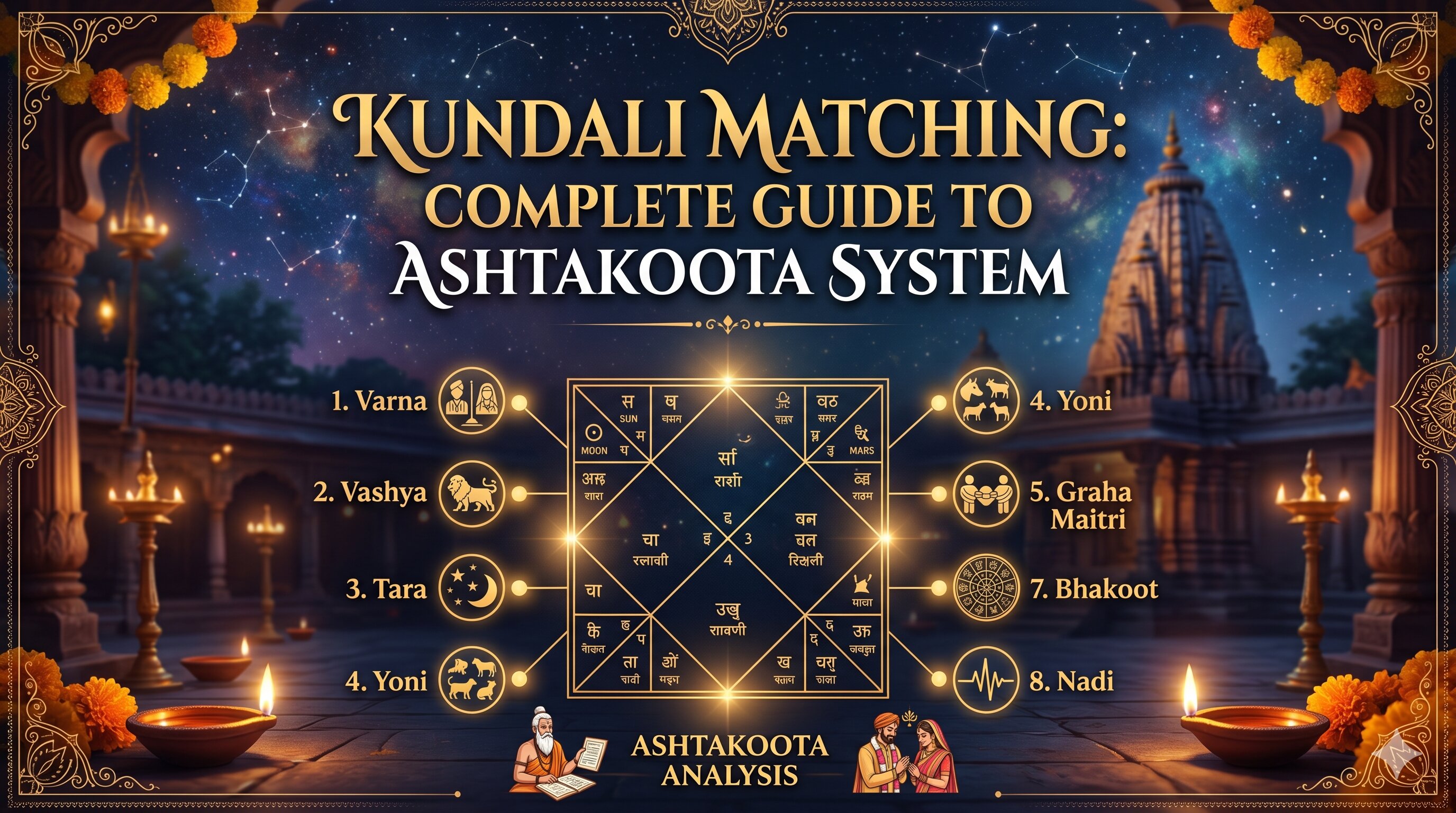
The Ashtakoota system evaluates eight distinct categories - Kootas - each measuring a different dimension of compatibility. Every Koota has a fixed maximum score. The total across all eight Kootas is 36 Gunas. The higher the combined score, the more compatible the couple is considered.
| No. | Koota | Max Points | What It Measures |
|---|---|---|---|
| 1 | Varna | 1 | Spiritual compatibility & ego level |
| 2 | Vashya | 2 | Mutual attraction & power balance |
| 3 | Tara | 3 | Health, longevity & wellbeing |
| 4 | Yoni | 4 | Sexual compatibility & intimacy |
| 5 | Graha Maitri | 5 | Mental compatibility & friendship |
| 6 | Gana | 6 | Temperament & behavioural nature |
| 7 | Bhakoot | 7 | Emotional & financial harmony |
| 8 | Nadi | 8 | Genetic & health compatibility |
| TOTAL | 36 | Overall compatibility score |
Note: The scoring is Moon-sign and Nakshatra based - all eight Kootas are calculated from the birth Nakshatra and Moon sign of each individual, not from the Sun sign or Ascendant (Lagna). This is why accurate birth time is important: without it, the Moon's Nakshatra and sign may be incorrectly computed, corrupting the entire matching result.
What it measures: Spiritual compatibility, ego levels, and the nature of each person's inner temperament. The word Varna in this context does not strictly refer to social caste but to the quality of spiritual development indicated by the Moon sign.
How it is scored: Each of the 12 Moon signs is assigned one of four Varnas: Brahmin (Pisces, Cancer, Scorpio), Kshatriya (Aries, Leo, Sagittarius), Vaishya (Taurus, Virgo, Capricorn), and Shudra (Gemini, Libra, Aquarius). The groom's Varna should be equal to or higher than the bride's Varna for full score. If the groom's Varna is lower than the bride's, 0 points are awarded.
Why it matters: This Koota reflects whether the two individuals operate from a compatible spiritual and motivational wavelength. Mismatched ego levels can create subtle but persistent friction in daily household life, even when other indicators are strong. Maximum score: 1 point.
What it measures: Mutual attraction, the degree of natural influence each partner has over the other, and the power balance in the relationship.
How it is scored: Moon signs are grouped into five Vashya categories - Chatushpad (quadruped), Manav/Nara (human), Jalchar (water-dwelling), Vanchar (wild animal), and Keet (insect/reptile). When the groom's sign is Vashya to the bride's, 2 points are awarded; when the bride's sign falls in Vashya to the groom's, 1 point; when they are mutually incompatible, 0.
Why it matters: Vashya speaks to natural rapport and influence. A couple with strong Vashya tends to feel naturally drawn to support each other. Maximum score: 2 points.
What it measures: Health, longevity, and overall wellbeing of the couple in the relationship.
How it is scored: The number of Nakshatras counted from the bride's birth Nakshatra to the groom's is divided by 9. If the remainder is 1, 3, 5, or 7 (odd and auspicious), the Tara is considered favorable. The same calculation is performed from the groom's Nakshatra to the bride's. If both directions are favorable, 3 points are awarded; one direction favorable yields 1.5 points; neither yields 0.
Why it matters: Tara Dosha, when present, is associated with persistent health challenges and difficulty sustaining the relationship's vitality over time. Maximum score: 3 points.
What it measures: Sexual compatibility, physical intimacy, and the sensuous harmony between partners.
How it is scored: Each of the 27 Nakshatras is associated with one of 14 animal symbols (Ashwa/horse, Gaja/elephant, Mesh/sheep, etc.). The compatibility between the animals assigned to each partner's birth Nakshatra determines the score: same animal = 4 points; friendly animals = 3 points; neutral animals = 2 points; enemy animals = 1 point; bitter enemy animals = 0.
Why it matters: Physical and sexual compatibility is a significant factor in the longevity and happiness of a marriage. A very low Yoni score (0–1) can create persistent disharmony in the intimate sphere of marriage even when intellectual and emotional connection is strong. Maximum score: 4 points.
What it measures: Mental compatibility, psychological affinity, and the natural friendship between the minds of both partners. This Koota also directly addresses the underlying issue in Bhakoot Dosha, making it doubly significant.
How it is scored: The planetary lords (Rasyadhipati) of each partner's Moon sign are identified. If both lords are the same planet (both have the same Moon sign), 5 points. If the lords are mutual friends, 4 points; one friendly and one neutral, 3 points; both neutral, 2 points; one friendly and one enemy, 1 point; mutual enemies, 0 points.
Why it matters: This Koota is the closest indicator of how well two minds will understand each other day-to-day. High Graha Maitri also has the classical power to neutralise Bhakoot Dosha when present. Maximum score: 5 points.
What it measures: Temperament and fundamental behavioural nature. The three Ganas - Deva (divine), Manav (human), and Rakshasa (demonic) - represent three distinct modes of operating in the world.
How it is scored: Each of the 27 Nakshatras belongs to one of three Ganas. Deva represents a sattvic, gentle nature; Manav a rajasic, worldly temperament; Rakshasa a tamasic, intense, and often non-conformist personality. Same Gana = 6 points; Deva–Manav or Manav–Deva = 5 points; Manav–Rakshasa or Rakshasa–Manav = 0 points (Gana Dosha); Deva–Rakshasa or Rakshasa–Deva = 0 points (also Gana Dosha, considered severe).
Why it matters: Gana compatibility reflects whether the couple's fundamental approaches to life, conflict resolution, and values will harmonise or chronically clash. A Deva–Rakshasa Gana mismatch is considered one of the three major Doshas in Ashtakoota, requiring careful classical cancellation assessment. Maximum score: 6 points.
What it measures: Emotional harmony, financial stability, and the overall health and prosperity of the couple and their family. Bhakoot is derived from Bhava Koot - the compatibility based on the relative position of the two Moon signs.
How it is scored: The groom's Moon sign is counted from the bride's Moon sign and vice versa. If these numbers form a ratio of 6/8 (Shadashtak), 9/5 (Navpancham), or 2/12 (Dwitiya Dwadash), Bhakoot Dosha is present and 0 points are awarded. All other combinations receive 7 points.
Three Bhakoot Dosha Combinations 6/8 - Shadashtak (Mrityu Shadashtak): Considered the most severe; associated with death-like suffering, severe health challenges, and marital discord. 9/5 - Navpancham: Can indicate challenges with progeny and children; may also cause financial instability. 2/12 - Dwitiya Dwadash: Associated with financial losses and chronic expenditure that strains the relationship. |
Why it matters: With 7 out of 36 total points, Bhakoot is the second most important Koota after Nadi. Bhakoot Dosha is one of the three major Doshas in Ashtakoota. A score of 0 here, especially combined with Nadi Dosha, significantly reduces total compatibility and flags a match that requires careful classical analysis before proceeding. Maximum score: 7 points.
What it measures: Genetic and biological compatibility, health of the couple, and - critically - the health and vitality of future offspring. Nadi is considered the supreme Koota in the Ashtakoota system because it relates to the most fundamental level of biological and karmic compatibility.
How it is scored: Each of the 27 Nakshatras is associated with one of three Nadis: Aadi (Vata), Madhya (Pitta), and Antya (Kapha). If both partners share the same Nadi, Nadi Dosha is present and 0 points are awarded. If they have different Nadis, they receive the full 8 points.
Why it matters: Nadi Dosha is considered the most serious Dosha in the Ashtakoota system - a Maha Dosha - because it is associated with health challenges, incompatibility at the deepest biological level, and in classical texts, difficulties with progeny. A score of 0 in Nadi Koota alone can push a couple's total below the critical threshold of 18 points. Maximum score: 8 points.
Three Doshas in the Ashtakoota system are classified as Maha Doshas - major afflictions that require special attention even when the overall Guna score is acceptable:
| Dosha | Koota / Points | Classical Concern |
|---|---|---|
| Nadi Dosha | Nadi / 8 pts | Biological incompatibility, health issues, progeny challenges - the most severe Dosha |
| Bhakoot Dosha | Bhakoot / 7 pts | Emotional discord, financial instability, health concerns for the couple |
| Gana Dosha | Gana / 6 pts | Temperament clash, behavioural incompatibility, chronic conflict |
Critical principle: A Maha Dosha is not automatically a marriage prohibition. Classical texts prescribe detailed cancellation conditions for each Dosha (see Section 5). A qualified Jyotishi must check these conditions before concluding that a Dosha is harmful.
Each of the three major Doshas is cancelled under specific conditions recognised across classical Vedic astrological schools. Cancellation means the Dosha's negative effects are significantly reduced or eliminated.
Classical texts - including the Muhurta Chintamani - also specify that Nadi Dosha is cancelled when certain specific Nakshatras are involved: Rohini, Mrigashira, Ardra, Pushya, Shravana, Revati, Jyeshtha, Krittika, and Uttarabhadrapada.
Once all eight Kootas are scored and summed, the total out of 36 is interpreted as follows:
| Score Range | Classical Interpretation |
|---|---|
| Below 12 | Below average - significant astrological challenges expected; most practitioners advise against proceeding without thorough chart analysis and remedies |
| 12 – 17 | Average compatibility - marriage may proceed with careful remedial measures; individual chart strength must compensate for lower Guna score |
| 18 – 24 | Acceptable compatibility - classical minimum (18) is met; considered the threshold for recommending marriage; Doshas should still be individually assessed |
| 24 – 32 | Good compatibility - above average; couple is well-matched across most dimensions; minor Doshas are unlikely to significantly affect outcome |
| 32 – 36 | Exceptional compatibility - rare and highly auspicious; the classical tradition considers this an excellent match |
Critical Note on Score Interpretation The Guna score alone is never sufficient for a complete compatibility assessment. A couple may score 28 out of 36 and still have an uncancelled Nadi Dosha - which carries more weight than the high total. Conversely, a couple scoring 17 Gunas may have all three major Doshas cancelled and strong individual chart strength, making the match entirely workable. Always assess Doshas separately from the total score, and always evaluate the 7th house, Navamsha chart, Dasha periods, and Mangal Dosha in the full horoscope matching process. |
Are you currently struggling with life phases like Astrology? Discover your precise chart insights now.
Ashtakoota Milan is the foundation of Kundali Matching, but a thorough Jyotishi examines several additional factors before completing a compatibility assessment:
Kundali Milan kaise karein / Shadi ke liye kundali kaise milaye: This is one of the most common questions asked about Vedic astrology. Here is the classical answer:
The most accurate method requires the full birth details of both individuals: date of birth, exact time of birth, and place of birth. From these, the Janma Kundali is prepared, identifying the Moon sign (Rashi) and birth Nakshatra - the two core inputs for Ashtakoota calculation. This is the only method that gives fully accurate results for all eight Kootas, including Tara, Yoni, Gana, and Nadi.
You can generate your Kundali and perform Ashtakoota matching at: nakshatraai.ai/add-kundli">nakshatraai.ai/add-kundli
Name-based matching (नाम से शादी के गुण कैसे मिलाएं?) uses the first letter of each individual's name to approximate their Janma Nakshatra, following the traditional Nakshatra-to-syllable table. This method is used when the birth time is unavailable. However, it is significantly less accurate than date-of-birth-based matching because:
Recommendation: Use name-based matching only as a rough preliminary check. For any serious marriage decision, obtain accurate birth details and compute the full Kundali. Consult an expert Jyotishi at nakshatraai.ai/astrologer">nakshatraai.ai/astrologer for a personalised assessment.
When Guna score is below 18 or when a Maha Dosha is present and not cancelled, the classical tradition prescribes specific remedies. These do not 'override' the birth chart; they reduce the intensity of the indicated challenges and strengthen the relevant planetary influences.
Primary Remedial Mantras For Nadi Dosha - Maha Mrityunjaya Mantra: Recite 108 times daily, especially on Mondays ॐ त्र्यम्बकं यजामहे सुगन्धिं पुष्टिवर्धनम् । Om Tryambakam Yajamahe Sugandhim Pushti-vardhanam For Bhakoot Dosha - Chandra (Moon) Mantra: Om Shram Shreem Shraum Sah Chandramase Namah - 108 times on Mondays For Gana Dosha - Ganapati Mantra: Om Gam Ganapataye Namah - 108 times daily for 40 consecutive days |
| Remedy Type | Key Practices |
|---|---|
| Mantra | Maha Mrityunjaya Mantra (108x daily); Chandra Mantra on Mondays; Ganapati Mantra 40 days |
| Puja | Nadi Dosha Nivaran Puja; Vishnu-Lakshmi Puja; Rudrabhishek (11 consecutive Mondays) |
| Charity (Daan) | White items on Purnima; black sesame on Saturdays; feeding Brahmins |
| Fasting | Monday vrat (for Moon); Ekadashi fast (for overall planetary harmony) |
| Gemstone | Pearl for Moon (Nadi/Bhakoot); Blue Sapphire for Saturn-ruled signs - only after Jyotishi consultation |
| Pilgrimage | Kashi Vishwanath; Kanya Kumari; Tirupati Balaji - for divine blessing before marriage |
18 is the classical minimum threshold - marriage can proceed, but the astrologer must check all three Maha Doshas (Nadi, Bhakoot, Gana) separately. A score of 18 with an uncancelled Nadi Dosha is considered more problematic than a score of 16 with all Doshas cancelled and strong individual charts. The number is a guide, not a verdict.
From a traditional Vedic perspective, Kundali Matching identifies the astrological strengths and risks in a proposed union. Many couples proceed without matching and have successful marriages; many with perfect scores face difficulties. The system is a planning tool for awareness, not a mechanical determinant of fate. Contemporary Jyotish holds that individual free will, effort, and spiritual practice play a substantial role in any marriage's outcome.
Nadi Koota is the most important, carrying 8 out of 36 points and representing the highest-weighted Dosha in the system. Bhakoot (7 points) is the second most important. Together, Nadi and Bhakoot account for 15 of 36 total Gunas - nearly 42% of the entire score - reflecting the classical tradition's emphasis on biological compatibility and emotional-financial harmony as the foundations of a successful marriage.
Kundali Matching (Ashtakoota) is a comparative system - it evaluates two people's charts against each other for marriage compatibility. Kaal Sarp Dosh is an individual chart configuration present in a single person's birth chart when all seven planets are hemmed between Rahu and Ketu. Both factors are relevant to marriage: a prospective partner with Kaal Sarp Dosh should have that dosh assessed individually alongside the Ashtakoota analysis. See our complete guide to Kaal Sarp Dosh [INTERNAL LINK: /kaal-sarp-dosh-complete-guide] for a full explanation.
If both partners have the same birth Nakshatra, it creates Nadi Dosha (since they will likely share the same Nadi), but - crucially - it also triggers multiple Dosha cancellation conditions simultaneously. Same Nakshatra with the same Rashi results in Nadi Dosha; same Nakshatra with different Rashis cancels the Dosha. The individual Charans (quarters of the Nakshatra) must also be compared. A qualified Jyotishi is needed to evaluate this case properly.
The Ashtakoota system is among Vedic astrology's most elegant frameworks - a structured, systematic approach to understanding how two individuals' Moon energies will interact across the full spectrum of married life: from spiritual alignment and physical intimacy to financial stability and the health of their children.
Approached correctly, Kundali Matching is not a gate that opens or closes the possibility of marriage, but a lantern that illuminates the terrain ahead. It shows where the path will be smooth and where rough ground lies - and, through the tradition's extensive Dosha cancellation system and remedial framework, it offers the wisdom to prepare for the challenges and the confidence to celebrate the gifts.
The Moon, the planet at the heart of this entire system, represents the mind, emotions, and the soul's deepest needs. Kundali Matching, at its root, is the question: will these two minds find peace and growth in each other's presence? The classical system - composed over centuries by scholars from Parashara to Rama Daivagnya - is the tradition's most refined attempt to answer that profound question before the wedding fires are lit.
Connect with a Jyotishi on Nakshatraai.ai Generate your Kundali and perform Ashtakoota matching: nakshatraai.ai/add-kundli">nakshatraai.ai/add-kundli Speak with an expert Jyotishi for a personalised Kundali Matching assessment and Dosha remedy plan: nakshatraai.ai/astrologer">nakshatraai.ai/astrologer |
Disclaimer: This article is for educational and informational purposes only. Astrological guidance does not substitute for consultation with a qualified Jyotishi or Hindu priest who can evaluate your specific birth chart and circumstances. Ritual procedures should ideally be performed under the guidance of a qualified pandit.