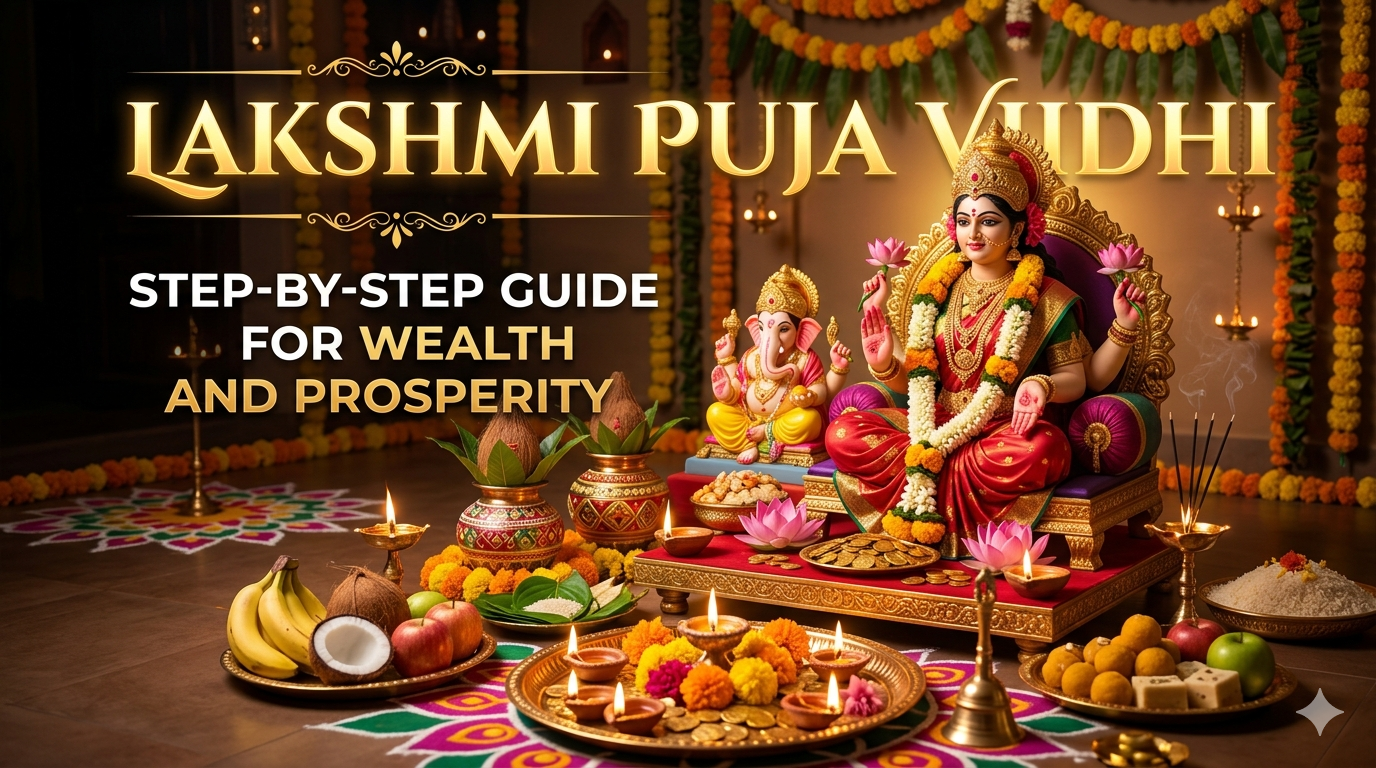
Quick Answer: How Do I Perform Lakshmi Puja at Home for Wealth? To perform Lakshmi Puja at home, clean the puja space and lay a red or white cloth on a raised platform (chowki). Place idols or images of Goddess Lakshmi and Lord Ganesha, then establish a Kalash (sacred pot). Begin with Ganesh puja to remove obstacles, then invoke Maa Lakshmi with the Avahana mantra. Offer Panchamrit (milk, curd, honey, ghee, sugar), lotus flowers, kheer, and golden marigolds. Light a ghee diya, recite the primary mantra Om Shreem Hreem Shreem Kamale Kamalalaye Praseed Praseed 108 times, and close with the Lakshmi Aarti. For Diwali, this puja is performed during Pradosh Kaal, the auspicious window beginning after sunset on Amavasya. For regular worship, Friday evenings are the most sacred weekly muhurta. लक्ष्मी पूजन की पूजा कैसे की जाती है? Lakshmi Puja ke liye puja sthan ko saaf karein aur chowki par lal ya safed kapda bichain. Lakshmi ji aur Ganesh ji ki murti ya tasveer rakhein. Kalash ki sthapana karein, Ganesh puja se shuruaat karein, phir Maa Lakshmi ka aavahan mantron ke saath karein. Panchamrit, kamal ke phool, kheer, aur sone ke rang ke phool arpit karein. Ghee ka diya jalayein, mantra 'Om Shreem Hreem Shreem Kamale Kamalalaye Praseed Praseed' 108 baar japein, aur Lakshmi Aarti ke saath samaapt karein. Diwali par yah puja Pradosh Kaal mein ki jaati hai, jo Amavasya ki shaam surya ast ke baad shuru hoti hai. Har hafte Shukrawar ki shaam ko bhi Lakshmi ji ki puja ka vishesh mahatva hai. |
Goddess Lakshmi - the divine consort of Lord Vishnu and the supreme bestower of wealth, fortune, beauty, and grace - is among the most beloved deities in the Hindu tradition. Her name derives from the Sanskrit root laksh, meaning 'to perceive, understand, and know,' as well as 'goal' and 'aim' - revealing that her gift is not merely material abundance, but the alignment of a devotee's life with their highest purpose. Lakshmi Puja Vidhi, when performed with knowledge, sincerity, and correct procedure, is one of the most powerful rituals available to a householder seeking prosperity, domestic harmony, and spiritual elevation.
This guide covers everything you need to know: the scriptural basis of Lakshmi worship, the complete samagri (material) list, the full step-by-step vidhi for both Diwali Lakshmi Puja and weekly Friday Lakshmi Puja, the primary mantras, and answers to the most frequently asked questions.
Goddess Lakshmi is one of the principal deities of Hinduism, forming part of the divine feminine trinity (Tridevi) alongside Saraswati and Parvati. She emerged from the churning of the cosmic ocean - the Samudra Manthan - seated on a fully bloomed lotus, adorned with gold ornaments, and holding lotus flowers in her hands. Her arrival during the Samudra Manthan is one of the most celebrated episodes in the Vishnu Purana and the Srimad Bhagavatam, establishing her as the ultimate embodiment of Shri - the sacred quality of auspiciousness, beauty, and abundance that sustains all creation.
In classical Vedic texts, Lakshmi is praised in the Sri Suktam - a sixteen-verse hymn from the Rigveda's Khilani (supplementary) section - which remains the foundational liturgical text for her worship to this day. She is described therein as Hiranyavarna (golden-hued), Chandraam (radiant as the moon), and Jatavedo (knower of all births) - qualities that her puja rituals seek to invoke.
Classical Note: The Sri Suktam is the oldest scriptural source for Lakshmi worship and is recited during formal pujas. The Lakshmi Tantra, a Pancharatra Agama text, provides detailed vidhi for her propitiation. Contemporary practice draws from both Vedic and Tantric streams.
Goddess Lakshmi manifests in eight primary forms collectively known as Ashtalakshmi, each bestowing a distinct dimension of prosperity:
| No. | Form | Blessings Bestowed |
| 1 | Adi Lakshmi | Primordial form; spiritual wealth, liberation (moksha), and inner peace |
| 2 | Dhana Lakshmi | Material wealth, money, gold, and prosperity; favours those who work with determination |
| 3 | Dhanya Lakshmi | Agricultural and food abundance; nourishment, gratitude, and nature's bounty |
| 4 | Gaja Lakshmi | Royal wealth, power, and animal wealth; restores lost fortune (as with Indra in the Samudra Manthan) |
| 5 | Santana Lakshmi | Wealth of progeny; blessings for children, family, and lineage |
| 6 | Veera/Dhairya Lakshmi | Courage, bravery, and inner strength to overcome adversity |
| 7 | Vijaya Lakshmi | Victory over obstacles, enemies (inner and outer), and life's challenges |
| 8 | Vidya Lakshmi | Knowledge, arts, sciences, and intellectual growth; depicted in white like Saraswati |
The following list covers the complete puja samagri for both the elaborate Diwali Lakshmi Puja and the simpler weekly Friday puja. Items marked with an asterisk (*) are essential for Diwali; all others are recommended for both occasions.
| Category | Items |
| Deity Images / Idols* | New murti or photograph of Goddess Lakshmi and Lord Ganesha; Lakshmi Yantra (for daily use) |
| Altar Setup* | Wooden chowki (raised platform); red or white cloth (laal/safed kapda); rangoli powder for floor decoration |
| Kalash (Sacred Pot)* | Copper or silver kalash; Gangajal or clean water; mango leaves (5 or 7); coconut (saphal nariyal); mauli (red thread); unbroken rice grains (akshat) |
| Flowers* | Lotus flowers (kamal - most sacred to Lakshmi); golden/yellow marigolds; white mogra (jasmine); rose petals; lotus seeds (kamal gatta) |
| Panchamrit* | Milk (dudh), curd (dahi), honey (shahad), ghee (clarified butter), sugar (mishri) - these five are combined for the ritual bath (abhishek) of the deity |
| Naivedya (Offerings)* | Kheer (rice pudding - Lakshmi's favourite), batasha (sugar drops), panchmeva (five dry fruits), seasonal fruits, coconut |
| Puja Items* | Roli (kumkum), haldi (turmeric), akshat (unbroken rice), chandan (sandalwood paste), sindoor, abir-gulal; incense sticks (agarbatti); camphor (kapoor) |
| Lamps* | Ghee diya (minimum one, ideally five around the deity); cotton wicks; sesame oil lamp for Pradosh Kaal observance |
| Wealth Symbols* | Silver or gold coin; copper coins (kaudi); account books (bahi-khata) for Diwali business puja; ornaments and jewellery |
| Additional (Diwali) | Seven types of grains (sapta dhanya): wheat, rice, chickpea, barley, sesame, moong dal, kangani; silver Lakshmi-Ganesha idol (new, for Diwali); diyas for deep-malika (row of lamps) |
| Optional / Tantric | Lakshmi Yantra (Sri Yantra); Shri Suktam text for recitation; Lakshmi Chalisa booklet |
Note: If any samagri item is unavailable, akshat (unbroken rice grains) may be substituted as a classical remedy. The intent (sankalp) and devotion of the worshipper carry more weight than the material perfection of the offerings.
Diwali Lakshmi Puja is performed on the Amavasya Tithi (new moon day) of the Kartik month, which falls in October or November. The correct puja window is Pradosh Kaal - the period beginning after sunset on this Amavasya night, lasting approximately 1 hour 45 minutes to 2 hours 24 minutes depending on the year and location. Within Pradosh Kaal, the Vrishabha Lagna (Taurus ascendant) window is considered especially auspicious for householders because Taurus is a sthira (fixed) lagna, symbolising stable, enduring wealth.
A second window called Nisheeth Kaal (around midnight) also exists but is traditionally recommended only for advanced practitioners and Tantric rituals, not for household Lakshmi Puja. Always check the current year's panchang or consult a Jyotishi for exact muhurta times for your city.
| Step | Name | Action |
| 1 | Shuddhi (Purification) | Bathe early on Diwali morning. Clean the entire home, especially the puja room. Sprinkle Gangajal throughout the house to purify the space energetically. |
| 2 | Chowki Sthapana (Altar Setup) | Place a wooden chowki. Cover it with a clean red cloth. Draw a swastika and ashtadal (eight-petalled lotus) on the cloth using roli. Sprinkle akshat on the chowki. |
| 3 | Deity Placement | Place the new Lakshmi-Ganesha murti (idol) on the chowki, with Ganesha to Lakshmi's right. Place a Lakshmi Yantra behind or beside the murti. Arrange lotus flowers and golden marigolds at the deity's feet. |
| 4 | Kalash Sthapana | Fill the copper kalash with water and a small amount of Gangajal. Add a pinch of roli, akshat grains, and a coin inside. Place five mango leaves around the rim. Set a coconut on top. Tie mauli (red thread) around the neck. Invoke the sacred rivers (Ganga, Yamuna, Godavari, Saraswati, Narmada, Sindhu, Kaveri) into the kalash. |
| 5 | Sankalpa (Resolution) | With water in the right palm, take the sankalpa - state your full name, gotra, and the purpose of the puja. This formal declaration establishes your intent before the deity. |
| 6 | Ganapati Puja | Always worship Lord Ganesha first. Offer roli, akshat, flowers, and a modak (sweet). Chant Om Gan Ganapataye Namah 21 times. Seek his blessing to remove all obstacles from the puja. |
| 7 | Navagraha Puja | Offer akshat, flowers, and incense to the Navagrahas (nine planetary deities). In Diwali puja tradition, this step ensures all planetary influences are harmonised before Lakshmi is invoked. |
| 8 | Lakshmi Avahana (Invocation) | Show the Avahana mudra (both palms joined, thumbs folded inward). Chant: 'Aagachchha Devi Deveshi! Tejomayi Maha-Lakshmi! Kriyamanam Maya Pujam Grihana Suravandite!' - inviting the Goddess to arrive and accept the worship. |
| 9 | Panchamrit Abhishek | Bathe the murti with Panchamrit - first milk, then curd, honey, ghee, and finally sugar-water - each poured gently while chanting Om Shreem Mahalakshmyai Namah. After the Panchamrit bath, offer a final bath of clean water (shuddhodaka). |
| 10 | Vastra and Shringar | Offer a new pink or white cloth (or a symbolic piece of fabric). Apply chandan, roli tilak, and sindoor to the Goddess. Offer ornaments, gold or silver, and flowers - especially lotus. |
| 11 | Dhoop, Diya, Naivedya | Light the agarbatti and show it before the deity (3 circles). Light the ghee diya. Offer kheer, batasha, panchmeva, coconut, and fruits. Place kamal gatta (lotus seeds) at Lakshmi's feet. Offer the seven grains (sapta dhanya). The ghee diya should burn through the entire night. |
| 12 | Mantra Japa | Recite the primary mantra 108 times using a rudraksha or crystal mala:Om Shreem Hreem Shreem Kamale Kamalalaye Praseed PraseedOm Shreem Hreem Shreem Mahalakshmyai NamahAlso chant Sri Suktam (16 verses) if known. |
| 13 | Bahi-Khata Puja (Diwali specific) | Place account books, currency notes, jewellery, and business instruments before Lakshmi. Apply roli and akshat to them. Offer Saraswati Puja on the bahi-khata (account books) and Kuber Puja on the tijori (safe). Chant Om Yakshaya Kuberaya Namah 21 times. |
| 14 | Lakshmi Aarti | Perform the Lakshmi Aarti using a ghee diya, rotating it in clockwise circles before the deity. Sing Om Jai Lakshmi Mata - the most beloved and universally chanted Lakshmi aarti. All family members should participate, folding their hands in gratitude. |
| 15 | Pradakshina and Visarjan | Perform three clockwise circumambulations (pradakshina) around the chowki. Seek forgiveness for any errors in the puja. Offer final flowers and bow deeply. The diya must continue burning; do not extinguish it. |
Friday (Shukrawar) is governed by Shukra (Venus) - the planet of wealth, beauty, love, and artistic grace in Vedic astrology. It is the most auspicious day of the week for Lakshmi worship, and the Vaibhav Lakshmi Vrat - a Friday fast performed for 11 or 21 consecutive Fridays - is one of the most widely observed devotional observances in Indian households. Regular Friday Lakshmi puja, even without a full-day fast, creates a consistent energetic channel for Lakshmi's grace into the home.
Two windows are most effective for Friday Lakshmi mantra japa and puja: Brahma Muhurta (approximately 4–6 AM) for maximum spiritual potency; and Pradosh Kaal (around sunset, approximately 6–7 PM) for domestic prosperity. For most householders, the evening Pradosh Kaal is the practical and powerful choice.
| Step | Name | Action |
| 1 | Snana and Shuddhi | Take a bath on Friday morning. Wear clean, preferably white, pink, or yellow clothes. Clean the puja space and wipe the Lakshmi idol or photo with a clean cloth. |
| 2 | Altar Setup | Place Goddess Lakshmi's idol or portrait at the centre of a clean altar, facing East or North-East. Place a Kalash filled with water and mango leaves beside it. Lay a red or pink cloth on the chowki. |
| 3 | Ganesh Puja | Begin by invoking Lord Ganesha with flowers, roli, akshat, and a short prayer. Chant Om Gan Ganapataye Namah 11 times. |
| 4 | Flower Offerings | Offer fresh lotus flowers (most sacred), white mogra (jasmine), or rose petals to the Goddess. Note: Do not offer Tulsi leaves to Goddess Lakshmi on Fridays - Tulsi is primarily sacred to Lord Vishnu. |
| 5 | Tilak and Offerings | Apply roli and chandan tilak to Lakshmi ji. Offer haldi-kumkum, akshat, and a few coins at her feet. Light agarbatti (incense) and show it before the deity. |
| 6 | Naivedya | Offer kheer (rice pudding), panchmeva, coconut, or seasonal fruits. A small bowl of mishri (rock sugar) and batasha is also traditional. Offer with sincerity, placing items before the murti. |
| 7 | Diya and Mantra Japa | At sunset (Pradosh Kaal), light a ghee diya at the main entrance of the home to invite Lakshmi's presence. Then chant the primary mantra 108 times using a rudraksha or crystal mala, facing East or North-East. |
| 8 | Sri Suktam / Lakshmi Stotra | If time permits, recite the Sri Suktam (16 verses) or the Kanakadharastava of Adi Shankaracharya. Even one sincere reading of the Lakshmi Ashtottara (108 names) carries powerful blessings. |
| 9 | Aarti and Closure | Perform Lakshmi Aarti with a ghee lamp. Distribute prasad to all family members. Avoid purchasing or lending money on Fridays, and maintain a peaceful, generous attitude throughout the day. |
The Vaibhav Lakshmi Vrat is observed by fasting on consecutive Fridays - either 11 or 21 as per one's vow. On each Friday, the devotee fasts until after the evening puja, then breaks the fast with prasad. After completing the vow, an Udyapan (concluding ceremony) is performed by offering the Vaibhav Lakshmi Vrat Katha book to other women in the household, symbolically spreading the goddess's grace.
Primary Lakshmi Puja Mantra
ॐ श्रीं ह्रीं श्रीं कमले कमलालये प्रसीद प्रसीद Om Shreem Hreem Shreem Kamale Kamalalaye Praseed Praseed Recitation: 108 times daily, ideally at Pradosh Kaal (evening) on Fridays, or during Diwali Lakshmi Puja. Meaning: O Goddess who dwells in the lotus (Kamala), who is the abode of the lotus, please be gracious, please be gracious.
Additional Mantras: • Om Shreem Mahalakshmyai Namah - Maha Lakshmi beej mantra; 108 times daily • Om Hreem Shreem Lakshmibhyo Namah - All-forms Lakshmi mantra; 108 times on Diwali • Om Shring Shriye Namah - Simple daily invocation; can be chanted even without formal puja • Sri Suktam (16 verses from the Rigveda Khilani) - The foundational Vedic hymn for Lakshmi; recite after the main mantra japa • Lakshmi Gayatri: Om Mahalakshmyai Vidmahe Vishnu Priyaayai Dheemahi Tanno Lakshmi Prachodayat - for knowledge and spiritual prosperity |
Are you currently struggling with life phases like Spirituality? Discover your precise chart insights now.
The Lakshmi Puja Vidhi, when performed consistently and correctly, is associated with a range of material and spiritual benefits that classical texts and generations of devotees attest to. These benefits are not instantaneous rewards but the cumulative result of aligning one's life with the vibrational quality of Shri - the sacred abundance principle that Lakshmi embodies.
| Domain | Specific Benefits |
| Financial | Increase in income streams; removal of debt burdens; protection of accumulated wealth; success in business and career; recovery of lost assets |
| Domestic | Harmony and happiness within the household; resolution of family conflicts; abundance of food, health, and comfort |
| Professional | Recognition in one's field; success in negotiations and partnerships; blessing for tradespeople, merchants, and entrepreneurs |
| Astrological | Propitiation of Shukra (Venus) through Friday puja; mitigation of Shukra Dosha in the birth chart; strengthening of the 2nd house (wealth) and 11th house (gains) |
| Spiritual | Cultivation of gratitude, generosity, and dharmic attitude toward money; gradual alignment with Adi Lakshmi's dimension of moksha-oriented prosperity |
No. While Diwali Lakshmi Puja is the most elaborate and auspicious annual observance, Friday (Shukrawar) is the ideal day for weekly worship. Additionally, Purnima (full moon), Amavasya (new moon), and Akshaya Tritiya are considered highly favourable for Lakshmi puja throughout the year. The most sustained benefits come from consistent weekly Friday puja rather than a single annual observance.
The lotus (kamal) is Goddess Lakshmi's most sacred flower - she is always depicted seated on a lotus, and her very iconography is inseparable from it. If fresh lotus is unavailable, white mogra (jasmine), golden marigolds, or rose petals are widely accepted alternatives. One important traditional guideline: do not offer Tulsi (holy basil) leaves to Goddess Lakshmi alone on Shukrawar, as Tulsi is primarily sacred to Lord Vishnu. Tulsi is appropriate when worshipping Lakshmi-Narayan together.
Yes. The Lakshmi Yantra (also called Sri Yantra) is the geometric visual form of Maa Lakshmi's energy and is highly recommended for home puja, particularly for businesspeople and householders seeking sustained prosperity. It is typically established on a copper plate and worshipped daily with roli, akshat, flowers, and mantra japa. The Sri Yantra is the most complex and powerful of all yantras in the Tantric tradition, representing the union of Shiva and Shakti through nine interlocking triangles. For more on Lakshmi Yantra puja and its specific vidhi, see our dedicated Lakshmi Yantra guide.
Diwali Lakshmi Puja is the major annual ritual performed on the Amavasya of Kartik month - it is a single grand puja with elaborate vidhi, Shodashopachara (16-step) worship, and the Bahi-Khata (account book) puja. Vaibhav Lakshmi Vrat is a Friday-based weekly observance maintained for 11 or 21 consecutive Fridays. The Vrat involves fasting, evening puja, and the reading of the Vaibhav Lakshmi Katha. Both practices are complementary and independent of each other.
Traditional guidelines advise: do not argue or speak harshly within the home; do not consume non-vegetarian food; do not lend or borrow money (this is considered inauspicious for Lakshmi's permanence in the house); do not leave the puja diya unattended or extinguish it - the ghee diya should burn through the night. The home should be brightly lit with diyas at every entrance, as tradition holds that Lakshmi enters homes that are clean and luminous, and passes by those that are dark or untidy.
Puja ke dauran kuch vishesh baaton ka dhyan rakhna chahiye: Ganesha ji ki puja hamesha pehle karein; Tulsi dal akele Lakshmi puja mein na chaden (Vishnu ke saath puja mein theek hai); diya bujhne na dein - raat bhar jalata raha chahiye; puja ke baad prasad zaroor banten; Lakshmi ji ki murti ya Yantra ko hamesha saaf aur susajjit rakhen.
Goddess Lakshmi's grace is not earned through elaborate ritual alone - it is cultivated through the quality of heart that ritual develops. The Lakshmi Puja Vidhi is, at its deepest level, a training in gratitude, generosity, cleanliness, and dharmic relationship with wealth. The lotus on which she stands remains untouched by the water below it - and the tradition's message is that true Lakshmi resides in those who hold prosperity without being corrupted by it.
Perform the Diwali Lakshmi Puja with full family participation during Pradosh Kaal. Establish the weekly Shukrawar puja as a consistent discipline. Recite Om Shreem Hreem Shreem Kamale Kamalalaye Praseed Praseed with attention and sincerity. Offer lotus, kheer, and light - and let the Goddess find in your home the qualities she most loves: purity, luminosity, and an open, grateful heart.
Connect with a Jyotishi on Nakshatraai.ai
Generate your Kundali and check for Shukra Dosha or Lakshmi-related planetary afflictions: nakshatraai.ai/add-kundli Get a personalised Lakshmi Puja muhurta and Yantra recommendation from an expert Jyotishi: nakshatraai.ai/astrologer |
Disclaimer: This article is for educational and informational purposes only. Astrological and puja guidance does not substitute for consultation with a qualified Jyotishi or Hindu priest who can evaluate your specific birth chart and circumstances. Ritual procedures should ideally be performed under the guidance of a qualified pandit.