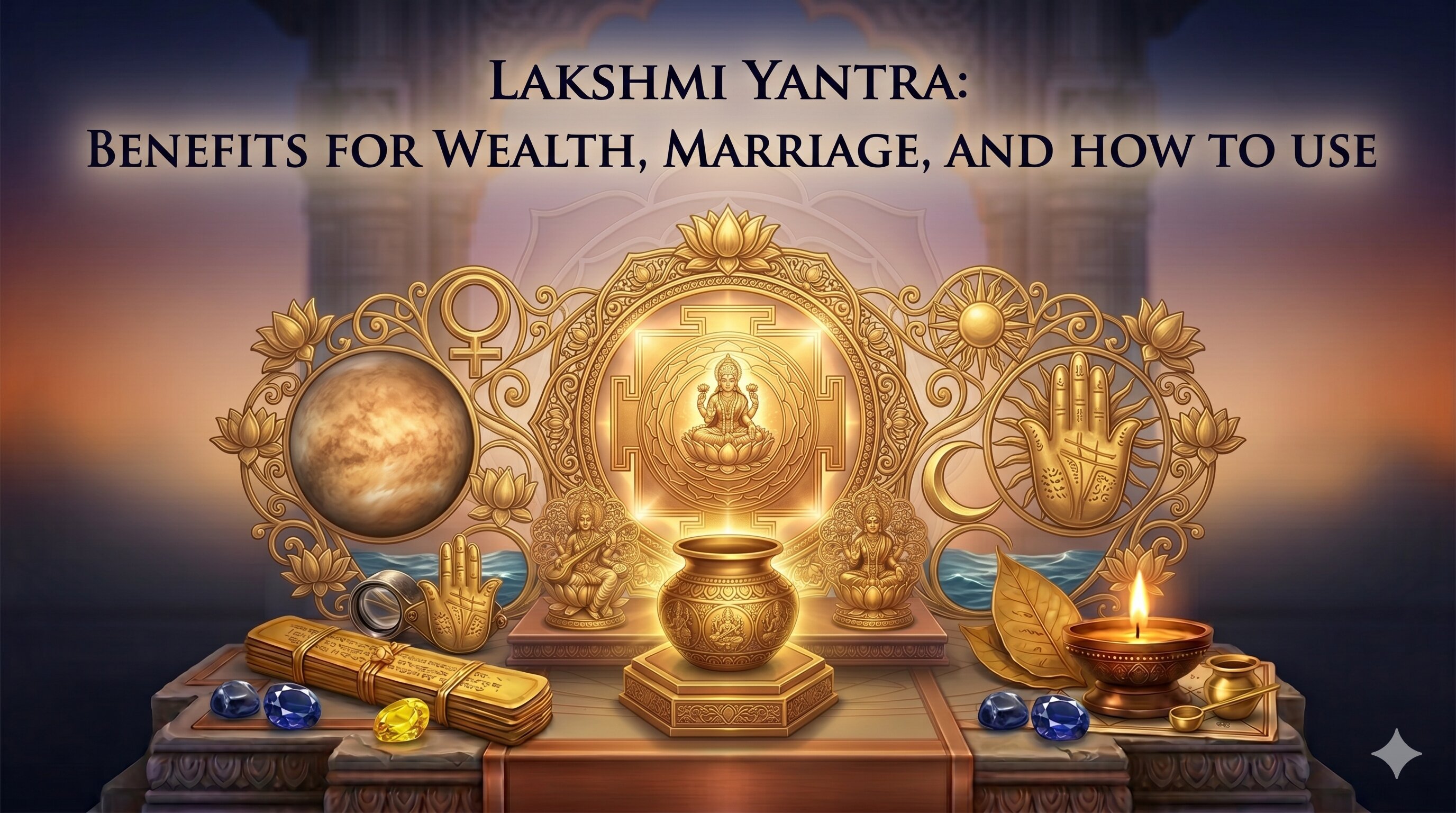
Quick Answer: What Is the Correct Way to Use Lakshmi Yantra for Wealth and Prosperity? The Lakshmi Yantra is a sacred geometric diagram (yantra) specifically consecrated to invoke the blessings of Goddess Lakshmi, the Hindu deity of wealth, fortune, and abundance. To use it correctly: place it in the North direction of your home or puja room (Kuber's direction for wealth), activate it on a Friday with lotus or white flowers and white sweets, and chant the Mahalakshmi Mantra - Om Shreem Hreem Shreem Kamale Kamalalaye Praseed Praseed Om Shreem Hreem Shreem Mahalakshmaye Namah - 108 times daily. The yantra channels the energy of all eight forms of Goddess Lakshmi (Ashta Lakshmi) and is more accessible for daily home worship than the more complex Shree Yantra.
धन और समृद्धि के लिए लक्ष्मी यंत्र का सही उपयोग कैसे करें? लक्ष्मी यंत्र को घर के उत्तर दिशा में या पूजा कक्ष में स्थापित करें - यह कुबेर की दिशा है और धन आकर्षण के लिए सर्वोत्तम मानी जाती है। शुक्रवार को कमल के फूल, सफेद मिठाई और दूध चढ़ाकर यंत्र को सक्रिय करें। प्रतिदिन 108 बार महालक्ष्मी मंत्र - 'ॐ श्रीं ह्रीं श्रीं कमले कमलालये प्रसीद प्रसीद ॐ श्रीं ह्रीं श्रीं महालक्ष्म्यै नमः' - का जाप करें। यह यंत्र अष्ट लक्ष्मी की आठों शक्तियों को आमंत्रित करता है और श्री यंत्र की तुलना में घर में उपयोग के लिए अधिक सुलभ है। |
In the vast treasury of Vedic sacred geometry, the Lakshmi Yantra holds a singular place of honour. It is the yantra of abundance - a precise geometric instrument consecrated to Goddess Lakshmi, the supreme deity of wealth, prosperity, beauty, and grace. Whether you seek relief from financial difficulty, wish to attract steady material growth, invite harmony into marriage and family life, or simply deepen your devotion to Goddess Lakshmi, this yantra provides a time-honoured focal point for that intention.
This guide covers everything you need to know: what the Lakshmi Yantra is, how it differs from the Shree Yantra, the significance of the eight forms of Lakshmi (Ashta Lakshmi) encoded within it, its specific benefits, the correct placement, the Friday activation ritual, and the powerful Mahalakshmi Mantra that animates it.
The word yantra comes from the Sanskrit root yam, meaning 'to sustain or hold,' combined with the suffix tra, indicating an instrument. A yantra is therefore an instrument that holds and concentrates divine energy - a visual mantra, if you will, rendered in sacred geometry rather than in sound.
The Lakshmi Yantra is a specific geometric design consecrated to Goddess Lakshmi. At its centre is a bindu (point) representing the primordial source, surrounded by interlocking triangles, a lotus ring, and a square outer enclosure with gates in the four cardinal directions. Each element carries precise symbolic meaning:
The yantra functions as a receiver and amplifier of the divine energy associated with its presiding deity. When properly energised (prana-pratishtha) and worshipped with the correct mantra and ritual, the Lakshmi Yantra is understood in the Vedic tradition to create a permanent field of Lakshmi's energy in the space where it is installed - continuously attracting abundance, dissolving obstacles to prosperity, and fostering harmony in relationships.
This is one of the most frequently asked questions in Yantra worship, and the confusion is entirely understandable - both yantras are associated with Goddess Lakshmi and the domain of wealth. However, they are distinct instruments with different geometries, presiding energies, and appropriate contexts of use.
| Feature | Lakshmi Yantra | Shree Yantra (Sri Chakra) |
| Presiding Deity | Goddess Lakshmi specifically | Goddess Lalita Tripura Sundari (a supreme form of Shakti); also venerated as Lakshmi's highest form |
| Geometry | Simpler - central bindu, triangles, lotus ring, outer square | Most complex yantra in Vedic tradition - nine interlocking triangles forming 43 smaller triangles (Navayoni Chakra) |
| Primary Domain | Wealth, material prosperity, debt removal, household harmony | Name, fame, worldly desires, spiritual liberation, and the full spectrum of material and spiritual fulfilment |
| Accessibility | More accessible; suitable for daily home worship by all devotees | More complex; traditionally requires initiation (diksha) in Sri Vidya for full ritual use |
| Scale of Benefit | Focused and practical - directly addresses material abundance and Lakshmi's specific blessings | Considered the most powerful yantra in existence; acts on all planes simultaneously |
| Best For | Households seeking consistent wealth flow, debt reduction, marriage harmony | Serious sadhakas, advanced practitioners, and those seeking both material and spiritual fulfilment |
In summary: the Shree Yantra is the most powerful and geometrically complex yantra in the Vedic tradition and operates on the broadest possible scale of manifestation. The Lakshmi Yantra is more focused, more accessible, and directly consecrated to Goddess Lakshmi for the specific purpose of attracting material prosperity, removing financial obstacles, and creating an environment of abundance. For most households, the Lakshmi Yantra is the more practical starting point. For serious spiritual practitioners working within the Sri Vidya tradition, the Shree Yantra is the supreme instrument.
Note: Some practitioners use 'Shree Lakshmi Yantra' as an alternative name for the Lakshmi Yantra itself. This is a common usage and does not refer to the Shree Yantra (Sri Chakra).
One of the most profound teachings encoded within Lakshmi Yantra worship is the understanding that prosperity is not one-dimensional. Goddess Lakshmi manifests in eight distinct forms, collectively known as Ashta Lakshmi, each bestowing a different category of wealth. The Lakshmi Yantra, when worshipped with devotion, is understood to invoke all eight forms simultaneously - making it a complete instrument for holistic abundance.
| No. | Name | Sanskrit | Wealth Bestowed |
| 1 | Adi Lakshmi | आदि लक्ष्मी | Primordial / spiritual wealth; liberation from the cycle of rebirth; eternal abundance and connection to the divine source. |
| 2 | Dhana Lakshmi | धन लक्ष्मी | Material wealth, money, gold, and financial assets. The most commonly invoked form for direct financial improvement. |
| 3 | Dhanya Lakshmi | धान्य लक्ष्मी | Agricultural wealth, food grain, and nourishment. Ensures that the family's physical needs are always met with abundance. |
| 4 | Gaja Lakshmi | गज लक्ष्मी | Power, royalty, and animal wealth. Historically associated with elephants as symbols of royal power; today signifies professional authority and status. |
| 5 | Santana Lakshmi | संतान लक्ष्मी | The wealth of children and progeny. Invoked by couples seeking to start a family and for the health and well-being of children. |
| 6 | Veera Lakshmi | वीर लक्ष्मी | Courage, strength, and inner power. Grants the bravery to face life's challenges without fear or retreat. |
| 7 | Vijaya Lakshmi | विजय लक्ष्मी | Victory in all undertakings - in court, in competition, in career, and in overcoming personal obstacles. |
| 8 | Vidya Lakshmi | विद्या लक्ष्मी | Knowledge, wisdom, and intellectual achievement. Grants success in education, arts, and the acquisition of skills. |
This understanding transforms the Lakshmi Yantra from a simple 'money magnet' into a complete system for attracting all forms of prosperity - material, intellectual, familial, and spiritual. True Lakshmi worship recognises that wealth is wholeness.
The benefits attributed to the Lakshmi Yantra in the Vedic tradition span every dimension of material and domestic life. They are broadly organised below:
A classical note: no yantra operates in isolation from the devotee's effort and ethical conduct. The Lakshmi Yantra intensifies and accelerates prosperity, but it works best in conjunction with honest endeavour, generosity, and a clean, positive environment.
Correct placement is essential for a yantra to function optimally. The Vedic tradition specifies precise directional and spatial guidelines based on Vastu Shastra and the yantra's purpose:
The North direction is ruled by Lord Kuber, the divine treasurer and guardian of wealth in Hindu cosmology. Placing the Lakshmi Yantra in the North direction of your home, office, or business premises directly aligns its energy with Kuber's domain, creating the most powerful configuration for wealth attraction.
A newly acquired yantra must be energised before it is placed permanently. The energisation (prana-pratishtha) is ideally performed by a qualified pandit who consecrates the yantra through Vedic ritual. However, for home activation, the following process is widely practised and considered fully effective when undertaken with sincere devotion:
Step 1 - Purification: Bathe and wear clean, preferably yellow or pink clothing. Clean the designated spot with water and apply a small tilak of turmeric and kumkum. Light a ghee lamp (diya) and incense.
Step 2 - Energise the Yantra: Place the yantra on a clean cloth (preferably yellow or red). Sprinkle it with clean water (or Ganga jal if available), then wipe gently. Apply a small dot of kumkum to the centre of the yantra, representing the bindu and Goddess Lakshmi's presence.
Step 3 - Invoke Ganesha: Offer a brief prayer to Lord Ganesha first - Om Gan Ganapataye Namah (21 times) - to remove all obstacles from the ritual.
Step 4 - Invoke Goddess Lakshmi: Offer fresh lotus flowers, pink or white flowers (jasmine, rose), white sweets (kesar kheer, coconut laddoo, or mishri), and fruits to the yantra. Light a camphor (kapoor) flame and circle it gently in front of the yantra in a clockwise direction (aarti).
Step 5 - Mantra Recitation: Recite the Mahalakshmi Mantra 108 times (see Section 7 below) with full concentration and sincere intention. A rosary (mala) of lotus seeds or sphatik (crystal) is recommended for counting.
Step 6 - Sankalpa (Intention): At the conclusion, hold your hands in prayer and clearly state your intention - what form of prosperity you are seeking, what obstacles you wish dissolved, or what quality of abundance you wish to invite. Speak sincerely from the heart.
Step 7 - Permanent Installation: After the ritual, permanently place the yantra at its chosen location. Ensure it faces the right direction. Offer a fresh flower to it each Friday thereafter.
Primary Lakshmi Yantra Mantra ॐ श्रीं ह्रीं श्रीं कमले कमलालये प्रसीद प्रसीद ॐ श्रीं ह्रीं श्रीं महालक्ष्म्यै नमः Om Shreem Hreem Shreem Kamale Kamalalaye Praseed Praseed Om Shreem Hreem Shreem Mahalakshmaye Namah Recitation: 108 times daily, ideally on Friday mornings or during Pradosh Kaal. |
Understanding the meaning of the mantra deepens its efficacy and transforms mechanical recitation into genuine devotional communication:
| Word | Meaning |
| Om (ॐ) | The primordial sound of the universe - the vibration of all creation. Opens the mantra to cosmic resonance. |
| Shreem (श्रीं) | The most important bija (seed) mantra of Goddess Lakshmi. Shreem vibrates at the frequency of abundance, prosperity, beauty, and auspiciousness. Repeated three times to intensify its potency. |
| Hreem (ह्रीं) | A powerful bija mantra of divine energy, purification, and transformation. It invokes the immediate presence of the Goddess and removes obstacles from the path. |
| Kamale (कमले) | "She who is the lotus" - referring to Lakshmi's association with the lotus flower, symbolising purity, spiritual elevation, and beauty rising from difficulty. |
| Kamalalaye (कमलालये) | "She who resides in the lotus" or "whose abode is the lotus" - an expanded attribute of Goddess Lakshmi as one fully established in purity and abundance. |
| Praseed Praseed (प्रसीद प्रसीद) | "Be gracious, be gracious" - a heartfelt and urgent plea for the Goddess's blessings. The repetition adds both emphasis and fervour to the prayer. |
| Mahalakshmaye (महालक्ष्म्यै) | "To the Great Goddess Lakshmi" - dative form, indicating that the prayer is directed specifically to Mahalakshmi in her supreme form. |
| Namah (नमः) | "I bow, I surrender" - an act of complete reverence and offering of the self to the Goddess. |
| Purpose | Mantra | Count |
| Lakshmi Beej Mantra (simple daily practice) | Om Shreem Mahalakshmiyei Namah | 108 times daily |
| Lakshmi Beej (seed mantra alone) | Om Hreem Shreem Lakshmibhayo Namah | 108 times |
| Lakshmi Gayatri | Om Shree Mahalakshmyai Cha Vidmahe Vishnu Patnyai Cha Dheemahi Tanno Lakshmi Prachodayat | 11 or 108 times |
| Full Mahalakshmi Mantra (complete version) | Om Shreem Hreem Shreem Kamale Kamalalaye Praseed Praseed Om Shreem Hreem Shreem Mahalakshmaye Namah | 108 times daily |
Are you currently struggling with life phases like Astrology? Discover your precise chart insights now.
Installing the yantra is the beginning; consistent daily practice is what sustains and amplifies its benefits over time. The following daily and weekly rhythm is recommended:
The Lakshmi Yantra is available in several materials, each with distinct energetic properties. The choice of material affects the yantra's vibration and resonance with different aspects of Lakshmi's energy:
| Material | Properties | Best For |
| Copper (Tamra) | The most traditional and widely recommended metal. Excellent conductor of energy, durable, and affordable. | General household use; daily worship; business premises |
| Silver (Chandi) | Associated with the Moon, purity, and mental peace. Amplifies emotional harmony alongside material prosperity. | Marriage harmony; family peace; emotional abundance |
| Gold (Suvarna) | Maximum spiritual potency; associated with divine light and the highest form of Lakshmi's grace. | Advanced practitioners; temples; major prosperity rituals |
| Sphatik / Crystal | Clear crystal amplifies clarity of intention and mental focus. Widely recommended for meditation practitioners. | Meditation rooms; spiritual practitioners; mental clarity |
| Bhojpatra (birch bark) | The traditional medium used in classical Tantra. Mantras and yantra geometry inscribed in ink or red paste. | Traditional ritual use; portability; prescribed in classical texts |
Important: Always ensure that any yantra purchased has been properly energised (prana-pratishtha) by a qualified Vedic priest before installation. A yantra that has not been ritually consecrated is simply a geometric design; the consecration ritual installs the divine energy of the deity within it.
Yes. Many households and temples keep both. They are complementary, not contradictory. The Lakshmi Yantra provides focused material abundance, while the Shree Yantra operates on the broadest cosmic scale. Together, they create a powerful field of prosperity on all levels. Ensure both are properly energised and regularly worshipped.
The yantra itself should face East or South (so the devotee faces West or North during worship). The primary placement direction for wealth purposes is the North wall of the home - the direction of Kuber, the divine treasurer.
Classical Vedic tradition advises a brief pause from direct puja contact during menstruation. However, chanting the mantra mentally and maintaining devotion is always permitted. This is a matter of personal observance; many contemporary teachers hold that sincere devotion overrides ritual restriction.
This varies entirely with individual karma, the sincerity of practice, and the nature of what is sought. Some practitioners report shifts in energy and unexpected financial opportunities within weeks. For deeper karmic patterns of financial difficulty, consistent practice over several months is typically required. Patience, consistency, and genuine effort in worldly affairs are essential companions to the yantra.
Yes. The yantra's domain extends to domestic harmony, relationship prosperity, and auspicious circumstances for finding a marriage partner. Santana Lakshmi and Gaja Lakshmi's energies are particularly relevant here. Worship on Fridays with specific intention toward marriage is a time-honoured practice.
The Kuber Yantra is specifically consecrated to Lord Kuber, the divine treasurer, and focuses on the accumulation and protection of wealth - it is particularly recommended for cash boxes and business safes. The Lakshmi Yantra is broader, encompassing all eight dimensions of prosperity and the full grace of Goddess Lakshmi, including relational and spiritual abundance. Both can be used together: Kuber Yantra in the cash box or safe; Lakshmi Yantra in the puja room or North wall.
The Lakshmi Yantra is one of the most accessible, time-tested, and practically effective instruments in the Vedic tradition for creating a sustained environment of prosperity. It is not a shortcut to wealth - it is a focal point for consistent devotion, a geometric key that aligns the energy of your home and your own consciousness with the abundant, gracious energy of Goddess Lakshmi.
Place it in the North, activate it on a Friday, offer lotus flowers and white sweets, recite the Mahalakshmi Mantra 108 times with sincere intention, and maintain the discipline of daily worship. Over time, the result is not merely financial improvement - it is a transformation in how you relate to abundance, what you attract into your life, and the quality of grace that flows through your household.
Goddess Lakshmi resides where there is cleanliness, gratitude, honest effort, and sincere devotion. The yantra creates the space; your practice invites her to stay.
Connect with a Jyotishi on Nakshatraai.ai Generate your Kundali and check for wealth-related yogas: nakshatraai.ai/add-kundli Speak with an expert Jyotishi for a personalised Lakshmi Yantra recommendation and ritual plan: nakshatraai.ai/astrologer Related Reading: [Internal Link: Kaal Sarp Dosh Complete Guide] | [Internal Link: Shree Yantra Complete Guide] | [Internal Link: Navagraha Shanti Puja] |
Disclaimer: This article is for educational and informational purposes only. Astrological and spiritual guidance does not substitute for consultation with a qualified Jyotishi or Hindu priest who can evaluate your specific birth chart and circumstances. Ritual procedures should ideally be performed under the guidance of a qualified pandit.