Quick Answer: Does Mahamrityunjaya Yantra Protect from Disease and Death?
Does Mahamrityunjaya Yantra protect from disease and death? Within the Vedic and Tantric tradition, the Mahamrityunjaya Yantra - the sacred geometric instrument of Lord Shiva in his aspect as the Great Conqueror of Death (Mrityu-Vijaya) - is one of the most powerful protective instruments available for health, longevity, and protection from untimely death (akal mrityu). The yantra encodes the energy of the Mahamrityunjaya Mantra (Rigveda 7.59.12) - one of the oldest and most potent mantras in the Vedic canon - in geometric form, creating a continuous vibrational field of healing and protection around those who install and maintain it correctly. It is particularly recommended for: serious illness, chronic disease, post-surgery recovery, fear of death, for elderly family members, and during periods of planetary affliction associated with health threats (Saturn-Mars conjunctions, malefic 6th or 8th house influences). The mantra Om Tryambakam Yajamahe Sugandhim Pushtivardhanam | Urvarukamiva Bandhanan Mrityor Mukshiya Maamritat should be chanted 108 times minimum daily. Results depend on the sincerity and consistency of practice.
Kya Mahamrityunjaya Yantra rog aur akal mrityu se raksha karta hai? Vedic aur Tantric parampara mein, Mahamrityunjaya Yantra - Bhagwan Shiv ka mrityunjaya swaroop - gambhir bimari, puraani bimari, surgery ke baad ki recovery, aur akal mrityu ke bhay se suraksha ke liye sabse prabhavshali upayonmein se ek maana jaata hai. Yah yantra Mahamrityunjaya Mantra (Rigveda 7.59.12) ki urja ko apni geometric sanrachna mein samaye hue hai. Mantra Om Tryambakam Yajamahe... ka minimum 108 baar pratideen jaap karna chahiye. Shayanagaar (bedroom) mein rakhna sweekarya hai - yah iss yantra ki visheshata hai. Nishtha aur niyamit abhyas se hi iska sampoorn phal milta hai. |
Among all the instruments in the Vedic sacred geometry tradition, the Mahamrityunjaya Yantra holds a singular position: it is the yantra of life itself. Where other yantras address wealth, protection from enemies, or directional balance, this yantra confronts the most fundamental human fear - the fear of disease, suffering, and death - and offers the highest possible source of reassurance: the grace of Lord Shiva in his aspect as Mrityu-Vijaya, the Great Conqueror of Death.
The word Mahamrityunjaya combines three Sanskrit roots: Maha (great), Mrityu (death), and Jaya (victory or conquest). Together: the Great Victory Over Death. This is both the name of the mantra - one of the oldest and most powerful verses in the Rigveda (7.59.12) - and the name of the yantra that encodes its geometry and energy in a permanent, continuously radiating instrument.
This guide covers the complete understanding of the Mahamrityunjaya Yantra - its scriptural and mythological foundation, specific situations where it is most effective, how to place it (including the important distinction that the bedroom is acceptable, unlike most other yantras), the complete Pran Pratishtha ritual, the mantra in full with word-by-word meaning, and how to maintain realistic expectations about its role in healing and protection.
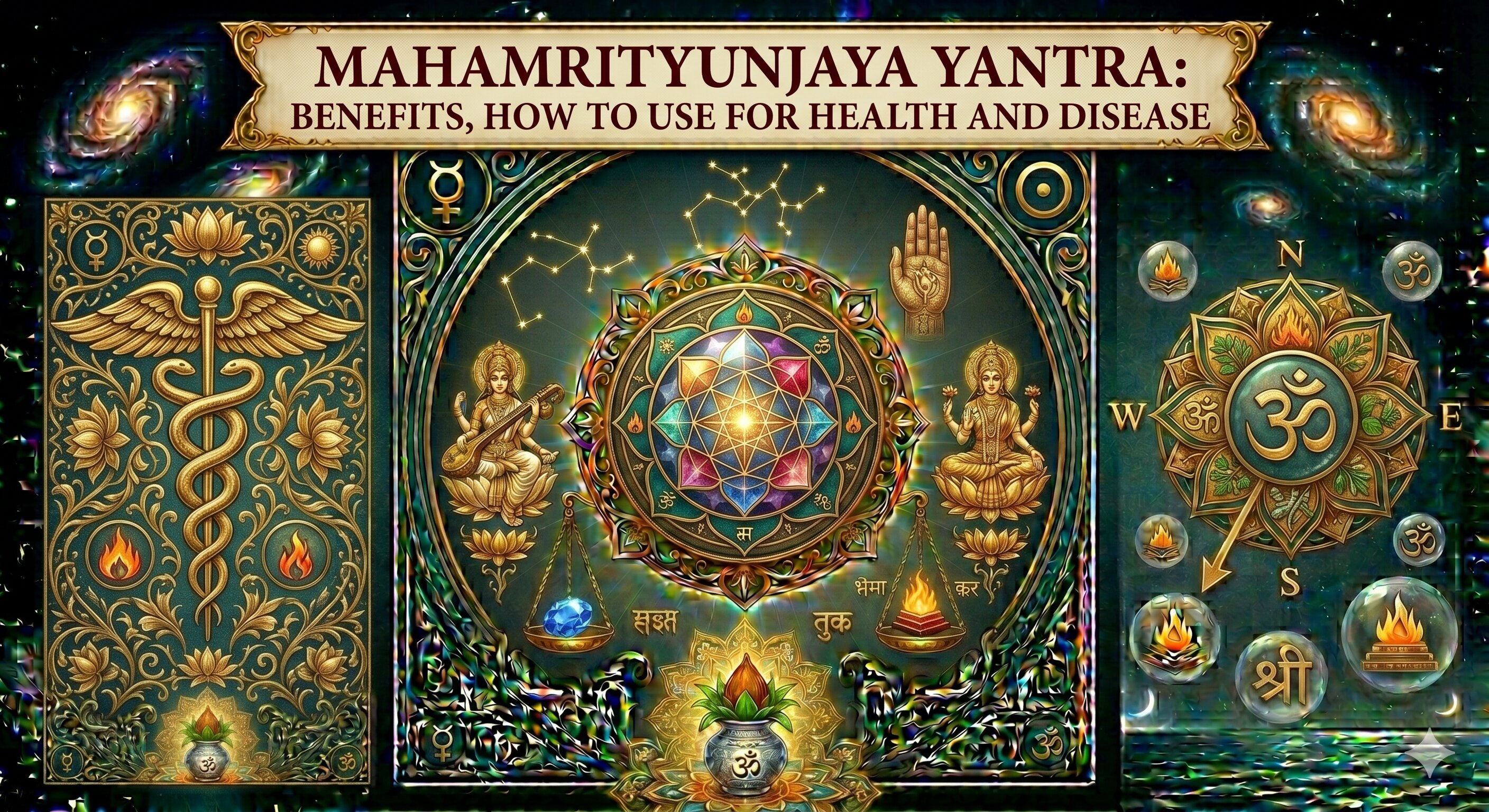
The Mahamrityunjaya Yantra is the sacred geometric instrument of Lord Shiva in his Mrityu-Vijaya (death-conquering) aspect. Like all yantras, it is a geometric diagram that encodes and continuously transmits a specific divine energy - in this case, the vibrational frequency of the Mahamrityunjaya Mantra, which is itself the sonic manifestation of Shiva's healing, protecting, and death-transcending power.
The yantra's geometry encodes the specific principles of Mrityu-Vijaya:
| Classical Note: The Mahamrityunjaya Yantra is described in the Rudrayamala Tantra, the Mantra Mahodadhi, and the Tantrasara traditions, which encode the Mahamrityunjaya Mantra's geometric equivalent. It is among the most universally recognised yantras in both North and South Indian Shakta-Shaiva traditions, and its use is consistent across regional variations. Unlike some yantras whose prescriptions vary by tradition, the Mahamrityunjaya Yantra's core application - health, protection from untimely death, and post-illness recovery - is unanimous across all major Vedic and Tantric schools. |
The Mahamrityunjaya Mantra has been called the heart of the Vedas - a description that appears in multiple Vedic and Puranic sources and reflects the mantra's singular importance in the entire Sanskrit spiritual canon. Alongside the Gayatri Mantra, it occupies the highest position among Vedic mantras for daily recitation and sadhana.
The Complete Mahamrityunjaya Mantra:
ओम् त्र्यम्बकं यजामहे सुगन्धिं पुष्टिवर्धनम् । उर्वारुकमिव बन्धनान् मृत्योर्मुक्षीय मामृतात् ।।
Om Tryambakam Yajamahe Sugandhim Pushtivardhanam | Urvarukamiva Bandhanan Mrityor Mukshiya Maamritat ||
Word-by-Word Meaning: Om - the primordial sound, the seed of all existence Tryambakam - the Three-Eyed One (tri = three; ambaka = eye): Lord Shiva, whose three eyes perceive the past, present, and future simultaneously, and whose third eye represents transcendental awareness beyond the cycle of birth and death Yajamahe - we worship, we honour, we offer reverence Sugandhim - the fragrant one; the one whose presence pervades all existence like a divine fragrance Pushtivardhanam - he who nourishes, strengthens, and increases vitality in all beings (pushti = nourishment, vitality; vardhana = that which increases) Urvarukamiva - like a ripe cucumber (urvaruka) from the vine: the image of a gourd that separates naturally and effortlessly from its stem when it is fully ripe Bandhanan - from bondage, from the ties that bind us to the cycle of suffering and mortality Mrityor - from death (mrityu = death) Mukshiya - may you liberate (imperative form of Maamritat - may I not be separated from immortality; may I not be cut off from deathlessness (ma = not; amritat = from immortality)
Complete Translation: "We worship the Three-Eyed Lord Shiva, who is fragrant and who nourishes and sustains all beings. As a ripe cucumber is naturally freed from the bondage of the vine, may He liberate us from the bondage of death - not from immortality."
Scriptural Source: Rigveda 7.59.12; also present in the Yajurveda (Taittiriya Samhita 1.8.6) and referenced in the Atharvaveda. The mantra is 32 syllables in its core form. |
The mantra's central image - the ripe gourd (urvaruka) separating naturally from its vine - is one of the most profound metaphors in all of sacred literature. It does not ask for the prevention of death but for liberation from the fear of death and from untimely, premature death (akal mrityu). The gourd does not fight to stay on the vine - it ripens fully, fulfils its purpose, and then releases naturally. This is the mantra's deepest teaching: complete health, full vitality, and then - when the time is truly right - effortless, fearless departure.
The Mahamrityunjaya Mantra's classical mythological context is the story of Markandeya, recorded in the Shiva Purana and referenced in multiple Puranic texts. It is one of the most beloved stories in the Shaivite tradition and provides the mantra's foundational narrative:
The sage Bhrigu and his wife Marudmati were devoted worshippers of Shiva. After years of prayers, Shiva offered them a choice: a hundred sons of average virtue and longevity, or one son of exceptional virtue who would live for only sixteen years. They chose the latter - and Markandeya was born.
As Markandeya's sixteenth birthday approached, his parents grew desperately anxious. But Markandeya himself - undisturbed - went to the Shiva lingam at the family shrine and entered deep meditation, holding the lingam in a protective embrace and chanting with complete devotion. At the appointed hour, Yama (the god of death) arrived with his terrible noose.
Yama cast his noose - but it encircled both Markandeya and the Shiva lingam. In that instant, Lord Shiva himself emerged from the lingam in terrible wrath, struck down Yama with his foot, and declared: "Death has no dominion over this child. He shall live forever." Lord Brahma subsequently appealed to Shiva to restore Yama to life, and Shiva agreed - but proclaimed that Markandeya would remain eternally sixteen years of age and would never die.
The mantra that Markandeya was chanting at that moment - the Mahamrityunjaya Mantra - is the living record of that divine encounter. For the practitioner, it is not merely a prayer about Lord Shiva conquering death: it is an invitation to enter, through mantra and yantra, the same field of divine protection that surrounded Markandeya in his supreme moment of surrender.
The Mahamrityunjaya Yantra's benefits are specific, and - within the Vedic framework - can be understood across three registers: physical protection and healing, psychological and emotional relief, and spiritual liberation.
| Benefit Category | Specific Applications |
| Protection from untimely death (Akal Mrityu Nivaran) | The yantra's primary classical application - protection from unexpected death through accident, severe illness, or sudden health crisis. It is invoked when medical prognosis is uncertain or when the individual faces life-threatening circumstances. |
| Support during serious illness | For individuals suffering from life-threatening conditions - cancer, organ failure, severe infection, cardiac events - the yantra provides a continuous vibrational field of healing energy alongside medical treatment. It is not a substitute for medicine; it is a complementary spiritual support. |
| Post-surgery and post-hospital recovery | Placed beside the patient's bed during recovery, the yantra's continuous energetic influence supports the body's natural regenerative processes and provides psychological reassurance that aids recovery. |
| Chronic disease management | For individuals managing long-term conditions - diabetes, arthritis, autoimmune conditions, neurological conditions - sustained daily practice with the yantra and mantra is associated with improved stamina, reduced anxiety about the condition, and an enhanced sense of well-being. |
| Protection of elderly family members | The yantra is traditionally installed in the bedrooms of elderly parents or grandparents - a practice that addresses both the family's fear for their loved ones and the elder's own anxiety about declining health. |
| Fear of death (Mrityu Bhaya) | The Mahamrityunjaya Mantra's deepest teaching is the dissolution of the fear of death. Regular practice - whether through the mantra or the yantra - produces a measurable shift in the practitioner's relationship with mortality: from terror to equanimity, from grasping to surrender. |
| Protection during dangerous journeys | Traditionally recited before long journeys, surgeries, or any undertaking that involves physical risk. The yantra installed at home provides a continuous protective field even when the practitioner is away. |
| Mental health support - anxiety and depression | When health anxiety, death anxiety, or grief is the primary presenting concern, the Mahamrityunjaya Yantra and mantra practice provide a concrete, actionable devotional focus that redirects the mind from catastrophic thinking toward surrender and trust. |
| Ancestral healing (Pitru Dosha support) | The mantra is chanted on behalf of deceased ancestors in the Pinda Daan tradition - the yantra in the home creates a space where prayers for the departed are amplified. |
Unlike most other yantras that are installed as permanent fixtures for general improvement, the Mahamrityunjaya Yantra is most potently used in response to specific health crises or periods of heightened mortal risk. The following situations constitute the traditional and most appropriate triggers for installation:
One of the most important and practically significant features of the Mahamrityunjaya Yantra is its placement flexibility. Unlike wealth yantras (Kuber, Lakshmi), which carry intense material energy and are best kept in dedicated puja spaces away from sleeping areas, or protective Tantric yantras (Baglamukhi) that require careful placement protocols, the Mahamrityunjaya Yantra is specifically appropriate for the bedroom - including directly beside or above the patient's bed
This placement permission reflects the yantra's nature: it is the most sattvic (pure, gentle, peaceful) of the major protective yantras. Lord Shiva in his Mrityu-Vijaya aspect is the physician of the cosmos - his energy is healing, calming, and deeply reassuring rather than energetically intense.
| Placement | Best For | Direction to Face |
| Beside the patient's bed (wall or table) | Active illness, post-surgery recovery, serious health crisis - this is the most direct application | Face East (toward sunrise energy) or North (toward Kubera's abundance). The yantra should face into the room, toward the patient. |
| Above the headboard of the bed | Chronic illness, elderly person's long-term bedroom, ongoing protective use for a specific individual | Face downward into the room or toward the sleeping person's head. Secure firmly. |
| North-East corner of the bedroom | General protective installation for a bedroom shared by a couple, particularly when one partner has health concerns | The North-East (Ishana corner) is the most spiritually active corner of any room - an ideal placement for all spiritual instruments including this yantra. |
| Home puja room or altar | For practitioners who prefer to keep the yantra in a dedicated sacred space, away from the bedroom | Face East or North. Daily mantra practice performed facing the yantra at the altar is equally effective. |
| ICU or hospital room (pocket yantra) | A small copper yantra or yantra locket placed beside or near the patient during hospitalisation. If the hospital facility does not allow objects, family members may keep it on their person and perform mantra practice in the waiting area. | Any direction is acceptable for a hospital-room portable yantra - intention and mantra practice override directional considerations in this context. |
Complete activation of the yantra through Pran Pratishtha is essential. For the complete universal 10-step Pran Pratishtha Vidhi applicable to all yantras, see [How to Activate a Yantra at Home: Pran Pratishtha Vidhi - Complete Guide (/how-to-activate-yantra)]. The following covers the Mahamrityunjaya Yantra-specific activation protocol.
| Factor | Recommended | Why |
| Best day | Monday (Somvar) - primary; also Pradosh (13th lunar day) | Monday is Lord Shiva's sacred day; Pradosh period (specifically the hours around sunset on the 13th day of each fortnight) is the most auspicious time in Shiva's weekly calendar |
| Best time | Brahma Muhurta (1.5 hours before sunrise) or Pradosh Kaal (approximately 1.5 hours after sunset) | Both are periods of heightened Shiva energy; Pradosh Kaal is specifically dedicated to Shiva worship in the tradition |
| Best lunar phase | Shukla Paksha (waxing moon), particularly Chaturdashi (14th day) or Purnima (full moon) | Rising lunar energy supports healing and growth; Shiva Chaturdashi (Maha Shivaratri) is the most powerful of all days for Shiva yantra activation |
| Maha Shivaratri | The single most auspicious day in the entire year for Mahamrityunjaya Yantra activation | Maha Shivaratri is the night when Shiva's energy is at its annual peak - a yantra activated on this night carries maximum potency |
| Avoid | Rahu Kaal, solar/lunar eclipses, periods of household Sutak (birth or death impurity) | Inauspicious periods disturb the subtle energy required for correct activation |
Materials for Mahamrityunjaya Yantra Activation (Shiva-specific additions to the standard Pran Pratishtha kit):
• Bilva leaves (Bel patra) - the most sacred offering to Shiva; essential for all Shiva rituals. Offer three-lobed Bilva leaves (trifoliate) at the yantra after abhishek. • Milk (Dudh) - use specifically for Panchamrit abhishek and additionally for a separate milk abhishek after Panchamrit: pour fresh cow's milk slowly over the yantra while chanting the mantra. • Vibhuti (sacred ash) - apply a mark of Vibhuti at the central bindu of the yantra using the ring finger. Vibhuti is Shiva's primary symbol and specifically associated with the Mahamrityunjaya aspect. • Dhatura flowers - if available, a single white Dhatura flower (Jimsonweed) is Shiva's sacred flower and enhances the activation's potency. Use with care; Dhatura is toxic to ingest. • Blue or white flowers - jasmine, white chrysanthemum, or light blue flowers are appropriate for Shiva worship if Dhatura is unavailable. • Rudraksha mala - use a 5-mukhi (five-faced) rudraksha mala for mantra chanting - it is specifically associated with Shiva's five aspects (Panchamukha Shiva). • Blue sandalwood or sandalwood paste - for tilak application at the bindu instead of regular chandan. • Camphor (Kapoor) - for aarti; Shiva is particularly associated with camphor's purifying, ego-dissolving property. |
Are you currently struggling with life phases like Health? Discover your precise chart insights now.
The Mahamrityunjaya Mantra (Complete):
Om Tryambakam Yajamahe Sugandhim Pushtivardhanam | Urvarukamiva Bandhanan Mrityor Mukshiya Maamritat ||
Daily Chanting Minimum: 108 times - one full mala of the rudraksha beads.
Extended Practice: • For serious illness or critical health situations: 3 malas (324 repetitions) daily • For post-surgery recovery: 1,008 repetitions over a period of 40 days (a mandala cycle) • For full Mahamrityunjaya Japa Anushthana (complete siddhi protocol): 1,25,000 repetitions - typically performed over a period of 40 to 90 days under qualified guidance
Best Times for Chanting: • Brahma Muhurta (1.5 hours before sunrise) - most powerful period for any mantra practice • Pradosh Kaal (approximately 1.5 hours after sunset) - specifically auspicious for Shiva mantras • At midnight on Monday - particularly during Shiva's night-time vigil periods
Chanting on Behalf of Another Person: When the ill person cannot chant themselves (unconscious, very weak, or an infant/child), family members may and should chant the mantra on the patient's behalf. The mantra's protective energy is specifically designed to be transferable - it is traditional to chant it for sick relatives, for those undergoing surgery, and for the dying. Hold the person's name in your heart while chanting and mentally direct the mantra's energy toward them.
Intention (Sankalpa) during chanting: Before each sitting, mentally or verbally state: 'I offer this chanting of the Mahamrityunjaya Mantra to Lord Shiva Tryambaka for the healing, protection, and liberation of [name], with complete surrender to his will and wisdom.' |
Correct pronunciation is important for mantra practice - though the Mahamrityunjaya Mantra's Sanskrit construction is relatively accessible compared to some more complex Tantric mantras. Key pronunciation notes:
| Practice | Frequency | Specific Instructions |
| Mahamrityunjaya Mantra chanting | Daily - minimum 108 repetitions | Use a 5-mukhi rudraksha mala. Face the yantra while chanting. On Mondays, increase to 3 malas (324 repetitions). |
| Milk offering | Daily or every Monday | A few drops of fresh cow's milk offered at the base of the yantra. On Mondays, a full milk abhishek (slow pour over the yantra while chanting once). |
| Bilva leaf offering | Daily if available; Monday minimum | Three-lobed Bilva leaves offered at the yantra. Remove wilted leaves promptly. A dried Bilva leaf that has not wilted is also acceptable. |
| Ghee lamp | Daily - especially at dawn and dusk | The Mahamrityunjaya Yantra responds strongly to a continuous lamp - if possible, keep an akhand diya (continuous flame) near the yantra during periods of acute illness. |
| Vibhuti application | Every Monday | Re-apply Vibhuti (sacred ash) at the central bindu of the yantra with the ring finger after the Monday milk abhishek. |
| Camphor aarti | Daily - morning and evening | Wave camphor in a clockwise circle before the yantra. The dissolution of camphor is a symbol of ego dissolution - central to the mantra's deeper meaning. |
| Cleaning the yantra | Monthly | Wipe copper yantras with tamarind-salt paste (to remove oxidation), rinse, dry, and re-apply Vibhuti. Do not use chemical cleaners on copper. |
| Re-energisation after yantra falls or is handled by impure hands | As needed | Immediately perform Gangajal purification and repeat the abbreviated Pran Pratishtha - milk abhishek, mantra 108 times, aarti. |
This section is among the most important in this article. One of the greatest disservices that can be done to a person in health crisis is to offer them a spiritual practice with inflated promises - and one of the greatest disservices that can be done to the tradition is to dismiss it as mere superstition. The truth, as the Vedic tradition itself consistently teaches, lies between these extremes.
Critical Clarification: The Mahamrityunjaya Yantra is a complementary spiritual practice - it is not an alternative to medical treatment. In the case of any serious illness, seeking qualified medical care is a religious duty (dharma) in the Vedic framework - the human body is considered a sacred instrument (deha) given for the purpose of spiritual evolution, and its proper care through medicine, diet, and lifestyle is an act of reverence. The mantra and yantra practice work best alongside - not instead of - appropriate medical care. Astrologers and pandits who encourage patients to forgo medical treatment in favour of purely ritual remedies are acting contrary to the Vedic tradition's own understanding of dharmic responsibility.
For mental health crises: If serious illness anxiety, death anxiety, or grief is significantly impairing daily functioning, please also seek support from a qualified mental health professional. The mantra practice is a powerful complementary support - not a substitute for clinical care when clinical care is indicated. |
From the Jyotish perspective, certain planetary configurations create heightened health vulnerability - periods when the individual is more susceptible to illness, accident, or serious health events. The Mahamrityunjaya Yantra is the primary protective recommendation for all of these:
| Astrological Condition | Health Concern | Yantra Application |
| Saturn-Mars conjunction or mutual aspect in the natal chart | Chronic illness, accidents, blood-related conditions, bone and joint issues | Install yantra; Saturday and Tuesday additional mantra sessions |
| Rahu or Ketu in the 6th or 8th house (natal or transit) | Mysterious illnesses, sudden health crises, fear of death | Install yantra; Rahu Kaal mantra practice is specifically effective |
| 6th lord or 8th lord strongly placed in the Lagna or in transit over the Lagna | Health threats manifesting in the native's life or body directly | Immediate yantra installation; increase to 3 malas daily |
| Sade Sati (Saturn's 7.5-year transit) for individuals with natal health concerns | Chronic conditions worsening; vitality declining; health-related depression | Sustained yantra practice throughout the Sade Sati period |
| Kaal Sarp Dosh affecting the 6th or 8th house (see [Kaal Sarp Dosh Guide (/kaal-sarp-dosh)]) | Health complications from the Rahu-Ketu axis crossing health houses | Mahamrityunjaya Yantra + Kaal Sarp Shanti Puja - complementary practices |
| Mangal Dosh with 8th house involvement (see [Mangal Dosh Remedies (/mangal-dosh-remedies)]) | Mars in 8th house - life-threatening events; surgical complications; accidents | Mahamrityunjaya Yantra + Mars remediation (see companion article) |
| Debilitated Sun or Moon in the 6th, 8th, or 12th house | Vitality depletion, immune weakness, psychological fragility in illness | Yantra with daily milk offering (Sun's element) and water (Moon's element) |
Related Guides on Nakshatraai.ai: • [How to Activate a Yantra at Home: Pran Pratishtha Vidhi - Complete Guide (/how-to-activate-yantra)] • [Kaal Sarp Dosh: Complete Guide, 12 Types, and Proven Remedies (/kaal-sarp-dosh)] • [Mangal Dosh Remedies: 7 Proven Upay from Lal Kitab and Parashara (/mangal-dosh-remedies)] • [Baglamukhi Yantra: Meaning, Benefits and How to Use for Protection (/baglamukhi-yantra)] • [Vastu Yantra: Benefits, Correct Placement and How to Use at Home (/vastu-yantra)] • [Emerald (Panna) Stone Benefits, Who Should Wear and Astrological Guide (/emerald-panna-stone)] |
Yes - and this is one of the most important ways in which the Mahamrityunjaya Yantra differs from most other yantras. Its energy is gentle, sattvic, and healing rather than activating or intense. It is specifically appropriate for bedrooms, sickrooms, and spaces where rest and recovery occur. Unlike wealth yantras (which carry activating commercial energy) or protective Tantric yantras (which carry intense warrior energy), the Mahamrityunjaya Yantra brings peace, protection, and Shiva's calming presence - all qualities that enhance sleep and recovery. It may remain uncovered at night.
Absolutely - and the tradition specifically encourages this. When a patient cannot chant themselves (due to unconsciousness, extreme weakness, or age), family members performing the mantra on their behalf is considered an act of profound love and effective spiritual support. Hold the patient's name in your heart while chanting. The Vedic understanding is that the mantra's protective energy, offered with genuine love and sincere intention, reaches the intended recipient regardless of physical proximity. A family vigil of continuous Mahamrityunjaya chanting around a critically ill person is one of the most powerful applications of this mantra in the entire tradition.
For a critical health crisis, the classical prescription is a Mahamrityunjaya Japa of 1,25,000 repetitions performed over a period of 40 days - this constitutes a full anushthana (complete spiritual undertaking) and represents a profound commitment of intention and time. If this full anushthana is not practically possible, a sustained practice of 3 malas (324 repetitions) daily is a meaningful and significant contribution. Even 11 or 21 sincere repetitions performed with complete presence and surrender carry genuine potency - the mantra's power is not purely about quantity but about the quality of attention and devotion brought to the practice.
Both are Shiva mantras, but they serve different functions. Om Namah Shivaya (the Panchakshara Mantra - five-syllable mantra) is the mula mantra of Shiva - his fundamental name mantra, used for general devotion, purification, and spiritual development. Mahamrityunjaya is specifically the ayur mantra - the mantra of longevity, health, and the conquest of death. For general daily Shiva practice, Om Namah Shivaya is most widely used (1,008 times is the classical full count). For health-specific applications, the Mahamrityunjaya Mantra is the primary prescription. Many practitioners use both - Om Namah Shivaya as the daily foundational practice, and the Mahamrityunjaya Mantra specifically during health challenges.
Yes. The most auspicious Nakshatras for Mahamrityunjaya Yantra activation are: Ardra (Rahu's nakshatra associated with Rudra-Shiva), Pushya (considered the most auspicious nakshatra in general), Rohini (Moon's own nakshatra - health-supportive), and Shravana (associated with healing and listening). Additionally, Maha Shivaratri is the single most auspicious day of the year for any Shiva-related installation or activation - if possible, reserve the yantra activation for this occasion.
Yes - children benefit significantly from the yantra's protective field. The yantra may be placed in a child's bedroom during illness. Parents may chant the mantra on behalf of a sick child, or the child (if old enough to speak) may be taught a simplified version: even chanting Om Namo Bhagavate Mahabalaya Shivaya Tryambakaya Mrityor Mukshiya Maamritat three times with the child daily is a meaningful practice. Many families maintain the Mahamrityunjaya Yantra in children's bedrooms as a permanent protective measure, particularly during childhood illness seasons.
The Mahamrityunjaya Yantra carries within its geometry one of the oldest and most profound invocations in human spiritual history - a prayer composed at the very dawn of the Vedic tradition, confirmed by the story of Markandeya's immortality, and refined by thousands of years of devotional practice by countless practitioners who faced illness, surgery, loss, and the final approach of death.
Its teaching is not that death can be prevented - the Vedic tradition is too honest for that. Its teaching is that untimely death can be averted, illness can be eased, fear can be dissolved, and the final transition can be made peacefully - like the ripe gourd releasing naturally from its vine, without suffering, without struggle, in the full awareness of the immortal Self that the gourd's temporary existence has been preparing to reveal.
Install the Mahamrityunjaya Yantra with reverence. Activate it on a Monday or on Maha Shivaratri. Place it beside the bed where rest and healing occur. Chant the mantra with devotion - Om Tryambakam Yajamahe Sugandhim Pushtivardhanam | Urvarukamiva Bandhanan Mrityor Mukshiya Maamritat - 108 times daily, 3 malas during acute illness, with sincere surrender to Shiva's will. And trust that the Three-Eyed Lord who conquered death for Markandeya hears every syllable uttered with genuine love.
Get Personalised Astrological Guidance for Health on Nakshatraai.ai Generate your Kundali and identify planetary configurations affecting your health - 6th, 8th house afflictions, Sade Sati, and more: nakshatraai.ai/add-kundli Speak with a qualified Jyotishi for a personalised health protection plan including yantra, mantra, and gemstone recommendations: nakshatraai.ai/astrologer |
Disclaimer: This article is for educational and informational purposes only. The Mahamrityunjaya Yantra and mantra practice are spiritual practices from the Vedic tradition and are not medical treatments. In all cases of serious or life-threatening illness, please seek qualified medical care as a priority. Spiritual practices described in this article are complementary to - not substitutes for - appropriate medical treatment. The health claims described are based on the Vedic astrological and devotional tradition; they are not medical claims. For individuals experiencing mental health crises, grief, or severe health anxiety, professional mental health support is also encouraged alongside spiritual practice.