Quick Answer: What Are the Most Effective Remedies for Mangal Dosh?
What are the most effective remedies for Mangal Dosh? The seven most widely practised and classically validated remedies for Mangal Dosh are: (1) Kumbh Vivah - a symbolic marriage ritual performed before the actual wedding to neutralise the dosh's effect on the spouse; (2) Mangal Graha Shanti Puja performed on a Tuesday with the Mangal Beej Mantra Om Kraang Kreeng Kraung Sah Bhaumaya Namah; (3) Red Coral (Moonga) gemstone - worn in copper or gold after consultation with a qualified Jyotishi, strictly for eligible lagnas (Aries, Cancer, Leo, Scorpio, Sagittarius, Pisces); (4) Hanuman Chalisa recitation every Tuesday; (5) Tuesday fast (Mangalvar Vrat) with specific dietary and ritual protocol; (6) donation of red masoor dal and red cloth on Tuesday; and (7) the Lal Kitab upay of keeping a square piece of silver in the wallet. Each remedy addresses the Mars energy from a different angle - ritual, gemological, devotional, dietary, charitable, and energetic.
Mangal Dosh ke sabse kargar aur satik upay kya hain? Mangal Dosh ke saat sabse prabhavshali aur paramparagat upay hain: (1) Kumbh Vivah - vivah se pehle ek prambanik anushthan jo dosh ka prabhav kam karta hai; (2) Mangalvar ko Mangal Graha Shanti Puja; (3) Lal Moonga (Red Coral) - yogya lagnaon ke liye hi, kisi yogya Jyotishi ki salah ke baad; (4) Mangalvar ko Hanuman Chalisa padhna; (5) Mangalvar ka vrat; (6) Lal masoor dal aur laal vastra ka daan Mangalvar ko; aur (7) Lal Kitab upay: wallet mein chandi ka chota tukda rakhna. |
Mangal Dosh - also known as Kuja Dosh, Bhoum Dosh, or Angaraka Dosh - is one of the most widely discussed configurations in Vedic astrology. It arises when Mars (Mangal) occupies certain houses in the birth chart: traditionally the 1st, 2nd, 4th, 7th, 8th, or 12th house from the Lagna (Ascendant), Moon, or Venus. The result, according to classical Jyotish texts including the Brihat Parashara Hora Shastra and Jataka Parijata, is an intensification of Martian energy that can create friction in marriage, delayed partnerships, periodic financial disruption, and an impulsive or aggressive temperament.
Crucially, Mangal Dosh is not a life sentence. The same tradition that identifies the dosh provides detailed, tested remedies - from ritual and gemstone to devotional practice and charitable action - that reduce its intensity and redirect its energy constructively. This article is a dedicated remedy guide covering 7 proven upay drawn from both the classical Parashari tradition and the practical Lal Kitab system, with step-by-step instructions for each.
For a complete understanding of what Mangal Dosh is, how it is identified in the birth chart, which houses create it, and when it is cancelled, please see our companion article: [Mangal Dosh: Complete Guide - What It Is, How It Affects Your Life, and Cancellation Conditions (/mangal-dosh)].
Every remedy in the Vedic system is most effective when the practitioner understands what it is actually addressing. Mars (Mangal), as a graha, represents courage, energy, initiative, blood, fire, aggression, and the warrior principle. When well-placed and well-aspected, it produces leaders, surgeons, soldiers, athletes, and decisive entrepreneurs. When afflicted - either by inauspicious house placement (Mangal Dosh) or by conjunction with malefics - it manifests as impulsiveness, destructive aggression, injury, accident, and friction in close relationships (particularly marriage, where its Drishti on the 7th house is the core concern).
The remedies below address Mars energy from seven distinct angles: ritual resolution (Kumbh Vivah), planetary propitiation (Shanti Puja), gemological strengthening (Red Coral), devotional redirection (Hanuman Chalisa), tapasya or austerity (Tuesday fast), charitable release (donation), and subtle energetic correction (Lal Kitab). For best results, consult a qualified Jyotishi to determine which remedies are most relevant for your specific chart and dasha period. Not every remedy is equally applicable for every manifestation of Mangal Dosh.
| Important: Mangal Dosh and Cancellation - Before investing in any remedy, first confirm with a qualified astrologer whether your Mangal Dosh is truly operative. Many charts that appear to have Mangal Dosh actually have cancellation (Bhang) conditions: Mars in Aries, Scorpio, or Capricorn (exaltation); Jupiter aspecting Mars; both partners being Manglik (mutual cancellation); specific Lagna configurations (for Cancer and Leo, Mars is Yogakaraka); and others. Unnecessary remediation is counterproductive. See: [Mangal Dosh: Complete Guide (/mangal-dosh)] |
What it addresses: The primary marital consequence of Mangal Dosh - specifically the traditional concern about harm to the first spouse. This is the most significant pre-marriage remedy in the classical tradition.
When to perform: Before the actual marriage ceremony. Can also be performed after marriage if the dosh is identified late, though pre-marriage is strongly preferred.
Source: Dharmashastra tradition; referenced through the concept of prathama bharya peedana in classical texts including the Jataka Parijata.
Kumbh Vivah (Kumbha = clay pot; Vivah = marriage) is a ritual in which the Manglik individual undergoes a complete traditional Hindu wedding ceremony with a symbolic partner - typically a clay pot (kumbh), a banana tree, a Peepal tree, or a silver/gold idol of Lord Vishnu - before their actual human marriage. The symbolic marriage absorbs the first-marriage karma associated with the dosh. When the clay pot is subsequently broken, the symbolic 'death of the first spouse' resolves the karmic pattern, freeing the actual marriage from this influence.
Best Locations for Kumbh Vivah: The most auspicious locations are Trimbakeshwar Jyotirlinga in Nashik (Maharashtra) - also the primary site for Kaal Sarp Dosh Shanti Puja; see [Kaal Sarp Dosh: Complete Guide (/kaal-sarp-dosh)] - and Mangalnath Temple in Ujjain (Madhya Pradesh), which is considered the birthplace of Lord Mangal (Mars). Both sites have experienced pandits who conduct Kumbh Vivah rituals regularly. The ceremony can also be performed at any Shiva temple under proper pandit guidance.
Both men and women with Mangal Dosh may perform Kumbh Vivah. The ritual is equally applicable and effective for both genders. |
What it addresses: Directly propitiates the planet Mars, reducing the intensity of its malefic influence in all areas - marriage, health, finances, temperament.
When to perform: Any Tuesday (Mangalvar); most effective on Tuesday during Shukla Paksha (waxing moon). For severe Mangal Dosh, perform on 11 or 21 consecutive Tuesdays.
Source: Graha Shanti tradition from the Brihat Parashara Hora Shastra and standard Navagraha worship protocol.
Mangal Beej Mantra (Primary): ओम् क्रां क्रीं क्रौं सः भौमाय नमः Om Kraang Kreeng Kraung Sah Bhaumaya Namah Recite 108 times on Tuesday using a red coral mala or rudraksha mala. Bhaumaya = 'son of the Earth' (a name for Mars/Mangal).
Mangal Navagrah Mantra (secondary, chant 108 times after the Beej Mantra): Om Angarakaya Vidmahe Bhoomipalaya Dhimahi Tanno Kujah Prachodayat
Mangal Navagraha Shloka (from Navagraha Stotra, 1 recitation): Dharanigarbhasambhutam Vidyutkaantisamprabham | Kumaram Shaktihastacha Mangalam Pranamaamyaham || Translation: I salute Mars, who was born from the womb of the Earth, who shines like lightning, who is youthful, who holds a spear (Shakti). |
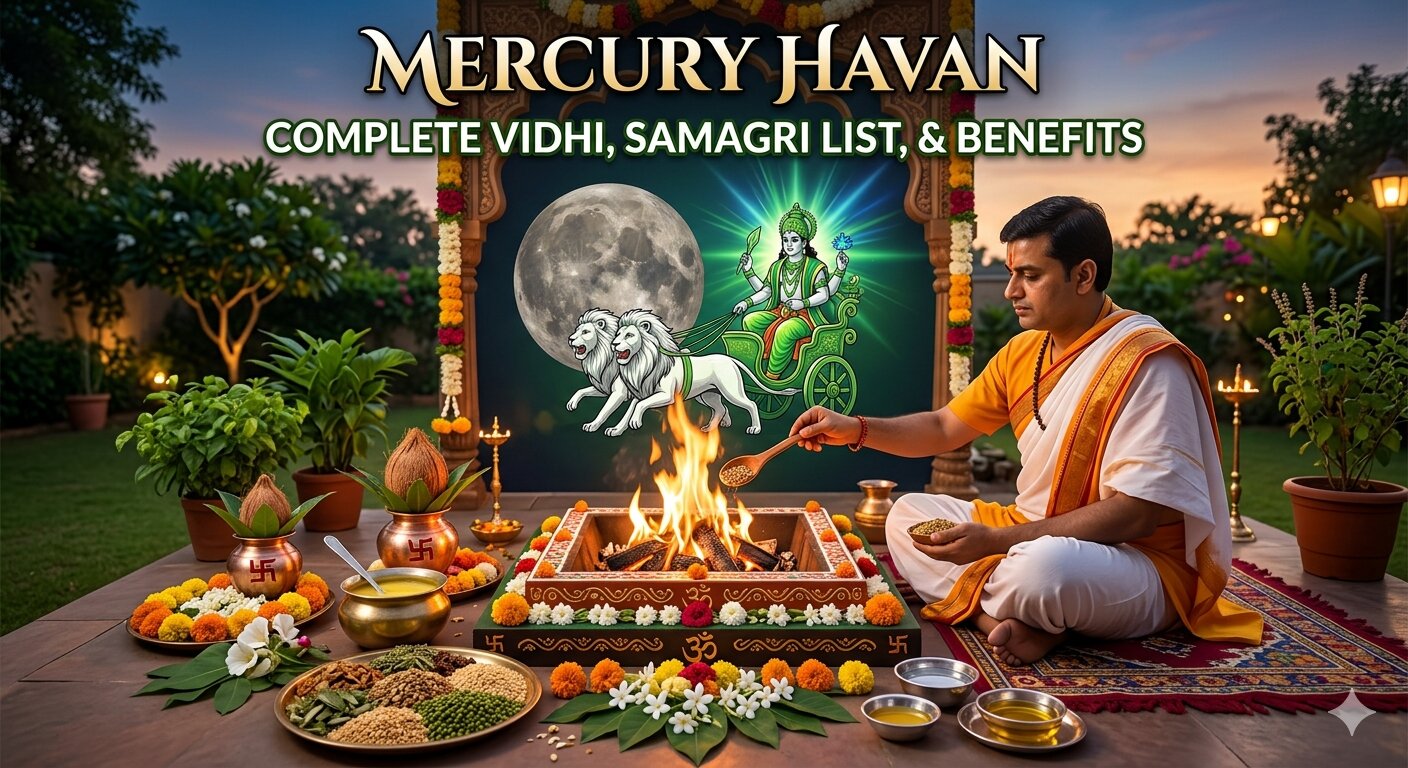
| Formal Mangal Graha Shanti Puja: For severe Mangal Dosh - particularly where the 7th or 8th house is involved - a formal Mangal Graha Homa (fire ritual) with a qualified pandit is recommended. This includes 7,000 Ahutis (fire offerings) of red sandalwood (lal chandan), ghee, sesame, red flowers, and other prescribed materials into the Homa kund. Major temples associated with Mangal worship - Mangalnath Temple (Ujjain) and Azhimala Devi Temple in Kerala - are particularly powerful sites for Mangal Shanti. |
What it addresses: Strengthens and stabilises Mars's energy in the natal chart; redirects Martian aggression into courage, decisiveness, and vitality. Reduces the impulsive, conflict-prone manifestation of Mangal Dosh.
Source: Navaratna gemstone tradition from Brihat Parashara Hora Shastra; Maharishi Parashara's classification of Mars as Yogakaraka for specific lagnas.
Critical Warning - Lagna Eligibility: Red Coral is the gemstone of Mars and strengthens its energy. If Mars rules inauspicious houses in your chart, wearing Red Coral can amplify the malefic effects rather than mitigating them. This is one of the most lagna-specific gemstone recommendations in Jyotish. Do not wear Red Coral without consulting a qualified astrologer.
| Lagna (Ascendant) | Red Coral Recommendation | Reason |
| Aries (Mesha) | Highly Recommended - Lifelong | Mars is the Lagna lord; Red Coral strengthens self, health, and longevity throughout life |
| Taurus (Vrishabha) | Generally Avoid | Mars rules the 7th (Maraka) and 12th house - can harm marriage and finances |
| Gemini (Mithuna) | Avoid | Mars rules 6th and 11th - malefic houses; can increase conflict |
| Cancer (Karka) | Highly Recommended | Mars is Yogakaraka - rules the auspicious 5th and 10th houses; wear for life |
| Leo (Simha) | Highly Recommended | Mars is Yogakaraka - rules 4th and 9th; promotes fortune, property, and wisdom |
| Virgo (Kanya) | Avoid in most cases | Mars rules 3rd and 8th - malefic; wear only during Mars Mahadasha with expert guidance |
| Libra (Tula) | Avoid | Mars rules 2nd (Maraka) and 7th (Maraka) - serious harm possible |
| Scorpio (Vrischika) | Recommended | Mars is the Lagna lord (also rules 6th); strengthens the native's vitality and purpose |
| Sagittarius (Dhanu) | Recommended - with Muhurta | Mars rules 5th and 12th; benefit in education, fortune, spiritual life |
| Capricorn (Makar) | Conditional - during Mars Dasha only | Mars rules 4th and 11th; trial period of 3 days recommended before committing |
| Aquarius (Kumbha) | Conditional - during Mars Dasha only | Mars rules 3rd and 10th; some benefit for career - trial period essential |
| Pisces (Meena) | Recommended | Mars rules 2nd and 9th; supports wealth, fortune, and spiritual life |
| Natural vs. Lab-Created Coral: Only natural, unheated, undyed Red Coral carries astrological efficacy. Lab-created, dyed, or reconstituted coral is ineffective for gemological remediation. Request a gemological certificate confirming the coral is natural and untreated from a recognised laboratory (GIA, IGI, or equivalent) before purchase. |
What it addresses: Lord Hanuman is the ruling deity of Mars (Mangal) in the devotional tradition. Propitiating Hanuman on Tuesday - Mars's sacred day - directly appeases the planetary energy of Mars, reducing the agitation and impulsiveness associated with Mangal Dosh.
Source: Vedic devotional tradition; the Hanuman-Mars correspondence is established in the Navagraha Stotra and Shakti Stotra traditions. Lord Hanuman's qualities - fearlessness, discipline, strength in service, and devotion - represent the highest expression of Mars energy.
Why Hanuman for Mars? In the Navagraha tradition, each planet is associated with a presiding deity who governs and moderates that planet's energy. Lord Hanuman governs Mars (Mangal). Hanuman embodies the highest Martian virtues - supreme strength, unwavering courage, absolute discipline, and complete subordination of ego in service. Worshipping Hanuman transforms the raw, aggressive Mars energy in the native's chart into its most constructive expression: disciplined strength, fearless action, and devoted service. This is why Hanuman Chalisa on Tuesday is considered one of the simplest and most effective ongoing remedies for Mangal Dosh.
For Tuesday visits to the temple: Panchamukhi (five-faced) Hanuman temples are particularly auspicious for Mangal Dosh remedy. The five faces represent the five directions and five elements - all of which are under Hanuman-Mangal's purview. |
What it addresses: Vrat (fasting) is one of the classical forms of tapasya (austerity) prescribed in the Vrata Katha and planetary propitiation traditions. Tuesday fasting specifically purifies the Martian energy in the native's subtle body and reduces the impulsive, heat-generating quality of afflicted Mars.
Source: Mangalvar Vrat tradition, documented in the Vrat Katha Sangrah and standard Navagraha Vrat protocols.
| Vrat and Health: Fasting practices should be adapted to individual health conditions. Those with diabetes, low blood pressure, pregnancy, or other medical conditions should consult a physician before undertaking extended fasting. The spiritual intent of the vrat - devotion, restraint, and dedication - is more important than the physical severity of the fast. A modified vrat observing one simple meal and avoiding rajasic/tamasic foods is effective and appropriate for those who cannot fast completely. |
Are you currently struggling with life phases like Astrology? Discover your precise chart insights now.
What it addresses: In the classical Daan (charity) tradition, donating a planet's specific associated substances on its sacred day appeases the planet's energy and reduces malefic effects. Mars's primary donation items are red lentils (masoor dal), red cloth, copper, and red flowers.
Source: Parashara tradition's Graha Daan system, documented in the Brihat Parashara Hora Shastra and standard Navagraha remedy compilations.
| Item | Significance | To Whom |
| Red masoor dal (red lentils) | Mars's primary grain; its red colour corresponds directly to Mars's elemental red energy | Brahmins, poor families, temples, or charitable organisations |
| Red cloth (lal vastra) | Red fabric represents Mars's colour - donating it transfers the Martian energy outward and balances the chart's imbalance | Brahmins, temple priests, or those in need |
| Copper vessel | Copper is Mars's metal in Vedic astrology - donating a copper plate, pot, or utensil is a classical Mangal Daan item | Temple or Brahmin |
| Red flowers | Red hibiscus, red roses, red marigold - Mars's sacred flowers | Hanuman or Mangal temple |
| Jaggery and wheat | Both associated with Mars and Sun - Mars is the natural ally of the Sun | Brahmins or charitable distribution |
| Coral or copper ring | If an undamaged coral or copper item is no longer in use, donating it is a powerful Mars Daan | Brahmin or Jyotishi |
What it addresses: In the Lal Kitab system of Pt. Roop Chand Joshi, silver is a material associated with the Moon - and in the Lal Kitab framework, strengthening the Moon (the planet of domestic peace, emotional stability, and relationships) directly counterbalances the aggressive heat of Mars. Keeping a square piece of silver (specifically square, as the square is the geometric form of stability and earth in the Lal Kitab tradition) in the wallet creates a continuous subtle energetic influence that moderates Mars's disruptive effect on finances, relationships, and domestic harmony.
Source: Lal Kitab (Pt. Roop Chand Joshi, early 20th century). The Lal Kitab treats Mars and Moon as in a state of tension - Mars heats and disrupts; Moon cools and stabilises. The silver square upay is one of the most widely recommended Lal Kitab Mars remedies across multiple chapters.
The seven remedies above are designed to be compatible and mutually reinforcing. However, not all combinations are equally appropriate or necessary for every chart. The following guidance helps practitioners select the right combination:
| Situation | Recommended Remedy Combination |
| Unmarried Manglik preparing for marriage | Remedy 1 (Kumbh Vivah - essential), + Remedy 4 (Hanuman Chalisa) + Remedy 5 (Tuesday fast) for 21 weeks before the wedding |
| Married Manglik with marital friction | Remedy 2 (Mangal Shanti Puja) + Remedy 4 (Hanuman Chalisa) + Remedy 6 (Tuesday donation) + Remedy 7 (Lal Kitab silver square) |
| Mangal Dosh with financial disruption | Remedy 6 (red dal donation) + Remedy 7 (silver square) + Remedy 3 (Red Coral if lagna-eligible) |
| Mangal Dosh with anger/temperament issues | Remedy 4 (Hanuman Chalisa daily) + Remedy 5 (Tuesday fast) + Remedy 7 (Lal Kitab upay) |
| Severe Mangal Dosh (7th or 8th house Mars) | Remedy 1 (Kumbh Vivah) + Remedy 2 (formal Mangal Homa with pandit) + Remedy 3 (Red Coral if eligible) + Remedy 6 (Tuesday donation) |
| General ongoing Mangal Dosh maintenance | Remedy 4 (Hanuman Chalisa every Tuesday) + Remedy 6 (Tuesday donation) + Remedy 7 (silver square) - sustainable long-term practice |
Related Articles on Nakshatraai.ai: • [Mangal Dosh: Complete Guide - What It Is, How It Affects You, and Cancellation Conditions (/mangal-dosh)] • [Kaal Sarp Dosh: Complete Guide, 12 Types, and Proven Remedies (/kaal-sarp-dosh)] • [How to Activate a Yantra at Home: Pran Pratishtha Vidhi (/how-to-activate-yantra)] • [Vastu Yantra: Benefits, Correct Placement and How to Use at Home (/vastu-yantra)] • [Baglamukhi Yantra: Meaning, Benefits and How to Use for Protection (/baglamukhi-yantra)] |
For unmarried Mangliks: Kumbh Vivah (Remedy 1) is the most important if marriage is approaching. For general, ongoing Mangal Dosh management regardless of marital status: Hanuman Chalisa every Tuesday (Remedy 4) combined with Tuesday fast (Remedy 5) is the most accessible and continuously effective combination requiring no specialist intervention or significant expense.
Yes. Mangal Dosh affects men and women equally in Vedic astrology, and all seven remedies in this guide are applicable to both genders. Kumbh Vivah is performed by both Manglik men and Manglik women - traditionally the symbolic partner for women is a clay pot or Peepal tree, and for men is a clay pot or banana tree, though practices vary by region and tradition.
Classical Jyotish holds that when both partners are Manglik, their Mars energies cancel each other - the dosh is mutually neutralised and no specific Mangal Dosh remedy is required for the marriage. However, if either or both partners are experiencing the personal effects of Mars affliction (anger, health issues, financial friction) independent of the marital concern, then ongoing devotional remedies like Hanuman Chalisa and Tuesday fast remain beneficial.
Classical texts prescribe most remedies in cycles of 21 or 43 days (one mandala cycle). The Tuesday fast and Hanuman Chalisa typically show perceptible effects within 21 to 40 days of consistent practice. Red Coral gemstone effects are typically felt within one to three weeks of wearing. Kumbh Vivah is a one-time ritual whose effect is immediate and permanent for the specific karmic pattern it addresses. The Lal Kitab silver square is a slow, cumulative upay - its effect deepens gradually over several weeks.
Rahu Kaal (the daily approximately 90-minute inauspicious period governed by Rahu) is to be avoided for initiating new remedies, performing formal pujas, or beginning gemstone activation. However, ongoing practices like the Hanuman Chalisa, Tuesday fast, and daily mantra chanting can continue through Rahu Kaal without concern - these are maintenance practices, not initiations. Check the daily Panchang for Rahu Kaal timings in your location.
Avoid: (1) wearing Red Coral without lagna-specific consultation - it can amplify malefic Mars effects for certain ascendants; (2) attempting formal Mangal Shanti Homa (fire ritual) without a qualified pandit; (3) performing Kumbh Vivah with an unqualified pandit or without proper Muhurta - both reduce the ritual's effectiveness. When in doubt, consult a qualified Jyotishi at nakshatraai.ai/astrologer.
Mangal Dosh is not a pronouncement of doom. It is a precise astrological indicator of intensified Mars energy - a planet whose raw power is neither good nor bad, but directional. The 7 remedies in this guide - from the profound ritual resolution of Kumbh Vivah to the daily simplicity of Hanuman Chalisa, from the gemological power of Red Coral to the Lal Kitab's quiet silver square - represent the full spectrum of the tradition's wisdom about how to work with Mars energy rather than against it.
The most important principle across all seven remedies is consistency. Mars is a warrior planet: it respects discipline, sustained effort, and devotional regularity far more than sporadic intensity. A practitioner who recites the Hanuman Chalisa every single Tuesday for a year, fasts with genuine tapasya, and donates red lentils with sincere intention will experience more lasting relief from Mangal Dosh than one who performs an expensive homa once and considers the matter closed.
Begin with what is accessible. Add structure gradually. Let the remedies compound over time. And if your chart's specifics make it difficult to determine the right combination - particularly regarding Red Coral eligibility or the necessity of Kumbh Vivah - consult a qualified Jyotishi who can assess your complete horoscope and dasha period before prescribing. Mars rewards those who approach it with respect, discipline, and courage.
Get Personalised Mangal Dosh Guidance on Nakshatraai.ai Generate your Kundali and check for Mangal Dosh - including house position, cancellation conditions, and severity: nakshatraai.ai/add-kundli Speak with a qualified Jyotishi for a personalised Mangal Dosh remedy plan based on your specific chart and dasha period: nakshatraai.ai/astrologer |
Disclaimer: This article is for educational and informational purposes only. Gemstone recommendations - especially Red Coral - should always be confirmed with a qualified Jyotishi who can assess your complete birth chart before purchase. Ritual procedures such as Kumbh Vivah and Mangal Graha Homa should be performed under the guidance of a qualified pandit. Astrological guidance does not substitute for medical advice - fasting protocols should be adapted in consultation with a physician for individuals with health conditions.