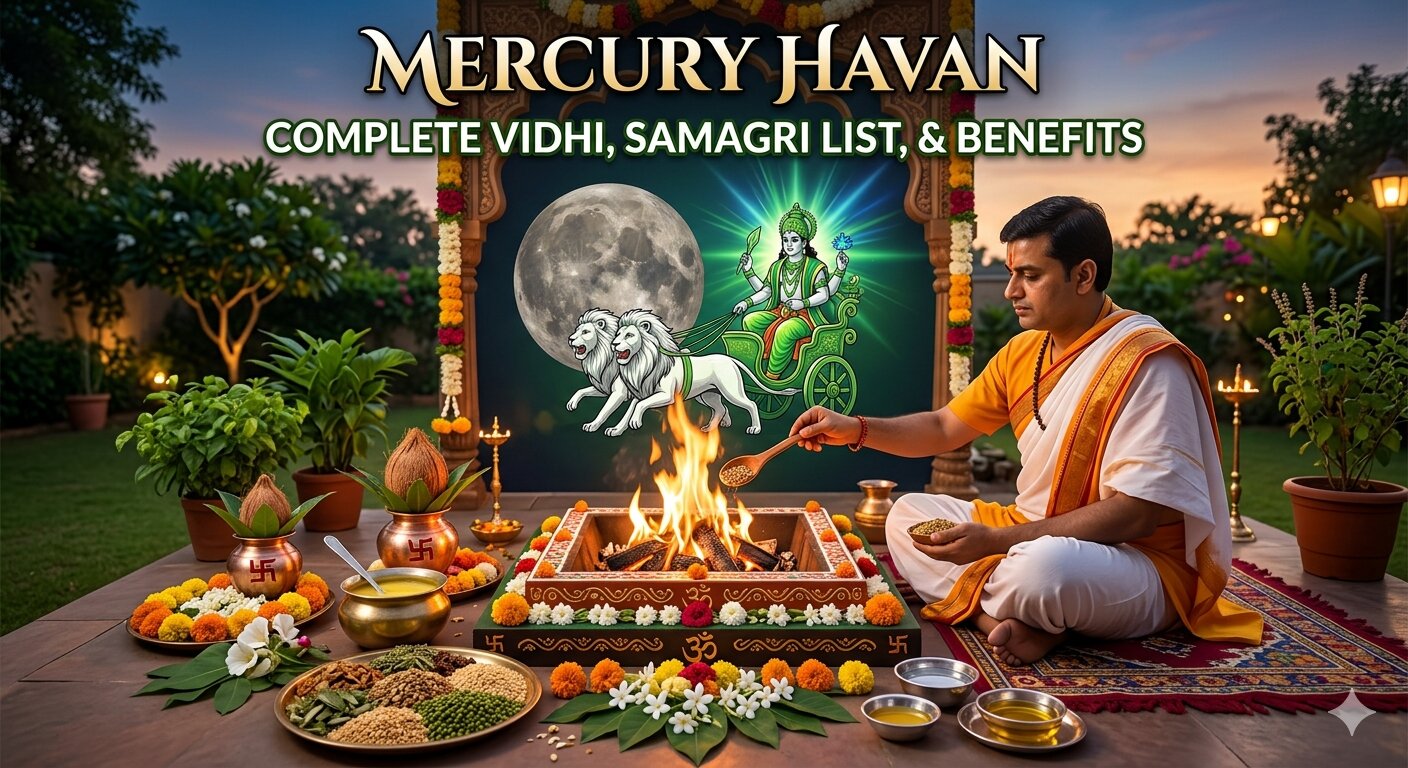
Quick Answer: How do I perform Mangal Puja to reduce Mangal Dosh? Mangal Puja is a Vedic ritual performed to pacify an afflicted or malefic Mars (Mangal Graha) in the birth chart - specifically to reduce the effects of Mangal Dosh. Perform the puja on a Tuesday (Mars's ruling day) at Brahma Muhurta (pre-dawn), facing South (Mars's cardinal direction). Gather the prescribed samagri: red flowers (marigold or hibiscus), red sandalwood (lal chandan), a copper vessel (tamba patra), red cloth, masoor dal (red lentils), jaggery (gur), and a Mangal Yantra. Conduct a full Panchopachar puja - Snan (purification), Vastra (red cloth offering), Gandha (red sandalwood), Pushpa (red flowers), and Dhoop-Deep (incense and lamp). Chant the Mangal Beej Mantra - Om Kraam Kreem Kraum Sah Bhaumaya Namah - minimum 108 times. Additionally, reciting the Hanuman Chalisa on Tuesday is one of the most effective Mangal upays in the North Indian tradition. मंगल की पूजा कैसे की जाती है? Mangal Puja Vidhi mein Mangalvar (Tuesday) ko Brahma Muhurta mein uthkar, dakshin disha (south) ki taraf munh karke pooja ki jaati hai. Lal phool (genda ya gudhal), lal chandan, tamba patra, masoor dal, gur, aur Mangal Yantra se Panchopachar vidhi se pooja ki jaati hai. Mantra - 'Om Kraam Kreem Kraum Sah Bhaumaya Namah' - 108 baar ya adhik baar jaap karna chahiye. Mangal Dosh ke upay mein Hanuman Chalisa ka path bhi ati mahatvapurna hai - visheshkar Mangalvar ke din. |
In Vedic astrology, few planetary configurations attract as much concern in matters of marriage and relationships as Mangal Dosh - also called Manglik Dosh or Kuja Dosh. When Mars (Mangal) occupies specific houses in the birth chart, its fierce, fiery energy can manifest as friction in partnerships, delays in marriage, and heightened aggression in personal conduct. Mangal Puja is the prescribed Vedic ritual remedy: a structured worship of Mangal Graha, performed to pacify Mars, redirect its destructive energy into protective strength, and progressively reduce the dosh's intensity over time.
Mangal Dosh - from the Sanskrit Mangala (Mars, the auspicious one) and Dosh (affliction) - forms when Mars occupies specific houses in the Lagna (Ascendant) chart. The classical positions recognised across Vedic astrological schools are the 1st, 4th, 7th, 8th, and 12th houses. Many authorities - including several North Indian schools - also include the 2nd house, bringing the total to six positions.
Mars is known in Vedic astrology by several names: Mangal (the auspicious), Angaraka (the burning coal), Bhauma (son of Bhumi, the Earth goddess), and Kuja (the fair one). As a karaka (significator), Mars governs courage, vitality, blood, siblings, land and property, military endeavours, mechanical ability, and the raw energy of assertiveness. Mars rules the signs Aries (Mesha) and Scorpio (Vrishchika), and reaches its highest exaltation in Capricorn (Makar).
When Mars is placed in the houses listed above, its aggressive, fiery nature disturbs the balance of those life domains - most significantly the 7th house (marriage and partnerships) and the 8th house (longevity of the spouse and joint resources). The result is what tradition describes as Mangal Dosh: a configuration requiring specific propitiation of Mars to restore harmony.
Classical Note: Mangal Dosh is among the most discussed configurations in the post-classical Jyotish tradition, particularly in North India where it has significant weight in matrimonial compatibility assessment (Kundali Milan). Contemporary astrologers emphasise that the dosh must be evaluated alongside the complete chart - the strength of the Ascendant lord, the Navamsha (D9) chart, applicable cancellation conditions, and the operative Dasha - before its severity is pronounced. Many charts that technically contain Mangal Dosh carry no meaningful affliction when cancellation rules apply.
The table below summarises how Mars's placement in each of the six Mangal Dosh positions manifests in the native's life, and the relative intensity associated with each placement.
| House | Life Area Affected | Core Effects and Intensity |
|---|---|---|
| 1st (Lagna) | Self, personality, health | Mars in the Lagna charges the native with aggression and impulsiveness; can create dominance issues in marriage; moderate to high intensity |
| 2nd | Family, speech, wealth | Harsh speech, financial disputes, family conflicts; considered by most North Indian schools; moderate intensity |
| 4th | Home, mother, property | Domestic instability, property conflicts, difficulty in settling; mother's health may also be affected |
| 7th | Marriage, partnerships | Primary marriage house; most discussed placement; conflicts with spouse, delays in marriage, compatibility tension; high intensity |
| 8th | Longevity, joint resources | Affects longevity of spouse in traditional interpretation; also triggers accidents and health crises; considered highest intensity |
| 12th | Expenditure, foreign lands, bed pleasures | Financial drain, troubled private life, emotional distance in marriage; often overlooked but consistently mentioned in classical texts |
A crucial interpretive point: the 7th-house placement is the most discussed because it directly afflicts the house of marriage. The 8th-house placement is considered the most intense because of traditional associations with the longevity of the spouse. However, no placement is irredeemably negative when cancellation conditions are present - and several chart configurations actively reduce Mangal Dosh to a benign influenc
The dosh is cancelled (Bhang) or substantially reduced under several recognised classical conditions. When any of these apply, the remedial urgency is significantly reduced - though regular Mars propitiation remains beneficial:
Cancellation does not erase the karmic signature of Mars - it means the native is better positioned to channel Mars's energy constructively rather than being overwhelmed by its more difficult manifestations.
The following items are required for a complete Mangal Graha Shanti Puja. All items follow Mars's elemental and colour associations - red (rakta), copper (tamba), and fiery energy.
| Samagri Item | Hindi Name | Purpose in Puja |
|---|---|---|
| Red Flowers (Marigold / Hibiscus) | Lal Phool (Genda / Gudhal) | Pushpa offering; red is Mars's colour |
| Red Sandalwood Paste | Lal Chandan | Gandha (fragrance offering); cooling Mars's fiery energy |
| Copper Vessel (filled with water) | Tamba Patra / Kalash | Mars's metal is copper; used for Abhishek and offering |
| Red Cloth | Lal Vastra | Vastra offering; Mars's associated colour |
| Red Lentils (Masoor Dal) | Masoor Dal | Mars's grain; offered to deity and donated to poor |
| Jaggery (Raw Cane Sugar) | Gur | Naivedya (food offering) to Mangal Dev |
| Mangal Yantra (copper-etched) | Mangal Yantra | Geometric representation of Mars's energy; primary worship object |
| Red Coral / Sindoor | Moonga / Sindoor | Optional: offering sindoor to Hanuman on Tuesday as Mangal upay |
| Ghee Lamp | Ghee Diya | Deep (lamp) offering; red ghee preferred, otherwise regular ghee |
| Incense Sticks | Agarbatti / Dhoop | Dhoop offering to complete Panchopachar |
Note: All items should ideally be procured fresh on the day of puja or the evening before. The copper vessel should be cleaned with tamarind or lemon to remove tarnish before use. The Mangal Yantra should be energised by a qualified Jyotishi or pandit before installation if possible.
The following is the complete Mangal Puja Vidhi for home worship, structured as a Panchopachar puja (five-element offering). For a formal Graha Shanti puja with full Homa and Navagraha rites, a qualified pandit should conduct the ceremony.
Before beginning, sit in a meditative posture facing South. Place your right hand on the Mangal Yantra or copper vessel and speak the Sankalpa - stating your name, gotra, the purpose of the puja (Mangal Dosh Shanti), and your intention. This conscious statement of purpose is what transforms a ritual from mere performance into a spiritually potent act.
Begin all Vedic rituals with a brief invocation to Lord Ganesha to remove obstacles. Offer flowers, a small piece of jaggery, and chant Om Gam Ganapataye Namah eleven times. This step cannot be skipped in classical Vedic ritual.
Pour clean water from the copper vessel over the Mangal Yantra three times, followed by milk once, and finally clean water again. While pouring, chant Om Kraam Kreem Kraum Sah Bhaumaya Namah continuously. Wipe the Yantra clean with a red cloth.
This is the most important step. With eyes closed, facing South, begin the mantra japa:
Primary Mangal Dosh Mantra ॐ क्रां क्रीं क्रौं सः भौमाय नमः Om Kraam Kreem Kraum Sah Bhaumaya Namah Recitation: Minimum 108 times daily, ideally at Brahma Muhurta (the pre-dawn hour). Continue for 40 consecutive Tuesdays for full effect. Why this mantra: This is the Beej (seed) mantra of Mangal Graha. 'Bhaumaya' refers to Bhauma - the son of Bhumi (Earth) - one of Mars's primary Vedic names. The syllables Kraam, Kreem, Kraum are bija aksharas that concentrate Mars's energy and redirect it from destructive to protective. Additional Mantras: • Om Angarakaya Namah - daily 108 times (Angaraka is another classical name of Mars) • Rina Mochana Mangala Stotram - for relief from debts and property disputes linked to afflicted Mars • Hanuman Chalisa - 1 full recitation every Tuesday as a Mangal upay |
Use a rudraksha mala (rosary) for counting - ideally one made of 5-mukhi (five-faced) rudraksha beads. Complete a minimum of 108 repetitions. For a concentrated Mangal Shanti course, perform 1,008 repetitions on each of 40 consecutive Tuesdays.
After mantra japa, perform the aarti of the Mangal Yantra by rotating the ghee lamp clockwise in circular motions. Sing or recite the Mangal Aarti. Perform a mental parikrama (circumambulation) or, if space permits, walk around the puja altar three times.
Daan is an essential and non-negotiable part of Mangal Dosh remediation. On the same Tuesday, donate the following to a Brahmin, temple, or genuinely needy person: masoor dal (red lentils), red cloth, jaggery, and copper items. Blood donation - if the native is medically eligible - is one of the most powerful Mangal Daan acts, as Mars governs blood in Vedic astrology.
One of the most widely practised and traditionally endorsed Mangal Dosh remedies - particularly in the North Indian Vedic tradition - is the regular recitation of the Hanuman Chalisa on Tuesdays. This practice is recommended across Parashari Jyotish, Lal Kitab, and popular remedial traditions alike, and carries the endorsement of generations of practising Jyotishis.
The link between Lord Hanuman and Mars is not merely folk belief - it has a scriptural and astrological basis. Lord Hanuman is the ruling deity (adhidevata) associated with Mars in many Vedic ritual texts. Hanuman embodies the highest expression of Martian qualities: boundless physical energy and courage (valor), absolute discipline and celibacy (brahmacharya), devoted service (seva), and protection of the righteous. By worshipping Hanuman, the devotee propiciates the finest qualities of Mars - redirecting its energy from aggression and conflict to strength, courage, and devotion.
Tuesday (Mangalvar) is simultaneously the day of Mars and the most auspicious day for Hanuman worship in the Northern and Central Indian tradition. The Hanuman Chalisa, composed by Goswami Tulsidas in the Awadhi language, is a 40-verse hymn that is among the most recited texts in the Hindu world. For Mangal Dosh specifically:
Are you currently struggling with life phases like Astrology? Discover your precise chart insights now.
While the home puja described above is powerful as a daily practice, a formal Mangal Graha Shanti Puja performed by qualified priests at a recognised Mars temple carries a significantly greater ritual potency - particularly for severe Mangal Dosh cases or when marriage is imminent.
Shri Mangalnath Temple, Ujjain, Madhya Pradesh
The Shri Mangalnath Mahadev Temple in Ujjain is the most sacred and celebrated site for Mars worship in India. Here, Lord Mangal is venerated as a form of Lord Shiva - consistent with the Vedic understanding that Mars (Bhauma) is the son of Earth (Bhumi) and a protege of Shiva. The Mangal Graha Shanti Puja performed at this temple follows the full classical Navagraha Shanti sequence with a specific Mangal Homa, and is considered the most authoritative ritual intervention for Mangal Dosh.
Hanuman Temples - Tuesday Puja
Any major Hanuman temple becomes a site for Mangal propitiation on Tuesdays. Significant temples include the Sankat Mochan Hanuman Mandir in Varanasi, the Hanuman Dhoka in Kathmandu, and Hanuman Garhi in Ayodhya. Regular Tuesday visits combined with Hanuman Chalisa recitation constitute one of the most sustained and effective Mangal Dosh remedies available.
Lord Subramanya Temples - South India
In the South Indian tradition, Lord Subramanya (Kartikeya, Murugan) is the primary deity of Mars. Temples such as Palani Murugan Temple in Tamil Nadu and the Subramanya Temple in Karnataka are especially sacred for Mars propitiation. Tuesday and the sixth lunar day (Shashti) are the most auspicious days for Subramanya worship.
Beyond the core puja and mantra practice, the classical Vedic and Lal Kitab traditions prescribe a range of supporting remedies:
The Lal Kitab, composed by Pt. Roop Chand Joshi, offers a practical stream of earthly remedies for Mars affliction:
Red Coral (Moonga), the gemstone associated with Mars, can significantly strengthen a benefic Mars or reduce the effects of an afflicted one. It should be worn on the ring finger of the right hand on a Tuesday morning after performing Mangal Puja. The stone must be set in copper (Mars's metal).
CRITICAL CAUTION: Red Coral amplifies Mars's energy in all directions - both positive and negative. Wearing it with an afflicted Mars can intensify the dosh rather than reduce it. Consult a qualified Jyotishi who reviews your complete chart before purchasing or wearing this gemstone. Never wear it based solely on having Mangal Dosh.
| Remedy Category | Key Practices |
|---|---|
| Mantra | Om Kraam Kreem Kraum Sah Bhaumaya Namah (108x daily on Tuesdays minimum); Om Angarakaya Namah (108x daily) |
| Puja | Mangal Graha Shanti Puja on Tuesday at Brahma Muhurta; Panchopachar with red samagri; Mangal Yantra Puja |
| Hanuman Upay | Hanuman Chalisa recitation every Tuesday; sindoor offering to Hanuman; visit Hanuman temple on Tuesdays |
| Fasting | Tuesday fast (Mangalvar Vrat) for 21 consecutive Tuesdays; consume only sattvic foods post-puja |
| Daan (Donation) | Donate masoor dal, red cloth, jaggery, copper items to Brahmins or needy on Tuesdays |
| Gemstone | Red Coral (Moonga) on ring finger of right hand - only after qualified Jyotishi consultation |
| Pilgrimage | Shri Mangalnath Temple, Ujjain; Hanuman temples on Tuesdays; temples of Lord Subramanya (South India) |
| Symbolic Remedy | Kumbh Vivah (marriage to clay pot or peepal tree) for severe Mangal Dosh before marriage |
Is Mangal Dosh always harmful?
No. Many accomplished individuals - athletes, military officers, surgeons, engineers, and entrepreneurs - have Mangal Dosh in their charts. Mars's energy, when properly channeled, produces exceptional vitality, courage, and drive. The dosh's effects are strongly modified by the rest of the chart, the strength of the Ascendant lord, and applicable cancellation rules. Mangal Dosh should be approached with intelligent understanding, not fear.
Can Mangal Dosh be permanently removed?
Vedic tradition holds that no dosh is permanently removed through ritual alone - it represents karmic energy carried from prior lifetimes. Consistent remedial practice, however, significantly reduces its intensity and accelerates karmic resolution. The most enduring results come from ongoing practices: Tuesday fasting, regular mantra japa, Hanuman worship, and acts of Mangal Daan (especially blood donation) - rather than a single one-time puja.
Can two Manglik people get married?
Yes - in fact, most classical schools consider a Manglik–Manglik union self-neutralising, as the Mars energies of both partners balance each other. This is one of the most accepted cancellation rules in matrimonial astrology. A qualified Jyotishi should assess both charts fully, including the Navamsha (D9) chart, before making a final matrimonial recommendation.
At what age does Mangal Dosh weaken?
Mars is said to reach full planetary maturity (Graha Pakva) at age 28. Most classical and contemporary practitioners hold that the malefic expression of Mangal Dosh diminishes significantly after the native crosses 28. This is why many Jyotishis recommend that Manglik individuals, especially those with severe placements, consider delaying marriage until after 28 - though this is guidance to be weighed alongside the complete chart, not a rigid rule.
Is Kumbh Vivah necessary for every Manglik?
No. Kumbh Vivah is prescribed specifically for severe cases of Mangal Dosh - primarily when a Manglik individual is marrying a non-Manglik partner and cancellation conditions do not apply. For mild or partially cancelled dosh, consistent mantra practice, Mangal Puja, and Tuesday fasting are sufficient remedies. A qualified Jyotishi must evaluate whether Kumbh Vivah is warranted based on the specific chart.
Mangal Dosh is one of Vedic astrology's most vivid teachings on the dual nature of planetary energy - the same Mars that drives aggression and conflict is also the planet of courage, vitality, and righteous action. The image of a fiery red planet hemmed in the wrong house of the chart speaks to a life where Martian energy has not yet found its constructive channel.
The Mangal Puja Vidhi outlined in this guide is not a suppression of Mars - it is an invitation to Mars's highest expression. The red flowers, the copper vessel, the facing of the South, the recitation of the Beej Mantra - each element is a precise Vedic technology designed to align the native's energy field with Mars's protective and courageous qualities rather than its disruptive ones. The Hanuman Chalisa, recited with devotion on Tuesdays, takes this further: it offers Mars's archetype of boundless, disciplined strength as a model for the native to aspire to.
Perform the Mangal Puja not from fear of the dosh but from the understanding that Mars, properly honoured, becomes your greatest ally - a planet that gives fearlessness, strength, and the capacity to overcome every obstacle the chart places before you.
Connect with a Jyotishi on Nakshatraai.ai Generate your Kundali and check for Mangal Dosh: nakshatraai.ai/add-kundli Speak with an expert Jyotishi for a personalised Mangal Puja assessment and remedy plan: nakshatraai.ai/astrologer |
Disclaimer: This article is for educational and informational purposes only. Astrological guidance does not substitute for consultation with a qualified Jyotishi or Hindu priest who can evaluate your specific birth chart and circumstances. Ritual procedures should ideally be performed under the guidance of a qualified pandit.