| Quick Answer: Does Nav Graha Yantra Solve All Planetary Problems at Once? |
| Does Nav Graha Yantra solve all planetary problems at once? The Nav Graha Yantra is a single sacred geometric diagram that houses all nine planetary energies -Sun, Moon, Mars, Mercury, Jupiter, Venus, Saturn, Rahu, and Ketu -each in its own dedicated compartment. It balances and harmonises the collective planetary field of a person's horoscope, making it ideal for anyone with multiple planetary afflictions or doshas. However, it does not replace targeted remedies for severe individual doshas such as Kaal Sarp Dosh or Shani Sade Sati -those require dedicated puja and rituals. Think of the Nav Graha Yantra as a powerful preventive and balancing tool: it holds the entire planetary system in equilibrium while specific doshas may still need individual attention. |
| Does Nav Graha Yantra solve all planetary problems at once -Hindi mein samjhein? Nav Graha Yantra ek aisa pavitra yantra hai jisme nau grahas -Surya, Chandra, Mangal, Budh, Guru, Shukra, Shani, Rahu aur Ketu -ke liye alag-alag khane bane hote hain. Yah yantra samast grahon ki shaktiyon ko santulit karta hai aur anek grah doshas se peedit logo ke liye bahut upyogi hai. Phir bhi, agar koi gambhir dosh ho -jaise Kaal Sarp Dosh ya Shani Sade Sati -toh uske liye alag, vishesh puja aur upay zaroori hain. Nav Graha Yantra ek sampoorn aur shaktishali raksha kavach ki tarah kaam karta hai, par vishesh dosh nivaran ka poora badal nahi ban sakta. |
In Vedic astrology, the nine planets -collectively called the Nava Graha -are not distant astronomical bodies. They are cosmic intelligences, each governing a specific domain of human experience: career and authority (Sun), mind and emotions (Moon), energy and courage (Mars), intellect and communication (Mercury), wisdom and fortune (Jupiter), relationships and wealth (Venus), discipline and karma (Saturn), and the karmic shadow axis of Rahu and Ketu. When multiple planets are afflicted or weakened in a person's birth chart, a single, comprehensive remedy is needed. That remedy is the Nav Graha Yantra.
Composed of nine interlocking geometric compartments, each consecrated to one of the nine planets, the Nav Graha Yantra is one of the most comprehensive tools in the Vedic remedial system. This guide covers its structure, proven benefits, correct placement, activation ritual, associated mantras, and -critically -when this yantra is sufficient and when additional individual graha pujas are required.
The word Yantra derives from the Sanskrit root yam (to control or restrain) and trana (liberation). A yantra is therefore a geometric instrument that controls and directs subtle energies for the liberation of its worshipper from obstacles, afflictions, and karmic bondage. In classical Tantra and Jyotish tradition, yantras are considered the geometric body of a deity or planetary force -where mantras are the sound body and murtis (idols) are the physical body.
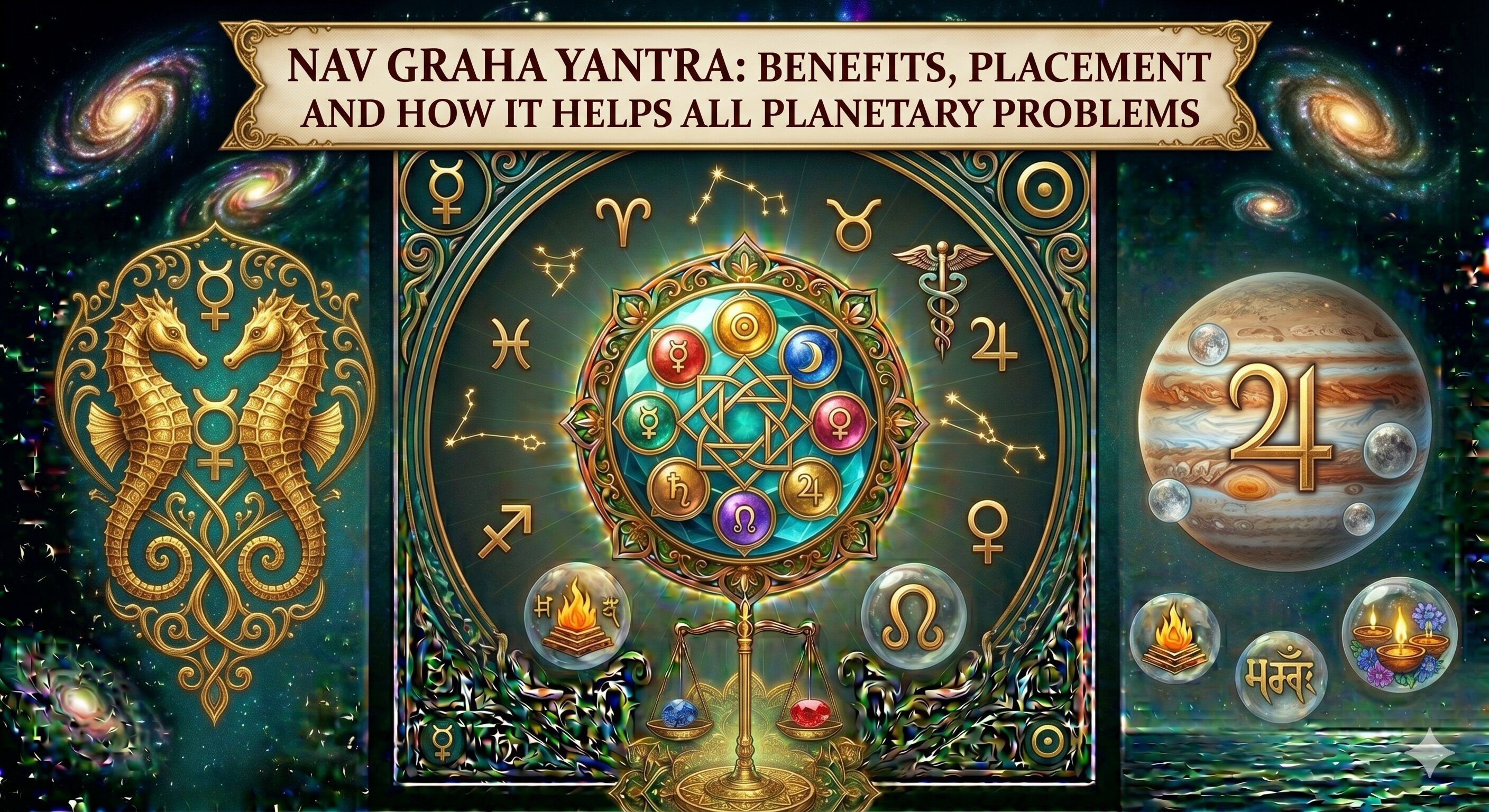
The Nav Graha Yantra integrates nine individual planetary yantras into a single unified diagram, typically engraved on copper, silver, gold, or Bhojpatra (birch bark). Each compartment contains the specific geometric form, seed syllable (beej akshar), and planetary symbol of one of the nine Vedic planets:
| No. | Planet (Graha) | Compartment Role in the Yantra |
| 1 | Surya (Sun) | Central compartment -the king of planets; governs authority, vitality, and soul purpose |
| 2 | Chandra (Moon) | Adjacent to Sun; governs mind, emotions, and maternal lineage |
| 3 | Mangal (Mars) | Governs energy, property, brothers, and courage |
| 4 | Budh (Mercury) | Governs intellect, speech, business, and education |
| 5 | Guru (Jupiter) | Governs wisdom, fortune, children, and spiritual growth |
| 6 | Shukra (Venus) | Governs relationships, arts, luxury, and marital harmony |
| 7 | Shani (Saturn) | Governs karma, discipline, longevity, and justice |
| 8 | Rahu (North Node) | Governs ambition, foreign connections, and sudden events |
| 9 | Ketu (South Node) | Governs spiritual liberation, detachment, and past-life karma |
The classical prescription for the Nav Graha Yantra appears in texts such as the Vishvasara Tantra and is endorsed by the broader tradition of Navagraha Stotra literature, attributed to the sage Vyasa. When all nine planetary compartments are energised together through the correct puja vidhi, the yantra creates a harmonising field that stabilises the native's entire planetary environment.
Classical Note: The Nav Graha Yantra works on the principle of resonance. Just as a properly tuned instrument produces harmonious sound, a correctly activated yantra attunes the subtle energies of the home or workspace -and by extension, the person who worships it - to the balanced frequency of all nine planetary intelligences simultaneously.
The navagraha yantra benefits extend across every major domain of human life because each of the nine planets governs a distinct area of experience. When the yantra is properly activated and worshipped, it produces the following cumulative benefits:
| Graha | Domain | Benefit When Energised |
| Surya | Career, authority, health | Strengthens leadership, improves recognition at work, boosts vitality |
| Chandra | Mind, emotions, mother | Reduces anxiety and mood swings; improves sleep and intuition |
| Mangal | Energy, property, siblings | Removes property disputes; increases courage and physical stamina |
| Budh | Intellect, speech, business | Enhances communication skills, academic performance, and business acumen |
| Guru | Wisdom, children, fortune | Attracts opportunities, improves judgment, supports childbirth |
| Shukra | Marriage, wealth, arts | Improves marital harmony, financial prosperity, and creative expression |
| Shani | Karma, discipline, longevity | Mitigates delays and obstacles; builds patience and just rewards |
| Rahu | Ambition, foreign, sudden gains | Channels Rahu's disruptive energy into breakthrough opportunities |
| Ketu | Spirituality, liberation | Deepens spiritual practice; reduces the hold of past-life patterns |
The primary integrated benefit is planetary equilibrium: when no single planet is starved of positive energy and none is overpowering the others, life flows with greater ease. Recurring patterns of delay, conflict, or misfortune often stem from one or two badly placed planets dragging down the entire chart -the Nav Graha Yantra functions as a recalibrating instrument for the whole planetary system.
The Nav Graha Yantra is suitable for a broad range of individuals and situations. It is especially recommended in the following cases:
Internal Link: If your chart contains Kaal Sarp Dosh -where all planets fall between Rahu and Ketu -the Nav Graha Yantra is a valuable complement to, but not a replacement for, the dedicated Kaal Sarp Shanti Puja. Read our complete guide: [Kaal Sarp Dosh: Complete Guide, 12 Types, and Proven Remedies -INTERNAL LINK PLACEHOLDER].
Correct placement is as important as the yantra itself. An incorrectly placed yantra cannot transmit its full energetic benefit -and in some traditions, improper placement can neutralise the yantra entirely. The following are the classical and practically endorsed placement rules:
The Nav Graha Yantra should ideally be installed in the dedicated puja room of the home. This is the space already consecrated by daily worship, incense, lamps, and mantra -making it the most receptive environment for the yantra's energy field.
The yantra should face East -the direction of the rising sun, which represents new beginnings, vitality, and the source of planetary light. The worshipper should face East while performing puja, with the yantra installed on the East-facing wall or on the puja altar facing East.
If a dedicated puja room is unavailable: place the yantra in the Northeast corner of the main living room or bedroom, which is the Ishaan Kona -the most sacred directional sector in Vastu Shastra, associated with spiritual blessings and divine protection.
The yantra should be placed at or above eye level -not on the floor. It may be hung on the wall, placed on a wooden or copper stand, or positioned on a raised altar surface. It should never be placed on the ground or in a bathroom, kitchen near the stove, or bedroom (unless a dedicated altar is maintained there).
For professional settings, place the Nav Graha Yantra on the East or North wall of the workspace. The business owner or decision-maker should ideally face East while seated, with the yantra visible from their workstation. This configuration channels the yantra's harmonising influence into the work environment.
| Navagraha Yantra Placement -Quick Reference |
| Best Room: Puja room (Pooja Ghar) |
| Best Direction: East-facing wall |
| Alternative: Northeast corner (Ishaan Kona) |
| Height: At or above eye level |
| Avoid: Floor, kitchen, bathroom, or unconsecrated spaces |
| Office: East or North wall; owner faces East |
A yantra that has not been activated (pranpratishtha) is merely an engraved metal plate. The activation ritual breathes life into the yantra, establishing the planetary intelligences within it as living, responsive forces. The Nav Graha Yantra should ideally be activated on a Sunday -the day of the Sun, the king of planets -during Brahma Muhurta (the hour before sunrise) or during the auspicious morning hours.
Most auspicious activation dates: Sundays coinciding with Uttarayana (northern solstice), Navratri, Diwali, or Makar Sankranti. Avoid activation during Rahu Kaal unless a qualified Jyotishi specifically recommends it.
Note: If you wish to have the yantra professionally activated by a qualified pandit before installation, many Jyotish and temple services offer this. The yantra arrives fully pranpratishtha-consecrated and may be installed directly after a brief welcome puja at home.
| Navagraha Beej Mantras -108 Repetitions Each |
| Surya (Sun): Om Hraam Hreem Hraum Sah Suryaya Namah |
| Chandra (Moon): Om Shraam Shreem Shraum Sah Chandraya Namah |
| Mangal (Mars): Om Kraam Kreem Kraum Sah Bhaumaya Namah |
| Budh (Mercury): Om Braam Breem Braum Sah Budhaya Namah |
| Guru (Jupiter): Om Graam Greem Graum Sah Gurave Namah |
| Shukra (Venus): Om Draam Dreem Draum Sah Shukraya Namah |
| Shani (Saturn): Om Praam Preem Praum Sah Shanaischaraya Namah |
| Rahu: Om Bhram Bhreem Bhraum Sah Rahave Namah |
| Ketu: Om Sraam Sreem Sraum Sah Ketave Namah |
The Navagraha Stotra, attributed to Vyasa and found in the Charandasi tradition, is the most comprehensive mantra for collective planetary propitiation. It addresses all nine planets in sequence with their classical epithets. For regular puja, reciting the full Stotra 9, 27, or 108 times is more powerful than the individual beej mantras alone, as it invokes the relational harmony between the planets rather than each in isolation.
The opening verse of the Navagraha Stotra:
| Japaa-kusuma-sankasham kashyapeyam mahadyutim | |
| Tamorim sarva-paapaghnam pranatosmi Divakaram || |
| (Salutation to the Sun -blazing like the hibiscus, son of Kashyapa, the destroyer of darkness and all sins) |
The complete Stotra proceeds through each of the nine planets in a similar verse structure. It is widely available in Sanskrit with transliteration from Vedic libraries and Jyotish publications, and is the recommended mantra for the Nav Graha Yantra puja.
Are you currently struggling with life phases like Astrology? Discover your precise chart insights now.
Once activated and placed, the Nav Graha Yantra requires consistent daily maintenance to sustain its energy field. The following daily practice (nitya puja) is recommended:
Nav Graha Yantra kaise use karein -practical Hinglish summary: Rozana subah yantra ke samne ghee ka diya jalayein, navagraha stotra padhein ya beej mantras ka jaap karein, aur dhoop-agarbatti chalayein. Ravivaar ko poori puja karein. Yantra ko saaf rakhein -dhool ya ganda hona yantra ki shakti ko kam karta hai.
One of the most practical questions a seeker faces is: is the Nav Graha Yantra sufficient for my situation, or do I need individual planetary remedies? The answer depends on the severity and specificity of the planetary afflictions in the birth chart.
| Situation | Nav Graha Yantra Sufficient? | Individual Graha Puja Also Needed? |
| General planetary balance and protection | Yes -ideal tool | Not required |
| New home or office consecration | Yes -highly recommended | Not required unless specific dosh identified |
| Mild multi-planet affliction (2–3 planets weakened) | Yes -very effective | May support but not mandatory |
| Severe single-planet affliction (e.g., debilitated Saturn) | Partial benefit only | Yes -individual Shani puja essential |
| Kaal Sarp Dosh (all planets between Rahu–Ketu) | Complementary support | Yes -Kaal Sarp Shanti Puja required |
| Shani Sade Sati (7.5-year Saturn transit) | Good protective base | Yes -Shani-specific remedies required |
| Mangal Dosh (Mars in 1st, 4th, 7th, 8th, or 12th house) | Partial -balances Mars broadly | Yes -Mangal shanti puja recommended |
| Guru Chandal Dosh (Jupiter + Rahu conjunction) | Complementary support | Yes -targeted Jupiter–Rahu remedy needed |
Key principle: The Nav Graha Yantra is an excellent preventive and balancing tool. For mild to moderate multi-planet challenges, it is often sufficient. For severe, chart-specific doshas that have been formally identified in a Jyotish reading -such as Kaal Sarp Dosh, Mangal Dosh, Pitra Dosh, or Shani Sade Sati in its most intense phase -the Nav Graha Yantra should be used alongside, not instead of, the prescribed dosh-specific remedy.
Internal Link: For those navigating Kaal Sarp Dosh alongside general planetary challenges, we recommend reading [Kaal Sarp Dosh: Complete Guide, 12 Types, and Proven Remedies -INTERNAL LINK PLACEHOLDER] for a complete understanding of the specific remedies that must accompany the Nav Graha Yantra in such cases.
| Benefit Area | Nav Graha Yantra Ke Fayde |
| Overall planetary harmony | Balances the energy of all 9 planets simultaneously, reducing conflict between planetary forces in the chart |
| Career and finance | Strengthens Sun (authority), Jupiter (opportunity), and Mercury (business intellect) together |
| Relationships and marriage | Harmonises Venus and Moon to improve marital peace, emotional connection, and maternal relationships |
| Health and vitality | Sun and Mars compartments energise physical stamina, immunity, and recovery from illness |
| Spiritual growth | Ketu compartment deepens detachment and meditation; Guru compartment expands wisdom |
| Protection from negative energy | Rahu's shadow energy is contained and channelled constructively; Shani's karmic tests are met with greater resilience |
| Home and family prosperity | Moon (domestic peace) and Jupiter (abundance) compartments bless the household with contentment and growth |
Yes. Unlike gemstones -which must be prescribed after careful chart analysis because they amplify both positive and negative planetary energy -the Nav Graha Yantra is broadly safe for general use. It harmonises rather than amplifies any single planet, making it suitable for most individuals without requiring a personalised chart reading. However, if you suspect specific doshas in your chart, a Jyotish consultation before or alongside installation is always recommended.
Copper is the most commonly used and accessible material and is traditionally associated with the Sun. It is the standard material for most navagraha yantras used in home worship. Silver (associated with the Moon) adds a cooling, emotive quality and is particularly beneficial for those with Moon-related afflictions. Gold, though rare and expensive, carries the combined energies of Jupiter and the Sun and is considered the most powerful material. For most households, a well-crafted copper yantra that has been properly activated is fully effective.
A properly consecrated yantra does not lose its potency under normal circumstances. However, if the yantra is dropped, cracked, or significantly tarnished beyond cleaning, it should be respectfully immersed in a flowing river (visarjan) and replaced. Many practitioners perform an annual re-energisation puja on Navaratri or the anniversary of the original installation -this refreshes the yantra's energetic field and renews the worshipper's sankalpa.
Classical Jyotish tradition recommends keeping yantras in the puja room rather than the bedroom. If the bedroom is the only viable option -for example, in a studio apartment -maintain a dedicated altar in the Northeast corner of the room, keep the yantra covered with a clean cloth during sleeping hours, and ensure a lamp or diya is lit during puja time. The yantra should not face the bed directly.
Daily worship, even if brief -a lamp, a flower, and a single recitation of the Navagraha Stotra -is ideal. The yantra's effectiveness is sustained and deepened through consistent devotion. If daily puja is not possible, at minimum light the lamp on Sundays and perform the full puja on auspicious days such as Navratri, Diwali, and the solar and lunar sankrantis.
Nav Graha Yantra ke pramukh laabh hain: samast grahon ka santulan, career aur vyavsay mein pragati, vaivahik sukh, swasthya suraksha, aur aatmik unnati. Iska upyog karne ke liye: shuddh mann se nitya subah diya jalayein, navagraha stotra padhein, aur Ravivaar ko poori puja karein. Ek bar achhi tarah se pran pratishtha ho jaane ke baad, yah yantra varshon tak ghar ki suraksha karta hai.
The Nav Graha Yantra is one of the most elegant solutions the Vedic tradition offers to the complexity of the human astrological situation. Rather than requiring nine separate yantras, nine separate pujas, and nine separate mantras -each demanding consistent attention -it brings the entire planetary council into one harmonised field, making the practice both comprehensive and manageable.
Its greatest strength is equilibrium. When the nine planets function in balance -when no single planet is starved of positive energy and none is dominating the chart with unchecked negative force -life unfolds with a quality of ease and purpose that those burdened by planetary imbalance rarely experience. The Nav Graha Yantra does not promise to dissolve all karma instantaneously. What it does promise, when worshipped with devotion and consistency, is a steadily improving relationship between the native and the cosmic forces that govern their life.
Use it as your primary remedy if multiple planets are challenging you and no single dosh has been formally identified. Use it as a complementary practice alongside targeted remedies for severe, chart-specific doshas such as Kaal Sarp Dosh or Shani Sade Sati. In either case, approach the yantra not as a mechanical solution but as a living relationship -with the nine cosmic intelligences that, according to Vedic wisdom, are continuously shaping the arc of your experience.
Recite the Navagraha Stotra with sincerity. Light the lamp on Sundays. Maintain the puja with consistency. The nine planets, acknowledged and honoured, become allies rather than adversaries.
| Connect with a Jyotishi on Nakshatraai.ai |
| Generate your Kundali and check your planetary positions: nakshatraai.ai/add-kundli |
| Speak with an expert Jyotishi for a personalised planetary assessment and Nav Graha Yantra activation guidance: nakshatraai.ai/astrologer |
Disclaimer: This article is for educational and informational purposes only. Astrological guidance does not substitute for consultation with a qualified Jyotishi or Hindu priest who can evaluate your specific birth chart and circumstances. Ritual procedures should ideally be performed under the guidance of a qualified pandit.