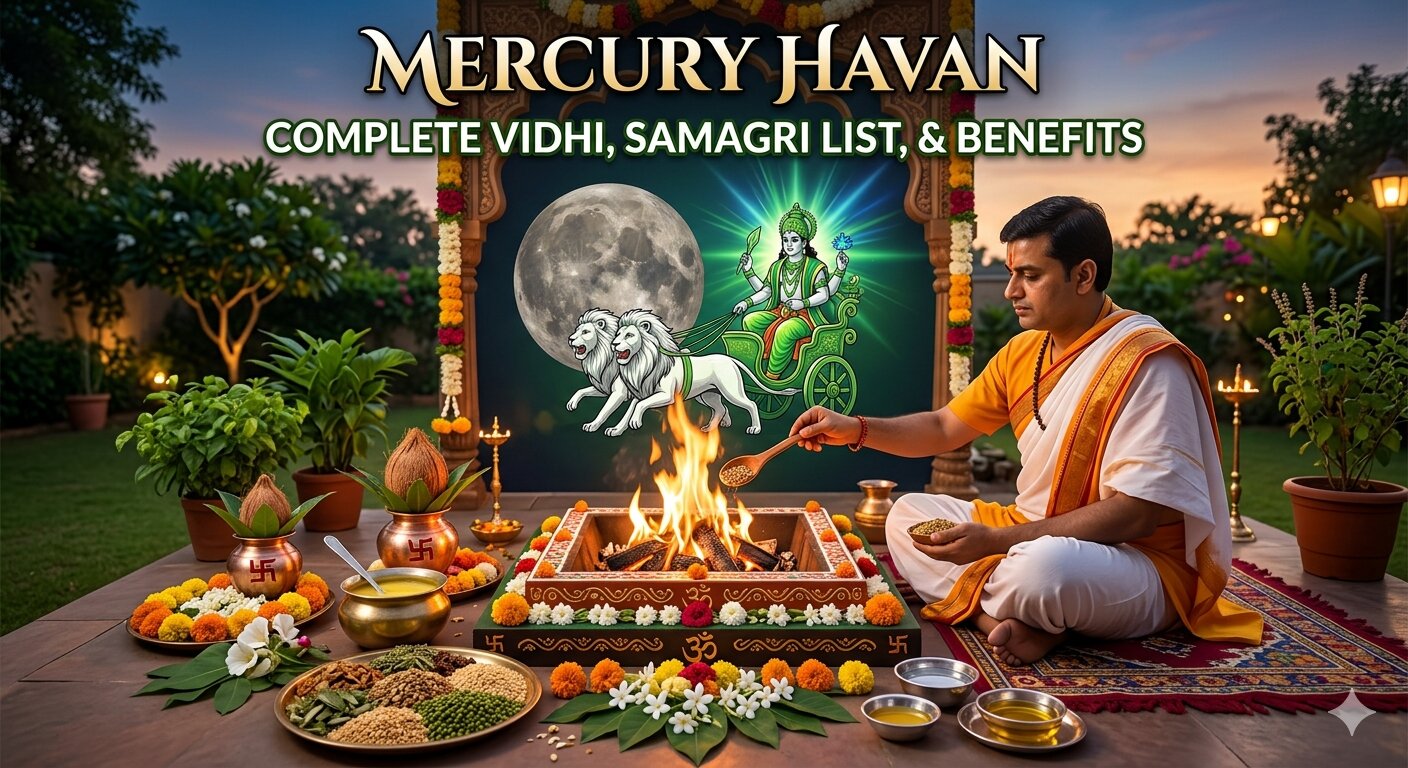
Quick Answer: How to Perform Rahu Graha Shanti Puja and When Is It Needed?
How to perform Rahu Graha Shanti Puja and when is it needed? Rahu Graha Shanti Puja is needed during Rahu Mahadasha or Antardasha, when Rahu occupies sensitive houses such as the 1st, 5th, 7th, 8th, or 12th, or when Kaal Sarp Dosh is present in the birth chart. The puja follows the Shodashopachara (sixteen-step) vidhi ,beginning with Sankalpa and Ganapati Puja, proceeding through Navagraha Shanti, Rahu Abhishek, Yantra Puja, mantra japa (Om Bhram Bhreem Bhraum Sah Rahave Namah), Homa, and concluding with Aarti and charitable donation. Key samagri includes blue or black flowers, sandalwood, Durva grass, a whole coconut, black cloth, a gomukhi mala for japa, and a Rahu Yantra. Saturday or the Rahu Kaal period are the most auspicious times. Post-puja, donating a blue or black blanket to a poor person on Saturday is a classical remedy.
राहु ग्रह की शांति पूजा कैसे की जाती है? Rahu Graha Shanti Puja tab zaruri hoti hai jab Rahu Mahadasha ya Antardasha chal rahi ho, janam kundali mein Rahu pehle, paanchve, saatve, aathve ya barahve bhav mein ho, ya Kaal Sarp Dosh ho. Puja ka sahi tarika Shodashopachara (solah upachar) vidhi hai ,Sankalpa aur Ganapati Puja se shuru hokar, Navagraha Shanti, Rahu Abhishek, Yantra Puja, mantra japa (Om Bhram Bhreem Bhraum Sah Rahave Namah), Homa aur Aarti tak. Zaruri samagri mein neele ya kaale phool, chandan, Durva ghaas, saabut naariyal, kaala kapda, gomukhi mala aur Rahu Yantra shamil hain. Shanivar ya Rahu Kaal ka samay sabse shubh hai. Puja ke baad Shanivar ko kisi garib vyakti ko neela ya kaala kambal daan karna ek prachin aur prabhavshali upay hai. |
In Hindu mythology, Rahu is the severed head of the demon Svarbhanu, who disguised himself as a god during the churning of the cosmic ocean (Samudra Manthan) to drink the nectar of immortality (Amrita). Lord Vishnu, alerted by the Sun and Moon, severed Svarbhanu's head with the Sudarshan Chakra before the nectar reached his throat. Because he had already swallowed a few drops, Svarbhanu became immortal, his head becoming Rahu (the North Node) and his tailless body becoming Ketu (the South Node). This is why solar and lunar eclipses are mythologically described as Rahu swallowing the Sun or Moon in periodic revenge.
Rahu does not own a zodiac sign in the traditional sense but is considered to function well in Gemini and Virgo (signs of Mercury, a friendly planet). It is generally regarded as exalted in Taurus (or Gemini, per different schools) and debilitated in Scorpio (or Sagittarius). Rahu takes approximately 18 months to transit each sign, completing its retrograde orbit of the zodiac in approximately 18 years ,which is also the length of its Mahadasha.
Classical Note: Goddess Durga is the presiding deity (Adhishthatri Devi) of Rahu across major Vedic astrological texts. Lord Shiva ,as Nagadhipati, the lord of serpents ,is also propitiated alongside Rahu, since Rahu takes the form of a serpent (sarpa). Lord Bhairava and Goddess Kali are additionally invoked in some regional and tantric traditions for Rahu pacification.
A qualified Jyotishi should evaluate the complete birth chart before recommending Rahu Shanti Puja. That said, the following configurations and life conditions are the classical indicators that make this puja necessary and beneficial:
| Category | Details |
| Rahu Mahadasha | Rahu's 18-year major period ,especially its opening years ,can bring intense disruption, confusion, and ambition unmoored from wisdom. Puja is most urgently recommended at the beginning of Rahu Mahadasha. |
| Rahu Antardasha | The sub-period of Rahu within other Mahadashas (particularly Saturn, Ketu, or Mars Mahadasha) often triggers acute Rahu effects. |
| Rahu in 1st House | Rahu on the Ascendant afflicts personal identity, health, and physical appearance; produces restlessness and impulsive decisions. |
| Rahu in 5th House | Afflicts intellect, children, and past-life karma; can cause obsessive thinking and delays related to progeny. |
| Rahu in 7th House | Turbulence in partnerships and marriage; attraction to unconventional or foreign partners; deception in relationships. |
| Rahu in 8th House | Life-altering crises, mysterious health issues, hidden fears; powerful but dangerous placement needing propitiation. |
| Rahu in 12th House | Excessive expenditure, sleep disturbances, and spiritual confusion; can produce both liberation and self-undoing. |
| Kaal Sarp Dosh | All planets hemmed between Rahu and Ketu ,Rahu Shanti Puja is a core remedy, alongside the Kaal Sarp Shanti Puja. |
| Rahu conjunct Sun or Moon | Grahan (eclipse) yoga: afflicts vitality (Sun) or mental peace (Moon) severely. |
| Rahu transit over natal Sun, Moon, or Ascendant | Even without a Mahadasha trigger, these transits can produce intense Rahu effects warranting upay and puja. |
The samagri (ritual materials) for Rahu Graha Shanti Puja reflects Rahu's astrological associations: dark blue and black colours, iron and lead metals, sesame seeds, serpent imagery, and the Yantra that geometrically encodes the graha's energy. The list below is comprehensive for a home puja or a pandit-led ceremony.
| Samagri Item | Purpose / Significance | Notes |
| Blue or black flowers (e.g., blue lotus, aparajita) | Rahu's associated colour is dark blue/smoke; offered to please the graha | Fresh flowers preferred; avoid red flowers |
| Sandalwood paste (chandan) | Cooling and purifying; offered during abhishek and tilak | White sandalwood preferred for Rahu |
| Durva grass (doob) | Sacred to Ganesha; invoked first to remove obstacles in any puja | 108 stalks auspicious |
| Whole coconut (sabutkhopra) | Symbol of ego-surrender; used in Sankalpa and Purnahuti | With husk for homa; without for abhishek |
| Black cloth (kala vastra) | Rahu's colour; used as aasan or donated post-puja | For deity aasan or daan to poor |
| Gomukhi mala (wool hand-bag for japa) | Holds the mala discreetly during mantra japa ,considered more potent | Woollen or cotton; 108-bead mala inside |
| Rahu Yantra (copper or silver) | Geometric diagram that anchors Rahu's energy; worshipped throughout puja | Energise before puja with mantra |
| Black sesame (kala til) | Rahu's primary grain; offered in homa and as daan | Also floated in river as upay |
| Urad dal (black gram) | Associated with Rahu and Saturn; used in homa and daan | Whole or split accepted |
| Ghee (clarified butter) | Essential homa ingredient; carries offerings to the divine | Pure cow's ghee |
| Iron nail or iron piece | Rahu's metal is iron/lead; offered symbolically for pacification | Small iron object or coin |
| Mustard oil (sarson ka tel) | Used to light the Rahu lamp (deepak); associated with Rahu and Shani | Light a diya with mustard oil before the idol |
| Camphor (kapoor) | Aarti ingredient; symbol of ego burning away in divine light | Used in final aarti |
| Incense sticks / dhoop | Creates sacred atmosphere; pleases the graha | Dark-scented: sandalwood, agar, tagar, cedar |
| Gomed (Hessonite Garnet) ,optional | Rahu's gemstone; may be placed before the yantra during puja | Only for puja placement, NOT for wearing without astrological advice |
| Panchamrit (milk, curd, honey, ghee, sugar) | Used in abhishek of the Rahu idol or yantra | Mix fresh before puja |
| Fruits and sweets (naivedyam) | Offered as bhog to Rahu | Dark-coloured fruits preferred: jamun, black grapes |
| Kalash (copper or brass pot) | Sacred water vessel; anchors divine presence | Fill with clean water, mango leaves, coconut on top |
| Sacred thread (mauli / molly) | Tied on wrist and kalash during Sankalpa | Red and yellow thread |
| Gangajal (Ganga water) | Added to kalash; purifies the puja space and offerings | A few drops sufficient if full Gangajal unavailable |
Note: For a full Rahu Shanti Yagya (homa with 18,000 mantra jaap) performed by qualified Vedic priests, additional samagri such as barley (jau), seven grains (saptadhanya), anjeer (fig), iron sheets, frankincense (loban), agar, tagar, cedar (devdaar), and jatamasi are also included in the homa material.
The classical Rahu Graha Shanti Puja follows the Shodashopachara (sixteen-step worship) framework, which is the standard complete-puja format in Vedic tradition. This may be performed at home by a devout practitioner or, for greater efficacy, under the guidance of a qualified Brahmin pandit trained in Graha Shanti procedures. The full Yagya format with 18,000 Rahu Beej Mantra jaap requires a team of priests.
Primary Rahu Beej Mantra
ॐ भ्रां भ्रीं भ्रौं सः राहवे नमः Om Bhram Bhreem Bhraum Sah Rahave Namah
Recitation: 108 times daily during personal practice; 18,000 times in a formal Rahu Shanti Yagya performed by qualified priests.
Secondary / Simpler Mantra: ॐ रां राहवे नमः | Om Raam Rahave Namah
Recitation: 108 times daily, especially during Rahu Kaal on Saturdays.
Supporting Mantras: • Om Namah Shivaya,108 times; Lord Shiva governs and calms Rahu • Om Dum Durgaye Namah ,108 times; Goddess Durga is Rahu's presiding deity • Om Gan Ganapataye Namah ,108 times; invoked at the start of all pujas |
Mantra japa is most effective when performed at a fixed time daily ,ideally during Brahma Muhurta (the hour and a half before sunrise) or during the Rahu Kaal window on Saturdays. Consistency over 40 or 108 days produces substantially stronger results than a single intensive session.
While Rahu Graha Shanti Puja can be performed at home or in any Shiva temple, certain sacred sites are particularly powerful for Rahu propitiation. These temples are either dedicated to Rahu or are known for the potency of Navagraha rituals performed there.
| Category | Details |
| Thirunageswaram, Tamil Nadu | One of the Navagraha temples of Tamil Nadu, specifically dedicated to Rahu (Naga graha). Considered the most powerful Rahu Shanti site in South India. The deity here is Rahu in the form of Naganatha. |
| Thirupaamboor, Tamil Nadu | Another significant Rahu temple in the Tamil Navagraha kshetra circuit; known for its serpent-deity worship and powerful Rahu Shanti pujas. |
| Trimbakeshwar, Nashik, Maharashtra | One of the 12 Jyotirlingas, renowned for Kaal Sarp Dosh Nivaran and Rahu-Ketu Shanti pujas. Trained priests perform Rahu Shanti as part of broader Navagraha rituals. |
| Kukkuke Subramaniya Temple, Karnataka | Famous for Sarpa Dosha and Rahu-Ketu related afflictions; Sarpa Samskara puja is performed here for serpent-related planetary issues. |
| Sri Kalahasti Temple, Andhra Pradesh | Renowned Vayu linga and Rahu-Ketu Dosha Nivarana pujas; Srikalahasteeswara Temple is one of the premier sites for Rahu-Ketu remedies. |
| Ujjain ,Kal Bhairav Temple, Madhya Pradesh | Lord Bhairava is propitiated alongside Rahu here; the city of Ujjain is considered sacred to Rahu because it is located on the prime meridian of classical Indian astronomy. |
Are you currently struggling with life phases like Astrology? Discover your precise chart insights now.
Rahu Graha Shanti Puja does not eliminate Rahu from the chart ,which would be astrologically impossible and not even desirable, since a well-channeled Rahu is a powerful driver of material achievement. Instead, the puja reduces the chaotic, deceptive, and disruptive expressions of an afflicted Rahu while amplifying its productive qualities. The classically recognised benefits are:
Alongside the formal puja, the following Rahu upay (remedies) from both classical Parashari Jyotish and the Lal Kitab tradition are widely practised for sustained Rahu pacification:
No. Rahu in favourable houses (3rd, 6th, 10th, and 11th) and well-aspected by Jupiter or Mercury can produce exceptional career success, particularly in politics, technology, media, and foreign relations. Many highly accomplished individuals have a powerfully placed Rahu. The puja is needed specifically when Rahu is afflicted, ill-placed, or operating in a difficult Mahadasha, not simply because Rahu exists in the chart.
Yes. The Shodashopachara puja as described in Section 4 can be performed at home by a sincere devotee. However, for maximum efficacy ,especially in the case of severe Rahu Mahadasha or Kaal Sarp Dosh ,the full Rahu Shanti Yagya with 18,000 mantra recitations should be performed by qualified Vedic priests. The home practice is a consistent and devotional daily remedy; the formal Yagya is a more powerful concentrated intervention.
Kaal Sarp Dosh Nivaran Puja addresses the specific configuration where all planets are hemmed between Rahu and Ketu, and primarily involves propitiation of the Rahu-Ketu axis together, with Naga (serpent) worship as a central element. Rahu Graha Shanti Puja focuses specifically on pacifying Rahu as an individual graha ,it is appropriate whenever Rahu is afflicted regardless of whether Kaal Sarp Dosh is present. When Kaal Sarp Dosh is present, both pujas are often recommended: Kaal Sarp Shanti at Trimbakeshwar and Rahu Shanti as an ongoing practice.
The correct Rahu Beej Mantra is: Om Bhram Bhreem Bhraum Sah Rahave Namah. This is established across classical Jyotish texts and is universally accepted. A simpler alternative ,Om Raam Rahave Namah ,is also valid and easier for daily personal practice. Both are effective; the Beej Mantra is more potent and is the one used in formal Yagyas.
The classical prescription for a mantra discipline (anushthana) is 40 consecutive days or 108 consecutive days. During this period, mantra japa should be performed at a consistent time daily, without a break. Interrupting the practice and restarting resets the count. During Rahu Mahadasha, maintaining daily Rahu mantra japa for the entire duration of the period is the most sustained and effective approach.
No. Gomed (Hessonite Garnet) amplifies Rahu's energy ,both positive and negative. If Rahu is severely afflicted, in an enemy sign, or connected to malefic houses (6th, 8th, 12th lords), wearing Gomed can exacerbate problems rather than resolve them. Gemstone prescription is the most individualised aspect of Jyotish remediation and requires a thorough chart analysis by a qualified Jyotishi. Never wear Gomed based solely on Rahu's Mahadasha being active without a full chart assessment.
Rahu, in Hindu cosmological understanding, is not merely a malevolent force to be feared and suppressed. It is the head of a being who desired to drink the nectar of the gods ,a metaphor for the soul's desperate, sometimes destructive reach for what lies beyond its current state. The disruption Rahu brings is the disruption of transformation: old patterns of identity and comfort are shattered to make way for something that the native could not have imagined. That is Rahu's gift, buried beneath its turbulence.
Rahu Graha Shanti Puja is not a transaction with a difficult planet ,it is an act of conscious engagement with the karmic material that Rahu represents. The mantra disciplines the obsessive mind. The homa purifies accumulated karmic residue. The daan breaks the cycle of hoarding that Rahu's shadow fosters. And the worship of Goddess Durga and Lord Shiva ,Rahu's presiding deities ,connects the native to the divine power that can contain and direct even the most intense planetary energy.
Perform the puja with understanding, not merely from fear. Maintain the mantra consistently. Observe the daan on Saturdays with genuine generosity. And when Rahu Mahadasha reaches its peak intensity, know that it is precisely at the outer edge of Rahu's coil that the most extraordinary transformations become possible.
Connect with a Jyotishi on Nakshatraai.ai Generate your Kundali and check for Rahu Dosh: nakshatraai.ai/add-kundli Speak with an expert Jyotishi for a personalised Rahu Graha Shanti Puja assessment and remedy plan: nakshatraai.ai/astrologer |
Disclaimer: This article is for educational and informational purposes only. Astrological guidance does not substitute for consultation with a qualified Jyotishi or Hindu priest who can evaluate your specific birth chart and circumstances. Ritual procedures should ideally be performed under the guidance of a qualified pandit. Gemstone recommendations require individual chart assessment.