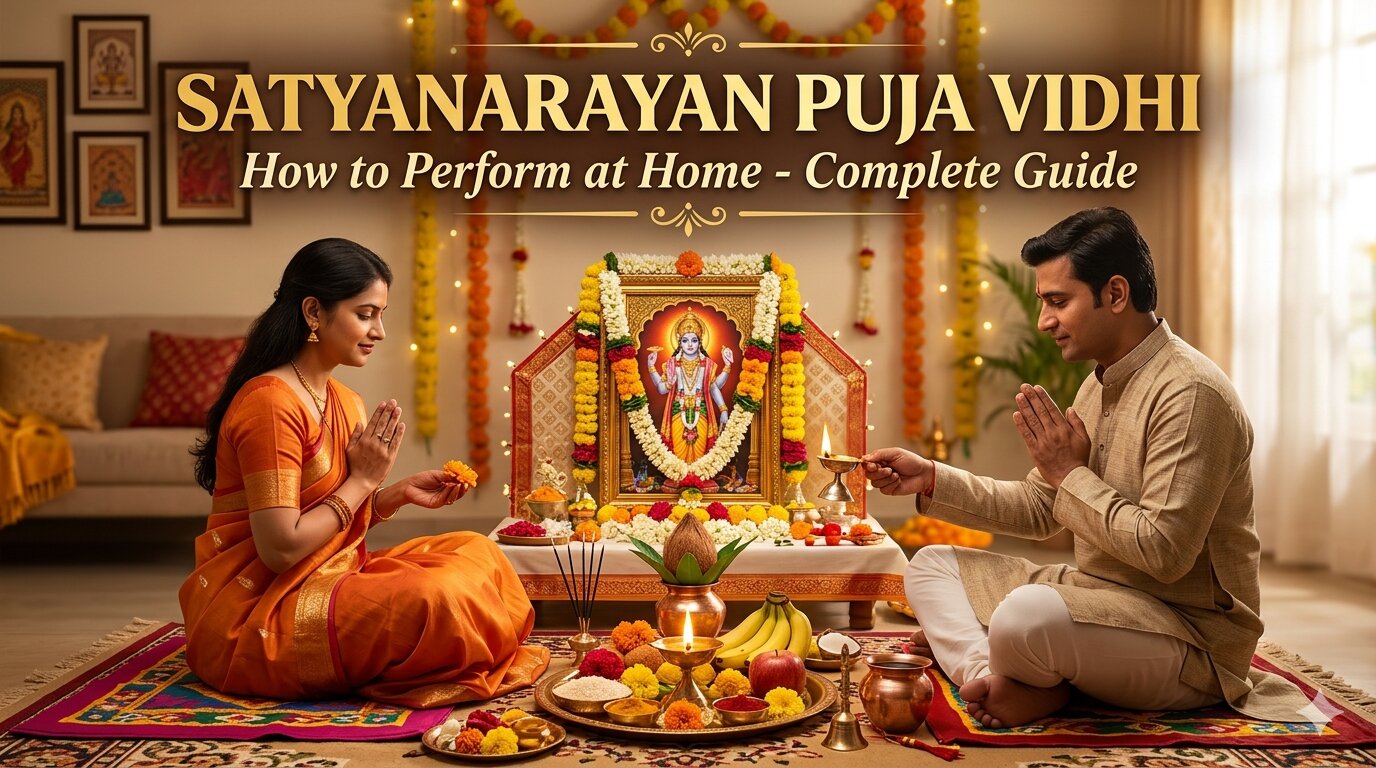
Quick Answer: How do I perform Satyanarayan Puja at home?
Satyanarayan Puja is a devotional Vishnu worship ritual performed at home to express gratitude or seek blessings on auspicious occasions - a new home, new business, marriage, childbirth, or personal milestone. The complete vidhi includes a Sankalpa (vow), Panchamrit abhishek of the Vishnu idol, Shodashopachara (16-step offering), reading all five chapters of the Satyanarayan Katha, and a three-part Aarti closing sequence. It is best performed on Purnima (full moon), Ekadashi, or Thursday, and is traditionally observed with family and invited guests.
Satyanarayan Puja Vidhi kaise karein?
Satyanarayan Puja ek Vishnu bhakti vidhi hai jo ghar par shubh avsar par ki jaati hai - naya ghar, nayi dukaan, shaadi, santaan praapti, ya koi bhi mannat poori hone par. Poori vidhi mein Sankalpa, Vishnu pratima ka Panchamrit abhishek, Shodashopachara puja, Satyanarayan Katha ke paanchon adhyaay ka paath, aur Aarti shaamil hai. Purnima, Ekadashi ya Guruvar (Thursday) ko karna sabse shubh maana jaata hai. Parivar aur mitr-jan ke saath karna paramparaanusaar hai.
Of all the Vishnu pujas performed in Hindu households across India, the Satyanarayan Puja stands apart for its accessibility, its emotional resonance, and its extraordinary longevity. It requires no temple, no elaborate priestly apparatus, and no particular astrological condition - only a clean space, a gathered family, the right samagri (ritual materials), sincere devotion, and an observance of the prescribed vidhi (procedure).
Whether you are celebrating a new beginning, fulfilling a vow made in a time of need, or simply expressing gratitude to Lord Vishnu, this puja creates a powerful container for intention, prayer, and community.
The name itself is instructive: Satya means truth; Narayan is one of Vishnu's foremost names, meaning the one who is the refuge of all beings. To perform this puja is, at its heart, to bow before truth and seek its protection.
The Satyanarayan Puja is one of the few Hindu rituals with no single prescribed season - it is performed year-round whenever the occasion or the heart calls for it. That said, certain days carry heightened auspiciousness for Vishnu worship and are traditionally preferred.
| Occasion / Day | Reason for Auspiciousness |
| Purnima (Full Moon) | Most commonly prescribed day in the Skanda Purana's Satyanarayan Mahatmya; the lunar energy is at its peak and considered most receptive to Vishnu's grace |
| Ekadashi (11th lunar day) | The sacred fast-day of Vishnu observed twice a month; Satyanarayan Puja on Ekadashi is considered especially meritorious |
| Thursday (Guruvar) | Thursday is ruled by Jupiter (Brihaspati/Guru) and is traditionally associated with Vishnu worship throughout North and South India |
| Griha Pravesh (New Home) | First puja performed after entering a new home to consecrate the space and invite divine protection |
| New Business Launch | Performed before opening a new shop, office, or enterprise; seeks Satyanarayan's blessing for honest and prosperous conduct |
| Marriage, Engagement, Birth | Marks major life milestones; the Katha explicitly describes the consequences of neglecting the vow made at such times |
| Goal Achievement / Mannat Poori | Fulfilling a vow (mannat) made to Lord Satyanarayan when a specific wish was granted |
| Kartik Purnima | Particularly sacred; considered the most auspicious Purnima of the year for this puja |
Classical Note: The Satyanarayan Mahatmya - the section of the Skanda Purana that narrates the stories of the puja - specifies Purnima as the primary day. However, tradition across different regions of India has expanded this to include all Ekadashis, Thursdays, and any personally significant auspicious occasion. The puja's power ultimately rests on sincerity of devotion (bhakti), not exclusively on calendrical timing.
Gathering all samagri in advance - ideally the evening before - ensures the puja proceeds without interruption. The list below covers a complete home puja. Items marked * are essential; the remainder enhance the ritual's completeness.
The complete Satyanarayan Puja Vidhi follows the Shodashopachara framework - the classical 16-step worship sequence used in all major Vishnu pujas. The sequence below represents the standard North Indian household procedure; regional variations exist in South India and Bengal but the core structure is identical.
The puja space should be cleaned and mopped on the morning of the puja, ideally with Gangajal sprinkled after mopping. All participants should bathe and wear clean, preferably yellow or white clothing. The priest or head of household (the karta) should apply a tilak of sandalwood or roli on the forehead before beginning.
Place the wooden chowki in a clean, north-east-facing direction. Cover it with red or yellow cloth. Place the Ganesha idol first at the centre-front of the chowki, then arrange the Satyanarayan–Lakshmi image behind it. Set the Kalash to the right of the deity: fill it with water, line its neck with mango leaves (five or seven), and crown it with a whole coconut. The Kalash represents the presence of all sacred waters and the cosmic womb of creation.
All Hindu rituals begin with the worship of Lord Ganesha as the remover of obstacles. Offer akshat, roli, and flowers to the Ganesha idol. Recite the Vakratunda Mahakaya mantra 11 times:
Ganesha Invocation
वक्रतुण्ड महाकाय सूर्यकोटि समप्रभ।
निर्विघ्नं कुरु मे देव सर्वकार्येषु सर्वदा॥
Vakratunda Mahakaya Suryakoti Samaprabha
Nirvighnam Kuru Me Deva Sarvakaryeshu Sarvada
The Sankalpa is the formal declaration of intent - one of the most important steps. The karta holds akshat and water in cupped hands while the priest recites the Sankalpa, stating the gotra (lineage), the performer's name, today's date in the Vikram Samvat calendar, the place of puja, and the specific intention (e.g., "for griha pravesh," "for mannat poori," "for family wellbeing"). The water and akshat are then released into a small plate. This step formally consecrates the puja and binds the divine witness.
Offer akshat, roli, flowers, and Tulsi to the Kalash. Sprinkle water from the Kalash over all items on the altar, sanctifying them. The Navagraha Puja - brief worship of the nine planetary deities represented by nine small mounds of rice or a yantra - is then performed to ensure no planetary obstacle interferes with the puja's completion. [For a detailed understanding of planetary configurations in your birth chart, see our guide on [INTERNAL LINK: Kaal Sarp Dosh - Complete Guide].]
(See dedicated section below.)
After the abhishek, the idol is cleaned and re-adorned. The 16 classical offerings are then made in sequence:
Following the 16-step offering, the community recites either the Vishnu Sahastranama (the 1,000 names of Vishnu) or repeats Om Namo Narayanaya 108 times together. Many households simplify this to the continuous recitation of Om Namo Bhagavate Vasudevaya 108 times - the dwadashakshari (12-syllable) mantra of Vishnu. Both are equally valid.
Primary Satyanarayan Mantra
ॐ नमो भगवते वासुदेवाय
Om Namo Bhagavate Vasudevaya
(See dedicated section below.)
(See dedicated section below.)
After the Aarti, the prasad - Panchamrit and the prepared sheera - is distributed to all attendees. Tradition holds that no one should leave without partaking of the prasad. The Katha itself narrates the consequences of refusing or disrespecting the prasad, underscoring how central this closing act is to the ritual's integrity.
The Panchamrit abhishek is the ceremonial bathing of the Vishnu idol with five sacred substances - the word pancha (five) and amrit (nectar) combining to describe these five as collectively divine nectars. The abhishek is performed in Step 6 of the Shodashopachara.
| Substance | Sanskrit Name | Symbolism |
| Cow's Milk | Dugdha / Ksheera | Purity and nourishment; represents the sattvic (pure) quality of creation |
| Curd / Yoghurt | Dadhi | Prosperity; the transformation of milk into curd symbolises growth and abundance |
| Pure Honey | Madhu | Sweetness; represents the harmonious resolution of life's bitterness |
| Clarified Butter (Ghee) | Ghrita / Sarpi | Strength and clarity; ghee fed into fire sustains the divine; here it sustains the Lord |
| Sugar / Mishri | Sharkara | Joy and auspiciousness; the sweetness of devotion and divine grace |
Note on materials: Always use cow's milk (not processed or homogenised buffalo milk where possible), raw unprocessed honey, and pure desi ghee for the abhishek. The quality and purity of the Panchamrit reflects the quality of devotion offered.
Two prasads are central to the Satyanarayan Puja: the Panchamrit collected from the abhishek, and the sheera (semolina pudding) prepared separately. Both must be offered to the Lord before they are consumed by anyone.
Traditional note: Banana is considered especially dear to Lord Vishnu and is traditionally included in the sheera. The prasad should always be prepared in a state of cleanliness and mindfulness - ideally with mantra recitation throughout the cooking process. No tasting is permitted before the offering is made to the Lord.
Are you currently struggling with life phases like Spirituality? Discover your precise chart insights now.
The Satyanarayan Katha (also called the Satyanarayan Mahatmya) is a section of the Revakhanda of the Skanda Purana - one of the 18 major Puranas of Hinduism. It consists of five adhyayas (chapters), each narrating a distinct story that illustrates both the rewards of devotion to Lord Satyanarayan and the consequences of neglect, ingratitude, or disrespect of the prasad. The Katha is read aloud by the priest or a designated reader while all attendees listen with full attention - this listening itself is considered an act of devotion.
The Katha opens in the celestial court, where the divine sage Narada Muni arrives after witnessing immense human suffering during his travels on earth. Moved by compassion, he asks Lord Vishnu how suffering mortals may find relief and prosperity in this age of Kali Yuga. Vishnu reveals the Satyanarayan Vrat as the supreme and most accessible remedy - requiring no great wealth, no elaborate priestly apparatus, only faith, devotion, and the observance of the vidhi. He explains that this puja grants wealth, health, progeny, and ultimately liberation, and instructs Narada to spread this knowledge among all of humanity. The first chapter establishes the divine origin and universal accessibility of the puja - explicitly designed as a path for the common person in the Kali age.
The second chapter introduces three figures whose stories are intertwined. A destitute Brahmin wanders the streets struggling to feed himself. Lord Vishnu, moved by his plight, appears to him disguised as an elderly Brahmin and teaches him the Satyanarayan Puja. The Brahmin performs the puja with whatever modest alms he can gather that day and is immediately blessed with prosperity - thereafter observing the puja on every full moon.
A woodcutter who visits the Brahmin's home during the puja witnesses it, stays to listen, partakes of the prasad, and resolves to perform it himself. By that single act of attentive participation, the woodcutter too receives abundance and ultimately attains moksha. The chapter then introduces the merchant Sadhu, who witnesses King Ulkamukha performing the puja at the river Bhadrasheela and asks to learn the vidhi. He vows to perform the puja when blessed with a child. A daughter, Kalavati, is born - but Sadhu repeatedly postpones his vow, first saying he will observe it at Kalavati's marriage. This procrastination forms the thread that carries into the next chapters.
With his vow still unfulfilled, the merchant Sadhu and his son-in-law sail out on a trading voyage to the coastal city of Ratnapura. Lord Satyanarayan, displeased by the broken promise, allows a series of misfortunes to befall them: they are mistakenly arrested on suspicion of theft, chained, and imprisoned by King Chandraketu, who confiscates all their wealth. Back home, Sadhu's wife Leelavati and daughter Kalavati are robbed and reduced to begging.
It is Kalavati who, while seeking alms at a Brahmin's house, discovers a Satyanarayan Puja in progress. She listens to the Katha and accepts the prasad. When she tells her mother, Leelavati immediately resolves to perform the puja herself. She gathers what little she has, performs the puja with sincere devotion, and prays for her husband's release. That very night, Lord Satyanarayan appears to King Chandraketu in a dream and commands him to free the merchants and restore their wealth. The king obeys, the merchants are released, and the family is reunited. The chapter teaches that sincere devotion - even in conditions of extreme hardship - always reaches the Lord.
On his homeward voyage, Sadhu again encounters Lord Satyanarayan - this time disguised as an ascetic - who asks what cargo the boat carries. Flushed with the pride of recovered wealth, Sadhu mockingly replies that the boat carries nothing but leaves. The ascetic simply replies "So be it" and departs. When Sadhu checks the boat, he finds his cargo has been transformed into leaves exactly as he claimed.
He repents, prays sincerely, and his goods are restored. Back home, an equally telling incident unfolds: Leelavati has just completed the Satyanarayan Puja as her husband and son-in-law arrive. She tells her daughter Kalavati to finish the puja properly before going to greet her returning husband. But Kalavati, overwhelmed with joy at seeing her husband, rushes out without taking the prasad. As divine consequence, her husband's boat is immediately pulled underwater. Kalavati, distraught, realises her error - she returns, prostrates before the Lord, and takes the prasad with full devotion. Her husband's boat surfaces and he is restored to her.
The fourth chapter delivers the Katha's most direct teaching: the prasad is the grace of Lord Satyanarayan made tangible - to disrespect or rush past it is to disrespect the Lord's blessing itself.
The final chapter narrates the story of King Tungadhvaja. Returning from a hunt in the forest, the king encounters a group of cowherds joyfully performing the Satyanarayan Puja. Proud of his royal station, the king refuses to dismount from his horse, does not offer salutations to the Lord, and when the cowherds respectfully offer him prasad, he refuses it with contempt and rides away.
Shortly after, catastrophe strikes: his sons die, his cattle perish, and his kingdom is plunged into suffering. Recognising the cause of his misfortune, the king returns to the cowherds, performs the puja with complete humility, accepts the prasad, and prostrates before Lord Satyanarayan. His fortunes are immediately and fully restored. The fifth chapter closes the Katha with its overarching message: pride and ingratitude before the Divine have direct consequences; prasad is not merely a sweet - it is the Lord's grace incarnate.
Protocol during Katha: All attendees should be seated - ideally on the floor on a mat or aasan - facing the altar during the Katha. Mobile phones should be silenced. If the reading is in Sanskrit or Braj Bhasha and attendees do not understand the language, a Hindi or English summary may be read alongside. Leaving mid-Katha is traditionally discouraged; if unavoidable, one should briefly touch the ground and mentally seek the Lord's pardon before stepping away.
The Aarti is the ceremonial waving of a lit flame before the deity - an act of offering light, recognising the Lord's divine radiance, and surrendering the ego before it. In the Satyanarayan Puja, the Aarti sequence has three parts and forms the emotional and devotional peak of the entire ritual.
| Part | Aarti Name | Deity | Purpose |
| 1 | Jai Lakshmi Mata ki Aarti | Goddess Lakshmi | Invokes the goddess of wealth and auspiciousness who accompanies Vishnu at all times; performed first to seek her blessings for prosperity and family wellbeing |
| 2 | Om Jai Jagdish Hare (Vishnu Aarti) | Lord Vishnu / Satyanarayan | The principal and most beloved Vishnu Aarti in the North Indian tradition; the central act of the closing sequence; sung by all attendees together |
| 3 | Jai Ganesh, Jai Ganesh, Jai Ganesh Deva (Ganesha Aarti) | Lord Ganesha | Closes the puja by honouring Ganesha, who both opened and closes the sacred space; removes any inadvertent errors made during the puja |
Regional Variation: In South Indian households, the Satyanarayan Puja may conclude with the Mangalarti (a brief closing Aarti with camphor) and the Shanti Mantra recitation rather than the North Indian three-Aarti sequence. Both traditions are equally valid - the essential principle is that the puja closes with communal song, light, and prasad distribution.
Traditional orthodoxy holds that menstruating women should not perform or directly participate in the ritual. However, they may and should attend as listeners of the Katha, which itself carries full spiritual merit. Modern Hindu scholars and many contemporary pandits note that this restriction reflects a historical rather than a scriptural absolute - the Skanda Purana's text itself does not explicitly mention this prohibition. Each family should follow its own tradition respectfully.
Unlike some Vedic yagnas that require qualified priests, the Satyanarayan Puja is explicitly designed in the Skanda Purana to be accessible to all devotees. A learned family elder, father, or any senior member of the household who knows the vidhi can conduct the puja. Engaging a pandit is recommended when the Sankalpa needs to be recited in Sanskrit with full lineage details, or when performing the puja for a particularly significant occasion.
A complete Satyanarayan Puja - including the Kalash sthapana, Shodashopachara, full five-chapter Katha reading, and three-Aarti closing sequence - typically takes between two and three hours. A shortened version, using a condensed Katha summary and simpler offerings, can be completed in 60 to 90 minutes.
The Katha is considered an integral part of the puja, not an optional addition. The Satyanarayan Mahatmya (the Katha itself) is what makes this puja distinct from a generic Vishnu puja. Performing the Shodashopachara without the Katha is incomplete. At minimum, a brief summary of all five chapters should be read aloud, even if the full text is not recited.
The fifth chapter of the Katha specifically addresses the consequences of disrespecting the prasad. If prasad is accidentally dropped, offer a sincere apology to the Lord, replace it if possible, and distribute it to the earth (set it outside for birds or animals) rather than discarding it in a bin. Intentional disregard of prasad is the only truly inauspicious act - accidents are forgiven by sincere devotion.
The Satyanarayan Vrat refers to the observance in its complete form - including fasting until the puja is complete, maintaining purity throughout the day, and performing the puja before breaking the fast. The Satyanarayan Puja in common usage refers to the ritual itself, which may be performed without strict fasting. The full Vrat is generally observed when fulfilling a mannat or when the puja is being performed for the first time in a household.
While the Satyanarayan Puja is a devotional-gratitude ritual rather than a remedial one, Vishnu worship in general strengthens Jupiter (Brihaspati) and the benefic qualities in the birth chart. For those also dealing with Kaal Sarp Dosh or other nodal configurations - which require Rahu-Ketu–specific Shiva-oriented remedies - the Satyanarayan Puja serves as a complementary practice that builds overall sattvic merit. For the specific astrological context, see our detailed guide: [INTERNAL LINK: Kaal Sarp Dosh: Complete Guide, 12 Types, and Proven Remedies].
Of all the pujas a Hindu household can perform, the Satyanarayan Puja holds a special place precisely because it asks so little of the body and so much of the heart. Lord Vishnu, in the Skanda Purana's account, describes it as the puja for this age - Kali Yuga - specifically because Kali Yuga's conditions make elaborate ritual difficult for ordinary people. It was designed to be done at home, with family, with whatever one has, guided by sincerity rather than perfection.
The Katha's recurring lesson - that forgetting the vow, neglecting the prasad, or allowing pride to override devotion invites reversal of fortune - is not a threat but a teaching about the nature of divine relationship. Gratitude must be expressed. Intentions must be honoured. The sacred must not be treated casually. These are not merely ritual principles; they are life principles.
Perform the Sankalpa with clarity. Prepare the Panchamrit with care. Listen to the Katha with full attention. Sing the Aarti with your entire family. And share the prasad with every person present - for the prasad of Satyanarayan is, as the fifth chapter makes luminously clear, the very grace of the Lord made sweet and tangible in your hands.
Connect with a Jyotishi on Nakshatraai.ai
Generate your Kundali and check auspicious muhurat for Satyanarayan Puja: nakshatraai.ai/add-kundli">nakshatraai.ai/add-kundli
Speak with an expert Jyotishi for a personalised puja muhurat, Vrat calendar, and remedial guidance: nakshatraai.ai/astrologer">nakshatraai.ai/astrologer
Disclaimer: This article is for educational and informational purposes only. Ritual procedures vary across regions, lineages, and family traditions - the vidhi described here represents a widely observed North Indian household procedure. For puja on particularly significant occasions, engaging a qualified pandit who knows your family's gotra and regional tradition is always recommended. Astrological guidance does not substitute for consultation with a qualified Jyotishi.