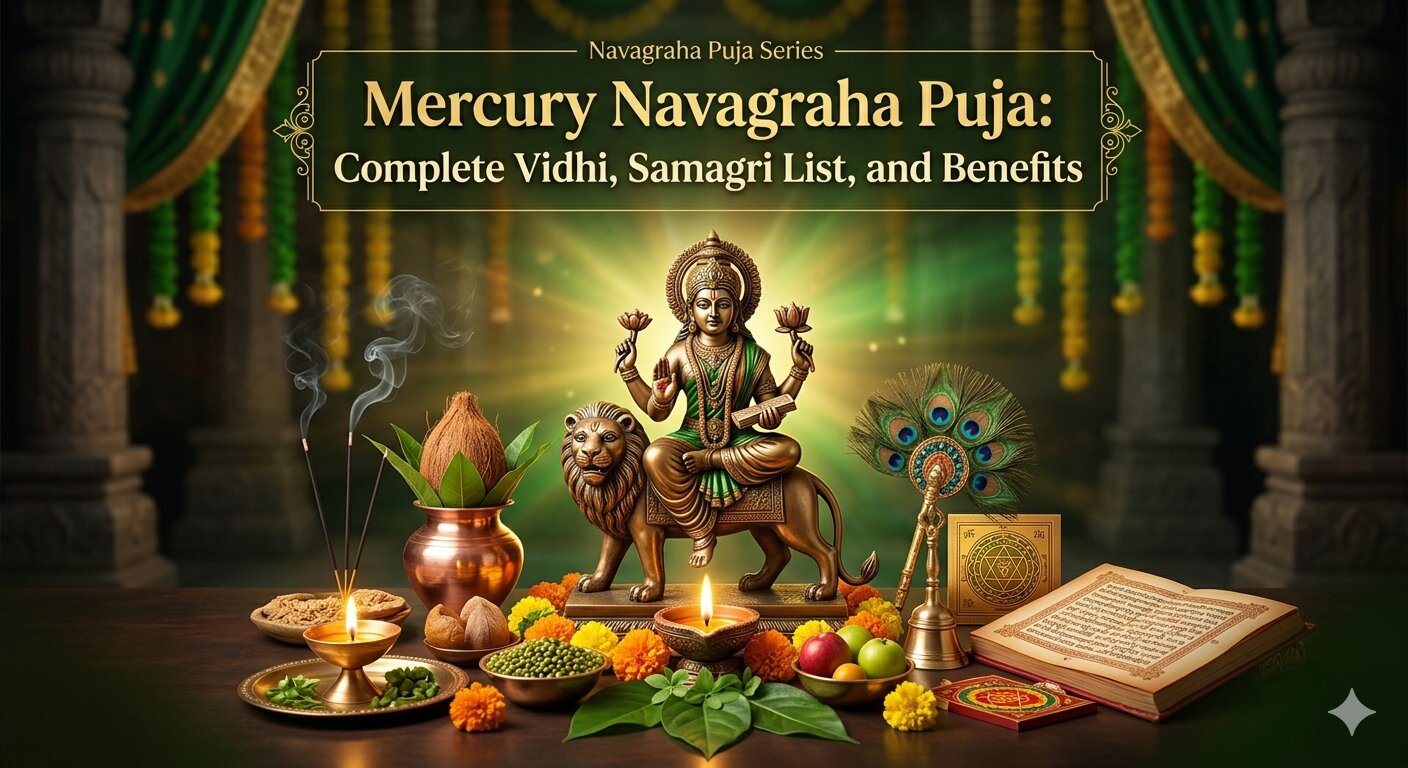
Quick Answer: How to Perform Shani Puja at Home How do I perform Shani Puja at home to remove Saturn's negative effects? Shani Puja is performed on Saturdays (Shaniwar), ideally at sunrise or during Pradosh Kaal (sunset). The essential samagri includes black sesame (kala til), urad dal, mustard oil (sarson ka tel), blue or black flowers, an iron vessel, and black cloth. Light a mustard oil lamp, offer black sesame and urad dal to Lord Shani Dev's idol or image, chant the Shani Beej Mantra ,Om Praam Preem Praum Sah Shanaischaraya Namah ,108 times, and feed black sesame to crows. Performing this with devotion every Saturday, especially during Sade Sati, Shani Dhaiya, or when Saturn occupies the 6th, 8th, or 12th house, is believed to reduce karmic obstacles and invite Saturn's protective grace.
घर में शनि देव की पूजा कैसे करनी चाहिए? Shaniwar ko subah ya Pradosh Kaal mein Shani Dev ki puja karni chahiye. Kala til, urad dal, sarson ka tel ka deepak, neele ya kaale phool, lohe ka bartan aur kali kapda ,ye saari samagri zaruri hai. Shani Dev ki murti ya tasveer ke saamne sarson tel ka deepak jalayein, kala til aur urad dal arpit karein, aur 'Om Praam Preem Praum Sah Shanaischaraya Namah' mantra 108 baar jaapein. Kauvon ko kala til khilaana bhi ek important upaay hai. Sade Sati, Shani Dhaiya, ya 6th/8th/12th ghar mein Shani hone par yah puja vishesh fal deti hai. |
In Vedic astrology, no planetary deity commands as much reverence ,and as much apprehension ,as Shani Dev, the divine personification of Saturn. He is Karma Karaka, the lord of cause and effect, the cosmic judge who rewards righteous action and tests the undisciplined with unyielding patience. Yet Shani Dev is not cruel; he is just. And the ancient tradition teaches that those who approach him with sincerity, correct practice, and genuine humility receive not punishment but protection.
Shani Puja Vidhi ,the prescribed ritual of Saturn worship, is one of the most powerful and time-honoured practices in Jyotish-based sadhana. Whether you are navigating the seven-and-a-half-year weight of Sade Sati, the 2.5-year pressure of Shani Dhaiya, a challenging Saturn Mahadasha, or simply wish to cultivate Saturn's stabilising qualities of discipline, patience, and longevity, this guide gives you the complete, authentic vidhi to perform Shani Puja at home.
Shani Dev is the divine personification of the planet Saturn, and one of the Navagraha ,the nine celestial bodies that govern human life in Vedic astrology. He is the son of Surya Dev (the Sun god) and his shadow consort Chhaya, and is the elder brother of Yama, the god of death. His twin associations with justice and time make him the supreme arbiter of karma in the Jyotish system.
His iconography is precise and meaningful: dark-complexioned, clothed in dark blue or black garments, he rides a crow or vulture and carries a bow, arrows, sword, and trident. The crow ,an astute and opportunistic bird ,is his vahana (vehicle), and represents the piercing intelligence with which Saturn sees through illusion to karmic truth.
Shani governs longevity, discipline, hard work, delay, restriction, responsibility, service, and karma. He rules the zodiac signs Capricorn (Makar) and Aquarius (Kumbha), and is exalted in Libra (Tula) while debilitated in Aries (Mesha). His Mahadasha in the Vimshottari system lasts 19 years ,the longest of any planet ,making his influence one of the most enduring any native will face.
Saturn is not malefic by nature. In the classical tradition, he is considered the greatest teacher (Guru) among the planets ,stern but fair. A well-placed, strong Saturn in a birth chart gifts the native with exceptional discipline, longevity, career success through sustained effort, and spiritual wisdom born of experience. It is only when Saturn is afflicted, debilitated, or transiting sensitive positions that his energy requires active remedial attention.
A key piece of mythological knowledge that shapes Shani Puja: according to Hindu scripture and the Ramayana tradition, Shani Dev once attempted to afflict Lord Hanuman but was utterly overpowered by Hanuman's boundless strength and devotion. In gratitude for his release, Shani Dev granted that he would never trouble sincere devotees of Hanuman. This is why Hanuman Chalisa is recited as part of Shani Puja, and why both Shani temples and Hanuman temples are visited on Saturdays.
The samagri (ritual materials) for Shani Puja is carefully prescribed. Each item carries a specific energetic correspondence with Saturn and should be gathered before beginning the puja. Below is the complete list with explanations:
| Samagri Item | Purpose & Significance |
| Black Sesame Seeds (Kala Til) | Most sacred offering to Shani Dev ,offered in the lamp, on the altar, and fed to crows |
| Urad Dal (Black Lentils) | Shani's grain ,offered as naivedya and donated to the poor after puja |
| Mustard Oil (Sarson Ka Tel) | Used to light the lamp and anointed on the Shani idol (Tailabhishekam) |
| Iron Vessel (Lohe Ka Bartan) | Shani's metal is iron ,water or oil offerings are made in an iron bowl |
| Black Cloth (Kali Kapda) | Draped over the altar or offered as dana to Brahmins or the needy |
| Blue or Black Flowers | Shami flowers, blue aparajita, or any dark-hued flowers are auspicious |
| Shami Leaves | Shami patra is highly sacred to Shani Dev ,offer 11 or 21 leaves |
| Til Oil Lamp (Sesame Oil Lamp) | Alternative to mustard oil; both are accepted by Shani Dev |
| Loban / Gugal Dhoop | Fragrances associated with Saturn for purifying the puja space |
| Shani Yantra (optional) | Energised yantra placed on altar to amplify Saturn's positive energy |
| Coconut | Offered at the beginning as part of the Sankalpa (ritual resolve) |
| Raw Sugar / Jaggery (Gur) | Mixed with sesame and offered ,Shani is pleased by this combination |
Note: All samagri should ideally be purchased on a Saturday morning. Wash and arrange everything before beginning. An iron lamp stand or iron plate (lohe ki thali) is preferred as the altar base ,this further aligns the ritual space with Saturn's metal.
Timing is central to Vedic ritual. The following table covers the key astrological conditions and occasions when Shani Puja is most warranted and most effective:
| Astrological Condition | Why Shani Puja Helps |
| Sade Sati (साढ़े साती) | Saturn transiting through the 12th, 1st, or 2nd house from your Moon sign ,a 7.5-year period. Weekly Shani Puja is essential. |
| Shani Dhaiya (शनि ढैया) | Saturn transiting through the 4th or 8th house from the natal Moon ,a 2.5-year period of moderate Saturnine pressure. |
| Shani Mahadasha | The 19-year major period of Saturn in Vimshottari Dasha ,puja amplifies the positive potential of this powerful period. |
| Saturn in 6th / 8th / 12th House | These dusthana placements can create health struggles, hidden obstacles, or heavy expenditure. Shani Puja pacifies these effects. |
| Shani Amavasya | New moon falling on a Saturday ,one of the most auspicious annual occasions for Shani Puja and ancestral offerings. |
| Shani Jayanti | Saturn's birthday, falling on Jyeshtha Amavasya (May-June) ,the single most powerful day of the year for Shani propitiation. |
| Saturn Retrograde | When Saturn appears to move backward in the sky, Shani Puja mitigates delays and reversals in career and personal life. |
| Any Life Obstacle Pattern | Persistent delays, chronic financial struggle, recurring legal complications, or inexplicable career reversals ,all respond to consistent Shani Puja. |
The two most auspicious times on Saturday are sunrise (early morning, facing West ,Shani's direction) and Pradosh Kaal (the 1.5-hour window around sunset). Pradosh Kaal on Saturday ,when it coincides with Pradosh Vrat ,is considered extremely powerful for both Shani and Lord Shiva, who are closely connected in the Shaiva tradition.
Brahma Muhurta (approximately 4:00–6:00 AM) is also highly recommended for mantra japa. Daily mantra practice at this hour, throughout a Sade Sati or Shani Mahadasha, is considered more powerful than any single annual ritual.
The following is the complete, authentic Shani Puja Vidhi as observed in the Vedic tradition for home practice. This can be performed by any devotee ,male or female ,on Saturdays. Women may perform this puja; some traditions advise not touching the Shani idol directly, in which case offering via a cloth or spoon is acceptable.
Wake up before sunrise. Take a purifying bath ,if possible, add a few black sesame seeds to your bath water, which is considered cleansing for Saturn-related karma. Wear clean clothes in dark blue, black, or grey ,Shani's colours. Set up a clean, uncluttered puja space, ideally facing West (Shani's directional association) or South-West.
Place Shani Dev's idol (ideally in iron or black stone) or a clear image on the altar. If you have a Shani Yantra, place it in front of or below the idol. Arrange all samagri within reach: sesame seeds, urad dal, mustard oil lamp, iron vessel with water, black flowers, Shami leaves, and black cloth.
Hold water in a cupped right hand, speak your full name, your gotra (lineage), and state the purpose of the puja: to appease Shani Dev, reduce the effects of (specific dosha or transit), and seek his blessings of discipline, protection, and karmic resolution. Let the water flow into an iron vessel. This Sankalpa formally initiates the ritual and aligns your intention with the divine.
Pour mustard oil into an iron or earthen lamp. Add a pinch of black sesame seeds to the oil. Light the lamp using a cotton wick. This lamp should remain lit throughout the entire puja. The mustard oil lamp is the single most important physical offering to Shani Dev ,in temples, Shani Tailabhishekam (anointing with mustard oil) is the primary ritual, and the home lamp replicates this principle.
Offer the following to Shani Dev in sequence, chanting 'Om Shanaischaraya Namah' with each offering:
Using a black hakik (black agate), iron, or rudraksha mala of 108 beads, begin the mantra japa. Face West. Breathe steadily and keep your mind focused on Shani Dev's form. Chant the Shani Beej Mantra 108 times:
ॐ प्रां प्रीं प्रौं सः शनैश्चराय नमः
Om Praam Preem Praum Sah Shanaischaraya Namah
If time permits, follow with 11 recitations of the Shani Dhyana Shloka (see Mantra section) and one full recitation of Hanuman Chalisa.
Perform aarti by circling a lit mustard oil lamp clockwise before Shani Dev's idol seven times, accompanied by ringing of a small bell. Chant 'Om Jai Shani Dev' during the aarti. Seven rotations correspond to the seven planets and the seven days of the week, all of which Shani governs in sequence.
This is one of the most important Shani Puja observances and must not be skipped. After completing the indoor puja, take a small amount of black sesame seeds and a chapati smeared with a little mustard oil outdoors. Place it where crows can access it ,on a rooftop, garden wall, or open ground. The crow is Shani's vahana (vehicle) and is considered his direct representative. Feeding crows is believed to directly reach Shani Dev and generates immediate goodwill from the planet.
Visit or approach a Peepal tree (Ficus religiosa). Pour water at its roots, light a mustard oil lamp, and place a pinch of sesame seeds at the base. The Peepal is considered the abode of Shani Dev (and also of ancestors in Hindu cosmology) ,watering it on Saturdays is one of the most highly recommended Shani remedies in the classical tradition.
The puja is completed with Dana ,the most ancient and enduring Shani remedy. Donate black urad dal, mustard oil, and black cloth to a poor person, labourer, or Brahmin on Saturday. You may also donate iron items, black blankets, or footwear to those in need. Shani Dev is the patron deity of workers, the underprivileged, and those who labour ,seva (selfless service) to them is the deepest form of his worship.
| Primary Shani Mantras |
Shani Beej Mantra (Primary) ॐ प्रां प्रीं प्रौं सः शनैश्चराय नमः Om Praam Preem Praum Sah Shanaischaraya Namah Recite 108 times every Saturday | 23,000 times for complete Shani Shanti
Shani Dhyana Shloka (Meditation Verse) ॐ नीलांजन समाभासं रवि पुत्रं यमाग्रजम् । छाया मार्तण्ड संभूतं तं नमामि शनैश्चरम् ॥ Om Nilanjana Samabhasam Ravi Putram Yamagrajam | Chhaya Martanda Sambhutam Tam Namami Shanaisscharam || Meaning: "I bow to Shani Dev, who shines like blue collyrium, who is the son of the Sun and the elder brother of Yama, who was born of the Sun and Chhaya."
Shani Ekashari Mantra ॐ शं शनैश्चराय नमः Om Sham Shanaischaraya Namah ,108 times daily for gentle daily propitiation
Hanuman Chalisa Recitation Recite Hanuman Chalisa once every Saturday after Shani Puja. Lord Hanuman is the supreme protector against Saturn's malefic effects ,Shani Dev himself granted that his devotees would be shielded from Saturn's harshness. |
The benefits of consistent Shani Puja extend across all major life domains governed by Saturn. When performed correctly and with sincere devotion over sustained periods ,not as a one-time event ,the following outcomes are traditionally associated with this practice:
Are you currently struggling with life phases like Astrology? Discover your precise chart insights now.
The new moon (Amavasya) that falls on a Saturday is called Shani Amavasya and is one of the most powerful single days of the year for Saturn propitiation. Perform the full Shani Puja Vidhi described above, add ancestral offerings (Pitru Tarpan ,water libations for deceased family members), and donate generously to the needy. Shani's connection to ancestral karma means that propitiating ancestors on Shani Amavasya directly benefits Saturn's position in the chart.
Shani Jayanti falls on Jyeshtha Amavasya (the new moon of the Jyeshtha month, typically in May or June). This is Saturn's birthday and the single most auspicious day of the year for Shani worship. In 2026, Shani Jayanti is especially significant as the date falls on a Saturday ,a rare and powerful conjunction. Perform the complete vidhi, observe a fast, and if possible visit a Shani temple for Tailabhishekam.
When Pradosh Vrat ,observed on the 13th day (Trayodashi) of the lunar fortnight ,falls on a Saturday, it is called Shani Pradosh. This evening is simultaneously auspicious for both Shani Dev and Lord Shiva, creating a uniquely powerful window for both Saturn pacification and Shiva worship. Perform Rudrabhishek at sunset on Shani Pradosh for comprehensive planetary and ancestral remedy.
The Shami tree (Prosopis cineraria) is Shani Dev's sacred tree. Watering it, offering black sesame at its roots, and keeping its leaves on the puja altar on Saturdays is an important classical remedy. Shami leaves are also used in all major Navagraha pujas. According to the Mahabharata, the Pandavas worshipped the Shami tree before the Kurukshetra war, it is associated with victory over difficult circumstances.
The Lal Kitab tradition ,a distinctive North Indian stream of remedial astrology ,offers grounded, earthly remedies for Saturn that complement classical Parashari Jyotish. These include:
For those who wish to perform or commission a Shani Puja at a sacred temple, the following are the most significant Shani pilgrimage sites in India:
Yes. The home vidhi described in this guide is designed for independent practice and has been observed by devotees for generations. The core requirements are sincerity, cleanliness, correct samagri, and consistent practice ,not a priest. A qualified priest (pandit) is recommended for major rituals such as Shani Shanti Havan or Rudrabhishek, but weekly Saturday puja at home is entirely appropriate for any devotee.
Yes. Women can and do observe Shaniwar Vrat and Shani Puja. Some regional traditions advise women not to touch the Shani idol directly, particularly during menstruation ,in these cases, offering via a cloth, flower, or spoon is acceptable. The mantra japa, lamp lighting, feeding of crows, and dana practices are all fully open to women.
Vedic tradition is clear on this point: ritual without consistency has limited effect. A single puja does not 'remove' Saturn's karmic weight permanently. The practice is cumulative ,weekly Saturday puja sustained over months and years gradually reduces the intensity of Saturn's afflictions and builds genuine karmic merit. Consider it a discipline rather than a transaction.
No ,this is one of the most common misconceptions in popular astrology. Shani Dev is the lord of karma and justice. A well-placed Saturn in the birth chart grants extraordinary qualities: discipline, longevity, worldly achievement through sustained effort, spiritual depth, and wisdom. Many of history's greatest leaders, scientists, and spiritual figures carried strong Saturn placements. The dread associated with Shani comes from his role as the planet of accountability;he simply ensures that karmic ledgers are settled, with precision.
Shani Puja is the broader practice of propitiating Saturn ,beneficial at any time. Sade Sati remedy is a specific application of Shani Puja performed during the 7.5-year Sade Sati transit period, when Saturn moves through the 12th, 1st, and 2nd houses from the natal Moon. During Sade Sati, weekly Shani Puja is essential rather than optional. Supplementing it with Hanuman Chalisa recitation daily, Shani Amavasya observances, and charitable donation creates a comprehensive Sade Sati sadhana.
For general weekly Saturday puja ,no consultation is strictly necessary. However, for determining which specific mantras, gemstones (like Blue Sapphire / Neelam), or intensified remedies are appropriate for your specific birth chart, consultation with a qualified Jyotishi is strongly recommended. Saturn gemstones in particular should never be worn without professional evaluation, as they powerfully amplify both positive and negative Saturn energy depending on the chart.
Shani Dev's message has never been one of punishment for its own sake. It is, always, a message about karma ,the precise and impersonal law that returns to each soul exactly what it has sown, in this life or another. His puja is therefore not a plea for escape from consequence but an act of alignment: of recognising the karmic patterns one carries, taking disciplined steps to resolve them, and cultivating the virtues ,patience, integrity, service, and humility ,that Saturn's energies are always attempting to grow within us.
Light the mustard oil lamp on Saturday morning. Offer your black sesame seeds with sincerity. Chant the Beej Mantra 108 times. Feed the crows. And give, without expectation, to those in need. In doing so, you are not only propitiating a planetary deity ,you are becoming the qualities that Shani Dev has always asked you to be.
The iron planet, severe and slow, ultimately bends not toward cruelty but toward character. Approach him with discipline and devotion, and Shani Dev's coil loosens ,not with force, but with the wisdom his transits were always asking you to find.
| Remedy Category | Key Practices |
| Mantra | Shani Beej Mantra (108x Saturdays); Hanuman Chalisa weekly; Dhyana Shloka daily |
| Daan (Donation) | Black urad dal, mustard oil, black cloth, iron items ,given to the needy on Saturdays |
| Feeding Crows | Feed crows with black sesame and chapati smeared with mustard oil every Saturday |
| Peepal Tree Worship | Offer water and light a mustard oil lamp under the Peepal tree on Saturdays |
| Shani Tailabhishekam | Anoint Shani Dev's idol with mustard oil ,most powerful physical remedy at temples |
| Shani Yantra | Install and worship an energised Shani Yantra with daily mustard oil lamp |
| Hanuman Temple Visit | Visit Hanuman temple on Saturdays and Tuesdays for Saturn protection |
| Shami Tree Worship | Water and worship the Shami tree ,Shani's sacred tree ,every Saturday |
| Seva (Selfless Service) | Serve the elderly, disabled, labourers, and the underprivileged ,most enduring remedy |
| Famous Shani Temples | Shani Shingnapur (Maharashtra), Tirunallar Saniswaran Temple (Tamil Nadu), Shani Dham (Delhi) |
Connect with a Jyotishi on Nakshatraai.ai Generate your Kundali and check your Saturn placement: nakshatraai.ai/add-kundli Speak with an expert Jyotishi for a personalised Shani Dosha assessment and puja plan: nakshatraai.ai/astrologer |
Disclaimer: This article is for educational and informational purposes only. Astrological guidance does not substitute for consultation with a qualified Jyotishi or Hindu priest who can evaluate your specific birth chart and circumstances. Ritual procedures should ideally be performed under the guidance of a qualified pandit. Gemstone recommendations, particularly for Blue Sapphire (Neelam), should only be followed after thorough professional astrological evaluation.