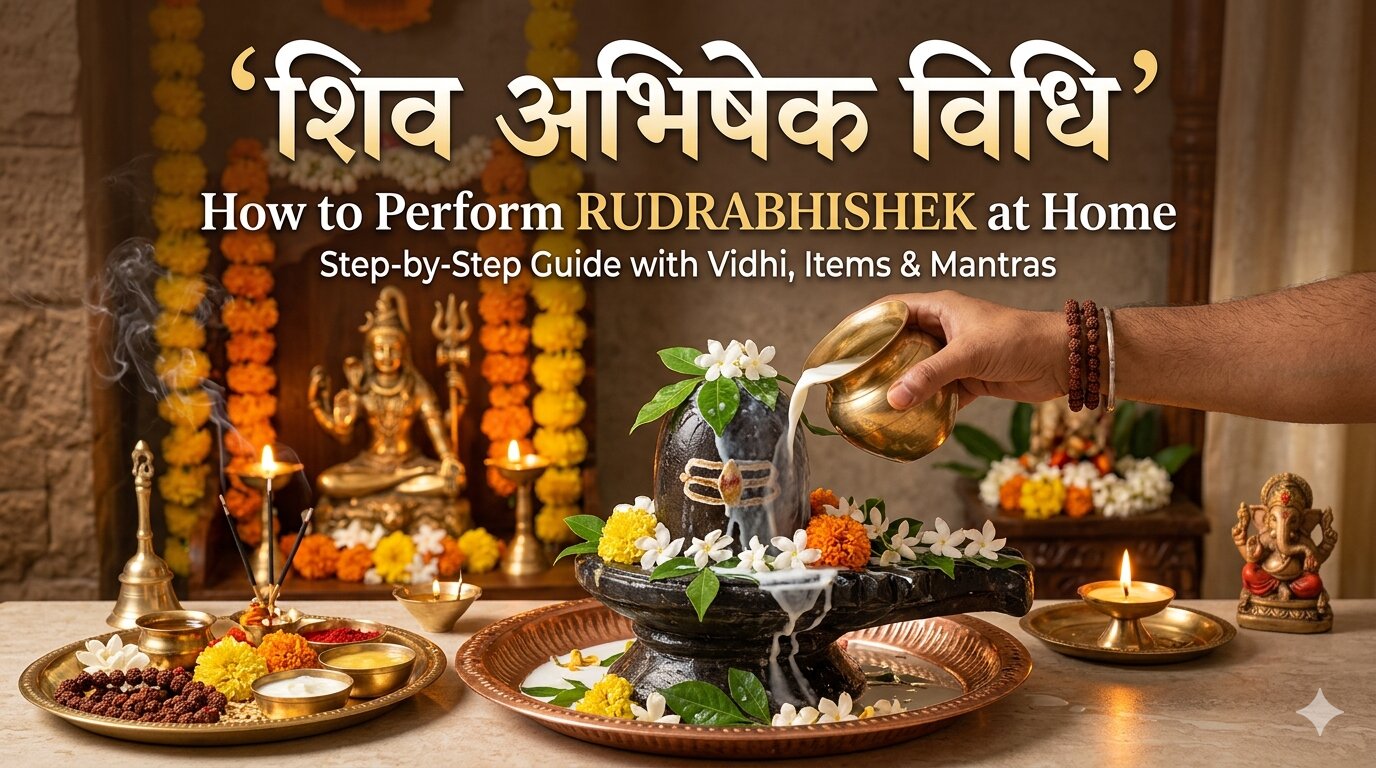
Quick Answer: How to Perform Shiva Abhishek / Rudrabhishek at Home How do I perform Rudrabhishek (Shiva Abhishek) at home? Rudrabhishek, or Shiva Abhishek, is the sacred ritual bathing of the Shiva Linga with holy substances - milk, Panchamrit, Gangajal, and rose water - accompanied by the chanting of Vedic mantras, especially Om Namah Shivaya and the Maha Mrityunjaya Mantra. At home, the puja begins with purification and Sankalpa, followed by the Panchamrit sequence (milk → curd → honey → ghee → sugar, each with mantra), Gangajal abhishek, and rose water. Bilva (bel) leaves, Dhatura, sandalwood paste, and flowers are then offered. The most auspicious days are Mondays, Pradosh (13th tithi), and Maha Shivratri - and the entire month of Sawan (July–August) is considered exceptionally powerful. Ghar par Rudrabhishek (Shiva Abhishek) kese karein? Ghar par Shiva Abhishek karne ke liye sabse pehle pavitrta aur Sankalpa karein. Phir Panchamrit (doodh → dahi → shahad → ghee → cheeni, har ek ke saath mantra) se Shivling par abhishek karein. Uske baad Gangajal aur gulab jal se abhishek karein. Bilva patra, Dhatura, chandan paste aur phool chadhaayein. Mantra mein Om Namah Shivaya (minimum 108 baar) aur Maha Mrityunjaya Mantra (Somvar ko 108 baar) padhen. Sarvottam din Somvar, Pradosh tithi, aur Maha Shivratri hain - aur poora Sawan maas abhishek ke liye atyant shubh maana jaata hai. |
Of all the forms of Shiva puja, Rudrabhishek - the sacred ritual bathing of the Shiva Linga with holy substances - is the most powerful that a devotee can perform, even at home, without the need for an elaborate temple setting. The word Abhishek (Sanskrit: अभिषेक) means 'ritual bath' or 'anointing,' and Rudra refers to the fierce, transforming aspect of Lord Shiva described in the Vedas. Together, Rudrabhishek is an act of devotional surrender: each liquid offered is an offering of the self, dissolving ego in the presence of the infinite.
Searches for Shiva Abhishek Vidhi spike massively during Sawan (Shravan month, July–August) - the entire month is considered Lord Shiva's favourite time of year, when even a simple Somvar (Monday) abhishek carries exceptional spiritual potency. Whether you are observing Sawan Somvar, a weekly Monday puja, or preparing for Maha Shivratri, this guide covers every step: the complete Panchamrit sequence with mantras, the samagri (materials) list, what to offer and how, the right mantras and their count, and the specific benefits of each offering.
Note: If you are performing Rudrabhishek specifically as a remedy for Kaal Sarp Dosh or planetary afflictions, please see our complete guide - [INTERNAL LINK: Kaal Sarp Dosh: Complete Guide, 12 Types, and Proven Remedies - nakshatraai.ai/kaal-sarp-dosh] - which covers Rudrabhishek on 11 consecutive Mondays as a classical Kaal Sarp Shanti remedy.
Rudrabhishek is one of the oldest forms of Vedic worship still practiced in its complete form today. Its scriptural basis lies in the Sri Rudram - an 11-chapter hymn to Lord Shiva contained in the Krishna Yajurveda - and in particular in the Namakam (chapter of names) and Chamakam (chapter of desires). The Shiva Purana, Skanda Purana, and Linga Purana all affirm that Abhishek is the form of worship most pleasing to Shiva: 'Abhishek priya Rudrasya' - Rudra is fond of Abhishek above all other forms of devotion.
Legend holds that Lord Rama performed Rudrabhishek at Rameswaram before his battle with Ravana, and the Pandavas performed it during their forest exile to receive divine strength. The Shiva Linga itself is understood as the formless, infinite form of Shiva - and pouring sacred liquids over it, while chanting his names, is a direct act of communion with that infinity.
In the home, the ritual does not require a pandit for a basic abhishek. A clean Shiva Linga, the correct samagri, a pure heart, and the right mantra are sufficient. For elaborate Maha Rudrabhishek or the classical 11-Monday Kaal Sarp Dosh remedy, the guidance of a qualified Brahmin priest is recommended.
Ghar par khud se Shiva Abhishek karne ke liye niche di gayi samagri ikattha karein. Every item in the list below has a specific scriptural purpose - this is not a shopping list but a ritual map.
| Category | Item | Purpose / Note |
| Deity | Shiva Lingam (home puja size) | Place on a clean platform, yoni facing north |
| Abhishek liquids | Raw cow's milk - approx 500 ml | Unboiled only; refrigerator cold acceptable |
| Abhishek liquids | Fresh curd - 100 ml | Homemade preferred |
| Abhishek liquids | Pure honey - 2 tbsp | Unprocessed, no heating |
| Abhishek liquids | Pure cow's ghee - 2 tbsp | A2 cow ghee ideal |
| Abhishek liquids | Rock sugar / mishri - 2 tbsp | Or fine white sugar |
| Abhishek liquids | Gangajal - as available | Or pure clean water |
| Abhishek liquids | Rose water - 100 ml | Gulab jal |
| Offerings | Bilva / bel leaves - 11 or 21 | Three-leaflet only; fresh, unbroken |
| Offerings | Dhatura flower or fruit | Sacred to Shiva; handle with care |
| Offerings | Blue lotus or white flowers | Neel kamal or any white/blue flowers |
| Offerings | Sandalwood paste (Chandan) | For application after abhishek |
| Offerings | Sacred ash (Vibhuti / Bhasma) | Apply on lingam post-puja |
| Offerings | Rice (Akshat) | Unbroken grains |
| Offerings | Seasonal fruits | Prasad offering |
| Puja items | Copper / brass Kalash (water vessel) | For abhishek pouring |
| Puja items | Rudraksha mala | For mantra recitation; 108 beads |
| Puja items | Ghee diya with cotton wick | For aarti |
| Puja items | Incense sticks / Dhoop | Agarbatti |
| Puja items | Camphor (Kapoor) | For aarti |
| Puja items | Cloth / platform for Lingam | Red or white silk / cotton |
Important: Tulsi leaves, turmeric (haldi), and Ketaki (screw-pine) flowers must never be offered to Lord Shiva - these are explicitly prohibited in the Shiva Purana. Champa flowers and coconut water are acceptable additions during Sawan.
Rudrabhishek ka step-by-step tarika niche diya gaya hai. Follow each step in sequence for maximum spiritual benefit.
Sankalpa is the formal vow that sets the intention of your puja. Hold water in your right palm, close your eyes, and state mentally or aloud: your full name, your gotra (lineage) if known, today's date and time, the name of the place, and your specific purpose (health, dosh nivaran, moksha, family peace, etc.). Then pour the water into the Kalash.
This step transforms the ritual from a mechanical act into a conscious offering.
If performing Rudrabhishek for planetary dosh nivaran - especially Kaal Sarp Dosh, Shani Dosh, or Rahu-Ketu afflictions - chant the Navagraha mantra or at minimum Om Shri Shanaishcharaya Namah (for Shani) and Om Raam Rahave Namah / Om Sraam Sreem Sraum Sah Ketave Namah (for Rahu/Ketu) 11 times each before proceeding. [INTERNAL LINK: See our Kaal Sarp Dosh guide for full Rahu-Ketu mantras - nakshatraai.ai/kaal-sarp-dosh]
Perform the five-substance abhishek in the prescribed sequence with mantras. See the full Panchamrit sequence in Section 4.
This is the most critical offering in all of Shiva puja - see Section 5 for the complete rules on Bilva leaves. Offer in this order: Bilva leaves → Dhatura → Blue or white flowers → Akshat (whole rice) → Any other seasonal offerings.
Sit in front of the Linga with your Rudraksha mala and recite the primary mantras. See Section 6 for full mantra details and counts. The minimum is 108 recitations of Om Namah Shivaya.
Panchamrit (Sanskrit: पञ्चामृत - pancha = five, amrit = nectar) is the sacred five-substance mixture that forms the heart of Rudrabhishek. Each of the five substances is offered separately and sequentially - they are not mixed together for Rudrabhishek (unlike the Panchamrit Prasad mixture consumed after temple puja). Each offering carries its own specific mantra and spiritual benefit.
| Step | Ingredient | Sanskrit / Hindi | Specific Mantra | Blessing Bestowed |
| 1 | Raw cow's milk (Doodh) | दुग्ध - Dugdha | Om Namah Shivaya (while pouring) | Longevity, health, clarity of mind |
| 2 | Fresh curd / yogurt (Dahi) | दधि - Dadhi | Om Shivaya Namah | Fertility, marital harmony, peace |
| 3 | Pure honey (Shahad) | मधु - Madhu | Om Rudraya Namah | Freedom from sorrow, sweetness in life |
| 4 | Pure ghee - cow's (Ghee) | घृत - Ghrita | Om Mahadevaya Namah | Protection from disease, energy |
| 5 | Rock sugar / mishri (Cheeni) | शर्करा - Sharkara | Om Shankaraya Namah | Prosperity, wealth, happiness |
Practical note: Use raw, unboiled cow's milk - heating destroys its ritual purity. Use pure honey without heating. All quantities are approximate - even a small amount offered with full devotion carries complete benefit. After each of the five offerings, rinse the Linga with a small pour of Gangajal before proceeding to the next substance.
The Shiva Purana states: 'The worship of Shiva performed without Bilva is fruitless.' No offering in all of Shiva puja carries the weight of the Bilva (bel) leaf. One Bilva leaf offered with sincere devotion is said to destroy the accumulated sins of three lifetimes.
The correct rules for Bilva offering - verified from the Shiva Purana and classical tradition - are as follows:
Dhatura is sacred to Shiva and features prominently in his iconography - it grows in cremation grounds, the domain of Rudra. Offering Dhatura flowers or fruits pleases Shiva in his fearless, trans-worldly aspect. Handle Dhatura with care - the plant is toxic; offer it devotionally without consuming it or allowing children to handle it.
The blue lotus is among the most auspicious flowers for Shiva worship. If unavailable, white flowers - jasmine (Mogra), white oleander, Shami flowers - are excellent substitutes. Avoid Tulsi, Ketaki (screw-pine), and any flowers that have been used elsewhere.
Sandalwood has a cooling, calming energy that is particularly pleasing to Shiva. Apply chandan to the Linga in a Tripunda (three horizontal lines) pattern after the main abhishek. Chandan is said to invite peace, clarity, and mental calm. If using a pre-made sandalwood paste, ensure it is pure and free from chemical additives.
Primary Shiva Abhishek Mantra ॐ नमः शिवाय Om Namah Shivaaya Meaning: Salutations to Lord Shiva - the five-syllable (Panchakshara) mantra representing the five elements (earth, water, fire, air, ether) through which Shiva pervades all of creation. Recitation: Minimum 108 times during abhishek; 1,008 times for full Rudrabhishek or dosh nivaran |
Maha Mrityunjaya Mantra - For Health, Longevity, and Liberation ॐ त्र्यम्बकं यजामहे सुगन्धिं पुष्टिवर्धनम् | उर्वारुकमिव बन्धनान् मृत्योर्मुक्षीय माऽमृतात् || Om Tryambakam Yajamahe Sugandim Pushti-Vardhanam | Urvarukamiva Bandhanan Mrityormukshiya Mamritat || Meaning: We worship the three-eyed Shiva who is fragrant and who nourishes all. May He liberate us from death as a ripe cucumber is freed from its vine - and may He not withhold immortality. Recitation: 108 times - especially powerful during Rudrabhishek on Mondays and Maha Shivratri. Chant continuously during the milk abhishek for maximum effect. |
Shiva Panchakshara Stotra नागेन्द्रहाराय त्रिलोचनाय... Nagendra-Haraya Tri-Lochanaya, Bhasma-Anga-Ragaya Maha-Eswaraya... Meaning: A classical stotra from the Shiva Panchakshara describing Shiva's divine attributes through each of the five syllables Na-Ma-Shi-Va-Ya. Recited after mantra japa for completion of the ritual. Recitation: Once or 3 times - ideally after japa, before aarti |
Additional mantra: For those performing Rudrabhishek specifically to appease Rahu and Ketu as part of Kaal Sarp Dosh nivaran, add Om Raam Rahave Namah (108 times) and Om Sraam Sreem Sraum Sah Ketave Namah (108 times) after the main japa. [INTERNAL LINK: Kaal Sarp Dosh Complete Guide - nakshatraai.ai/kaal-sarp-dosh]
Shiva Abhishek can be performed on any day with full benefit. The following days and times are considered especially auspicious across classical tradition:
The most auspicious day for regular Shiva worship. Monday is Lord Shiva's day - devotees observing Somvar Vrat (Monday fast) and performing abhishek on each Monday of Sawan receive multiplied blessings. For Kaal Sarp Dosh remedy, the classical prescription is Rudrabhishek on 11 consecutive Mondays. The entire month of Sawan (July–August) - when every Monday is called Shravan Somvar - is the peak season, carrying extraordinary spiritual power.
Pradosh occurs on the 13th day of both the waxing (Shukla Paksha) and waning (Krishna Paksha) lunar fortnights. Pradosh Kaal - the 1.5-hour window beginning 45 minutes before sunset - is said to be Lord Shiva's most beloved time of day. Performing Rudrabhishek specifically during Pradosh Kaal on the 13th tithi is considered the single most potent moment for Shiva worship outside of Maha Shivratri.
The 'Great Night of Shiva' - observed on the 14th tithi of Krishna Paksha in Phalguna (February–March) - is the most sacred day in the Shiva calendar. A Rudrabhishek performed on Maha Shivratri, especially the four-watch night puja (four abhisheks, one in each prahar of the night), carries the merit of an entire year's worship. [INTERNAL LINK: nakshatraai.ai/maha-shivratri-puja-guide - placeholder]
Are you currently struggling with life phases like Spirituality? Discover your precise chart insights now.
Har prakar ke abhishek ke alag-alag fayde hote hain. The table below maps each substance to its specific spiritual and worldly benefit, as described in the Shiva Purana and classical Vedic tradition.
| Abhishek Type | Key Benefit |
| Jal (water) / Gangajal | Fulfils desires, removes sins, purifies mind and surroundings |
| Milk (Doodh) | Bestows longevity, physical health, and clarity |
| Curd (Dahi) | Helps with fertility, marital harmony, emotional peace |
| Honey (Shahad) | Frees from troubles, brings sweetness and joy to life |
| Ghee | Protects from disease, grants strength and vitality |
| Panchamrit (all five) | Prosperity, wealth, abundance - the complete blessing |
| Sugarcane juice | Pacifies Shani (Saturn) dosha |
| Rose water (Gulab jal) | Soothes mind, grants beauty, peace, and joy |
| Full Rudrabhishek | Neutralises Rahu, Ketu, Shani doshas; moksha path opens |
The overarching benefits of a sincere, regularly performed Rudrabhishek include: removal of all sins and negative karma, recovery from illness and protection of health, removal of planetary doshas (especially Kaal Sarp Dosh, Shani Dosh, and Rahu-Ketu afflictions), fulfilment of material desires, family peace and marital harmony, and ultimately, the opening of the path to moksha (liberation). Shiva - the Mahakala, the lord of time - grants both worldly abundance and transcendence to sincere devotees.
| Category | Key Details |
| Best Days | Monday (Somvar), Pradosh (13th tithi), Maha Shivratri, Shravan Somvar |
| Best Time | Brahma Muhurta (before sunrise), or Pradosh Kaal (evening twilight) |
| Panchamrit Sequence | Milk → Curd → Honey → Ghee → Sugar/Mishri → Gangajal → Rose water |
| Primary Mantra | Om Namah Shivaya - minimum 108 times |
| Additional Mantras | Maha Mrityunjaya Mantra (108x Mondays), Shiva Panchakshara Stotra |
| Essential Offerings | Bilva leaves (3-leaflet, smooth side up), Dhatura, blue/white lotus, Chandan |
| Duration | Simple home abhishek: 30–60 min; full vidhi with mantras: 1–2 hours |
| Dosh Benefit | Pacifies Kaal Sarp Dosh, Shani Dosh, Rahu–Ketu afflictions (see internal link) |
Yes. A basic Shiva Abhishek at home - with the correct samagri, the right sequence, and sincere mantras - is completely valid and greatly meritorious. A pandit is recommended for formal Maha Rudrabhishek, for the 11-Monday Kaal Sarp Dosh ceremony, or for special occasions like Maha Shivratri. For daily or weekly Monday puja, self-performance is entirely traditional and encouraged.
A simple home abhishek with Panchamrit and 108 repetitions of Om Namah Shivaya takes approximately 30–45 minutes. A more complete version with all mantras, the Shiva Panchakshara Stotra, and aarti takes 1–1.5 hours. A formal Maha Rudrabhishek conducted by priests with full Sri Rudram recitation may take 3–5 hours.
Rudrabhishek on 11 consecutive Mondays is one of the most widely recommended classical remedies for Kaal Sarp Dosh. Lord Shiva is the Nagadhipati - the supreme lord of serpents - and his abhishek directly addresses the naga (serpent) energy of the Rahu-Ketu axis in the birth chart. For the complete Kaal Sarp Dosh puja vidhi and additional remedies including the Kaal Sarp Shanti Puja at Trimbakeshwar, see: [INTERNAL LINK: Kaal Sarp Dosh: Complete Guide, 12 Types, and Proven Remedies - nakshatraai.ai/kaal-sarp-dosh]
The classical instruction is to position the Shiva Linga so the yoni faces north, and to perform the puja facing east (so you are looking westward at the Linga's western face). East-facing is the standard direction for most Vedic puja. The northward orientation of the yoni ensures offered liquids flow toward the auspicious northern direction.
Yes. There is no prohibition in the Shiva Purana against women performing Rudrabhishek. Lord Shiva is worshipped equally by all devotees. Some regional temple traditions may have specific customs; however, home puja has no such restriction. Shiva himself, as Ardhanarishvara (half Shiva, half Parvati), embodies the complete unity of masculine and feminine.
A regular Shiva puja (daily worship) may include offering water, flowers, and basic mantras. Rudrabhishek specifically involves the full Panchamrit sequence, Gangajal, rose water, and the recitation of the Sri Rudram or Maha Mrityunjaya Mantra during the abhishek itself. It is more elaborate and carries greater potency. The term Shiva Abhishek Vidhi is often used interchangeably with Rudrabhishek when the full liquid-offering sequence is performed.
Rudrabhishek is not merely a ritual - it is a conversation with the infinite. Each drop of milk, each Bilva leaf, each repetition of Om Namah Shivaya is an act of surrender: the ego dissolving in the presence of Shiva, who is both the destroyer of limitation and the giver of liberation. The sacred texts are consistent: of all forms of Shiva worship, Abhishek is his most beloved. And the great blessing of this ritual is that its core - a Shiva Linga, water, a leaf, and a sincere heart - is available to anyone, anywhere, on any Monday morning.
Perform the abhishek not from routine but from recognition: you are not merely bathing a stone but invoking the consciousness that sustains the universe. As the Shiva Purana promises: one who performs Rudrabhishek with devotion and correct vidhi receives peace in this life and liberation after it. Har Har Mahadev.
Connect with a Jyotishi on Nakshatraai.ai Check your Kundali for Kaal Sarp Dosh or Shani Dosh before performing Rudrabhishek: nakshatraai.ai/add-kundli Speak with an expert Jyotishi for a personalised Abhishek and remedy plan: nakshatraai.ai/astrologer |
Disclaimer: This article is for educational and informational purposes only. Ritual procedures vary by regional tradition and lineage. For personalised Rudrabhishek guidance, planetary dosh assessment, or to connect with a qualified pandit, consult a verified Jyotishi. Astrological guidance does not substitute for consultation with a qualified priest who can evaluate your specific birth chart and circumstances.