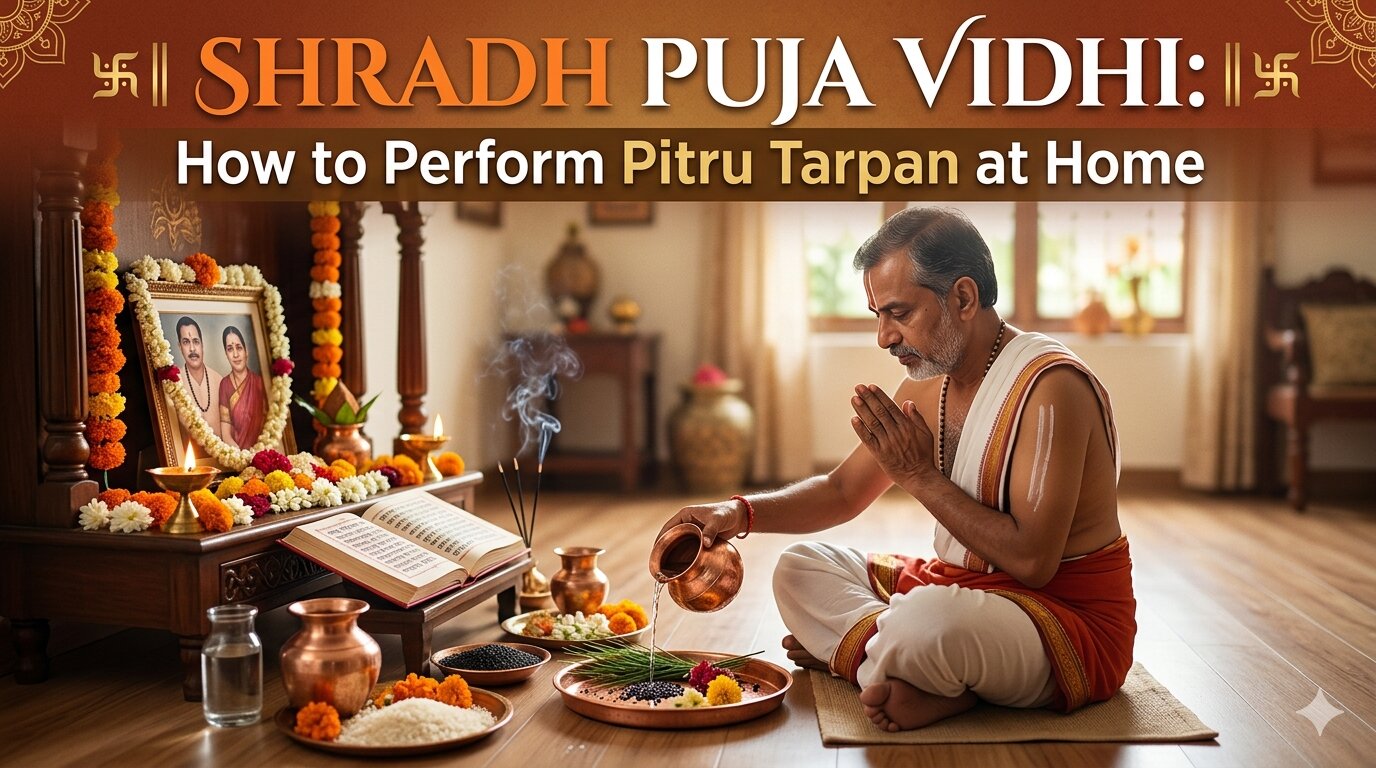
Quick Answer: How do I perform Shradh and Pitru Tarpan at home? Shradh Puja Vidhi at home begins with an early bath, wearing clean white or light-yellow clothes, and sitting facing South - the direction of Pitru Loka. Fill a copper vessel with water, add black sesame seeds (kaala til) and Kusha grass. Take a Sankalpa (ritual vow) stating your ancestors' names. Pour water from your cupped palms three times per ancestor while reciting Pitru Tarpan mantra. Optionally offer Pinda (rice balls mixed with sesame and ghee) on a banana leaf. Conclude by feeding a Brahmin, a crow, a cow, and the needy. Perform on the tithi (lunar day) matching the ancestor's death date during Pitru Paksha 2026 (26 September – 10 October 2026). If unsure of the tithi, perform on Sarva Pitru Amavasya (10 October 2026).
घर पर श्राद्ध और पितृ तर्पण कैसे करें?
Shradh Puja Vidhi ke liye subah snan karein, safed ya peele kapde pehen lein, aur dakshin disha (South) ki taraf muh karke baith jaayein. Ek taambey ke bartan mein paani, kaala til aur Kusha ghaas daalein. Apne pitra ka naam lekar Sankalpa karein. Haath ki hatheli mein paani lekar teen baar giraayein aur Pitru Tarpan mantra ka uccharan karein. Ho sake to Pinda Daan bhi karein - chawal, til aur ghee ke goley banaakar kele ke patte par rakhein. Ant mein ek Brahmin, kauve, gaay aur zarooratmand ko bhojan karaayein. Pitru Paksha 2026 mein 26 September se 10 October ke beech, apne pitra ki mrityu tithi ke din Shradh karein. Tithi yaad na ho to 10 October - Sarva Pitru Amavasya - ko karein. |
In Hindu tradition, the dead do not simply depart - they continue as Pitrus (ancestor-deities) in Pitru Loka, the ancestral realm, and depend on the living for sustenance through ritual offerings. The Garuda Purana, one of the eighteen Mahapuranas and the primary scriptural authority on death rites, describes how a soul denied the water and sesame of Tarpan suffers from thirst and hunger on its onward journey. Shradh Puja - the collective term for all rites of ancestral homage - is the living family's sacred response to that duty.
This guide covers the complete Shradh Puja Vidhi for home performance: what Shradh is, the correct Pitru Tarpan procedure (water, black sesame, Kusha grass, facing South, specific mantras), who should perform it, which day of Pitru Paksha to observe based on the ancestor's death tithi, an introduction to Pinda Daan, the Samagri list, and the spiritual benefits the tradition promises.
The word Shradh (Sanskrit: Shraddha) derives from shrad - meaning truth or sincerity - and dha - meaning to place or offer. As the Garuda Purana articulates: "Shraddhaya Idam Diyate Iti Shraddham" - any act performed with complete sincerity and faith for the benefit of ancestors is Shradh. In everyday practice, Shradh refers to the ritual offerings of food, water, and prayer made to departed souls so they may achieve peace (shanti) and liberation (moksha).
Maharshi Parashara, cited in classical Shradh treatises, defines Shradh as: any act performed with sesame seeds (til), Kusha grass (darbha), and Vedic mantras, at the correct time, in the correct place, and to the appropriate recipient. The Brahma Purana and Padma Purana both describe the concept of Rina Traya - the three debts every human carries from birth:
Classical texts describe several types of Shradh, including Nitya Shradh (daily ancestral remembrance), Naimittika Shradh (performed on specific occasions such as a death anniversary or Pitru Paksha), Kamya Shradh (performed to fulfill a specific desire), and Sapindikarana Shradh (the twelfth-day rite that formally elevates the departed from Preta to Pitru status). This guide focuses on the Naimittika Shradh performed during Pitru Paksha - the most universally observed form.
Related reading: [INTERNAL LINK: Kaal Sarp Dosh Complete Guide - Understanding Pitru Dosh and Ancestral Karma]
Pitru Paksha (also called Shradh Paksha or Mahalaya Paksha) is a 15-day lunar period dedicated to ancestral rites, falling during the Krishna Paksha (dark fortnight) of the Hindu month of Ashwin - typically September–October on the Gregorian calendar. According to the Garuda Purana and multiple Puranic sources, during this period Yama, the lord of death, releases souls from Pitru Loka to receive oblations from their descendants.
Pitru Paksha 2026 Dates Start: Saturday, 26 September 2026 (Purnima Shradh) End: Saturday, 10 October 2026 (Sarva Pitru Amavasya / Mahalaya Amavasya)
Auspicious Timings for Tarpan & Shradh: Kutup Muhurta, Rohina Muhurta, and Aparahna Kaal (approximately 10:30 AM – 3:00 PM) are the most auspicious windows for performing Shradh or Tarpan. Consult your local panchang for exact timings. |
| Tithi | Date 2026 | Perform Shradh For... |
| Purnima | 26 Sept (Sat) | Ancestors who died on Purnima |
| Pratipada | 27 Sept (Sun) | Ancestors who died on Pratipada |
| Dwitiya | 28 Sept (Mon) | Ancestors who died on Dwitiya |
| Tritiya | 29 Sept (Tue) | Ancestors who died on Tritiya |
| Chaturthi | 30 Sept (Wed) | Ancestors who died on Chaturthi |
| Panchami | 1 Oct (Thu) | Ancestors who died on Panchami |
| Shashthi | 2 Oct (Fri) | Ancestors who died on Shashthi |
| Saptami | 3 Oct (Sat) | Ancestors who died on Saptami |
| Ashtami | 4 Oct (Sun) | Ancestors who died on Ashtami |
| Navami | 5 Oct (Mon) | Ancestors who died on Navami (also for widows/mothers) |
| Dashami | 6 Oct (Tue) | Ancestors who died on Dashami |
| Ekadashi | 7 Oct (Wed) | Ancestors who died on Ekadashi |
| Dwadashi | 8 Oct (Thu) | Ancestors who were ascetics or saints |
| Trayodashi | 9 Oct (Fri) | Children and young family members who passed away |
| Chaturdashi | 10 Oct (Sat) | Those who died by accident, violence, or unnatural causes |
| Sarva Pitru Amavasya | 10 Oct (Sat) | ALL ancestors - especially those whose tithi is unknown |
Note: Tithi dates may vary by one day depending on your region's panchang. Always verify with a local Jyotishi or official panchang for precise timings.
The classical order of preference for performing Shradh, according to the Garuda Purana and Dharma Shastras, is as follows:
Modern practice increasingly recognises that any family member - regardless of gender - may perform Shradh with full spiritual benefit, provided the ritual is conducted with sincerity, correct materials, and proper mantras. Intent and purity of heart are paramount.
The Vishwamitra Smriti and the Garuda Purana together prescribe a surprisingly short essential list. Additional items are regional or traditional enhancements:
| Essential Items (Scriptural) | Optional / Traditional Additions |
| Copper or silver vessel (lota) | Gangajal (Ganga water to add to vessel) |
| Black sesame seeds - Kaala Til | Barley (Jau) and white rice |
| Kusha grass (Darbha / Kush) | Cow's milk, honey, ghee |
| Clean water | Banana leaves (for Pinda offering) |
| Kusha ring for ring finger | Cooked rice and barley flour (for Pinda Daan) |
| White or light-yellow dhoti / cloth to sit on | Incense sticks and ghee lamp |
| Sandalwood paste (for tilak) | Flowers (white only - for Deva Tarpan portion) |
| Sattvic cooked food (kheer, khichdi, puri, dal) | Silver or gold coin for dakshina |
Critical note from the Vishwamitra Smriti: For the Pitru Tarpan portion of the ritual, only water and black sesame seeds are prescribed - no flowers, no fragrance. Flowers may be added for the Deva Tarpan (offering to gods) portion only.
(Shradh Puja Vidhi Ka Sahi Tarika)
The Sankalpa is your formal declaration of intent. Sit facing South and speak aloud:
Sankalpa (spoken in Sanskrit or your own language):
"Mama Pitrunam Pritya Artham, [Gotra name if known], [Ancestor's name]'s Shradh-Tarpan Karishye."
Meaning: 'For the satisfaction and peace of my ancestors [name], I now perform this Shradh and Tarpan.'
If you do not know the Gotra: Simply state your own name and relationship ('I, [your name], son/daughter of [father's name], perform this rite for my father/mother/grandfather...'). |
This is the central ritual act. Full Pitru Tarpan Vidhi is covered in detail in Section 6 below.
Pinda Daan is covered in Section 7. Offer at least three Pindas - for father, grandfather, and great-grandfather (and their female counterparts).
Tarpan means 'to satiate' or 'to satisfy.' It is the foundational ritual act of Pitru Paksha - the offering of water mixed with black sesame seeds to each ancestor by name, poured from the cupped palms facing South.
Core Pitru Tarpan Mantras
For Father: "[Gotra] Gotrasya [Father's Name] Pitru Tarpayami" (pour water 3 times)
For Grandfather: "[Gotra] Gotrasya [Grandfather's Name] Pitamaha Tarpayami" (pour water 3 times)
For Great-Grandfather: "[Gotra] Gotrasya [Great-Grandfather's Name] Prapitamaha Tarpayami" (pour water 3 times)
For Mother: "[Gotra] Gotrasya [Mother's Name] Matru Tarpayami" (pour water 3 times)
General Pitru Invocation: "Om Pitru Devay Namah" - 108 times (general invocation for all ancestors)
"Om Sarva Pitrebhyo Swadha Namah" - for all ancestors collectively
"Om Yama Devay Namah" - to invoke Yama to grant peace to departed souls
If you do not know the gotra or name: Speak from the heart - state the relationship and pour water with sincere intent. The Garuda Purana affirms that Shraddha (devotion) is the operative principle. |
Offer at minimum three rounds of water per ancestor: one for paternal ancestors, one for maternal ancestors, and one collectively for all departed souls of the lineage. Many traditions offer eleven or sixteen rounds on Mahalaya Amavasya.
Pinda Daan is the pinnacle act of Shradh - the offering of rice balls (Pinda) that symbolically provide a 'body' of sustenance to the ancestor's subtle form. The Yoga Vasistha describes Pinda Daan as creating a new subtle body for the soul, freeing it from suffering and enabling its onward journey.
For the most complete Pinda Daan, pilgrimage to Gaya (Bihar), Prayagraj (Triveni Sangam), or Varanasi (Kashi Vishwanath Ghat) is recommended. The Garuda Purana states that Pinda Daan performed at Gaya under the sacred Akshay Vat tree grants moksha to ancestors equivalent to thousands of ordinary offerings.
See also: [INTERNAL LINK: Kaal Sarp Dosh and Pitru Dosh - How They Differ and Their Remedies]
Are you currently struggling with life phases like Spirituality? Discover your precise chart insights now.
The Garuda Purana and Vishnu Purana both enumerate the benefits of faithful Shradh performance. The tradition's promise is not merely metaphysical - it speaks directly to the quality of a family's lived experience:
| Benefit | Scriptural / Traditional Basis |
| Peace of Departed Souls | Ancestors attain Pitru-tripti (satisfaction) and proceed toward moksha rather than remaining as restless Pretas. |
| Reduction of Pitru Dosh | Unresolved ancestral karma in the birth chart (Pitru Dosh) is gradually reduced, easing delays, obstacles, and family conflicts. |
| Prosperity and Health | Ancestors' blessings activate what the Vishnu Purana calls Pitru Prasad - ancestral grace that manifests as health, wealth, and lineage continuity. |
| Clarity in Career and Relationships | Many practitioners report resolution of long-standing professional and relationship blocks following consistent Shradh observance. |
| Progeny and Family Harmony | The Garuda Purana links proper ancestral rites to smooth family relationships and the birth of healthy children. |
| Spiritual Liberation | For the performer: Shradh is classified as one of the five Maha Yajnas (great sacrifices) a householder must perform - it accumulates significant spiritual merit (punya). |
| DO - Auspicious Practices | DON'T - Avoid During Pitru Paksha |
| Perform Tarpan daily, even if briefly | Cut hair, shave, or trim nails |
| Eat sattvic food (kheer, khichdi, puri, dal, fruits) | Consume non-vegetarian food, onion, garlic, or alcohol |
| Feed crows, cows, dogs, and the needy | Celebrate weddings, Griha Pravesh, or new ventures |
| Read the Garuda Purana or Pitru Chalisa | Buy new clothes or jewellery (traditional restriction) |
| Donate food, clothing, and grains to the poor | Initiate new business or financial agreements |
| Respect and serve elders in the family | Engage in festivities or entertainment |
| Light a ghee lamp in the evening for ancestors | Taste food while cooking for the Shradh offering |
Perform Shradh on Sarva Pitru Amavasya - the last and most significant day of Pitru Paksha (10 October 2026). This day is specifically designated for all ancestors whose death tithi is unknown or has been forgotten. The tradition teaches that performing even a simple Tarpan on Mahalaya Amavasya with sincere intent reaches all departed souls of the lineage simultaneously.
Shradh for those who died by accident, suicide, or other unnatural causes (Akaal Mrityu) is performed on Chaturdashi tithi (9 October 2026 in this cycle). Special Tarpan with Kusha grass and water is offered. Prayers on this day are specifically said to bring peace to souls that may be wandering without having reached Pitru Loka.
If a close family member died within the twelve months preceding Pitru Paksha, the full Pitru Paksha Shradh sequence is generally not performed until the first annual Shradh (Varshik Shradh) is completed. Continue monthly Shradh rituals instead, and consult a qualified Pandit for guidance specific to your family tradition.
Yes. The Garuda Purana explicitly states that daughters and widows may perform Tarpan and Shradh when no male heir is present. Modern acharyas broadly extend this to any family member performing with devotion. Sincerity of intention - Shraddha - is the operative principle the scripture emphasises.
They are related but distinct. Shradh is the regular ancestral rite performed annually during Pitru Paksha and on death anniversaries - it is a duty of every Hindu householder regardless of whether Pitru Dosh exists. Pitru Dosh Puja is a specific remedial ritual to address the astrological combination of an afflicted Sun or Rahu-Sun conjunction in the birth chart, which indicates unresolved ancestral karma. Performing regular Shradh is itself one of the most powerful long-term remedies for Pitru Dosh.
For a complete understanding of ancestral karma in astrology: [INTERNAL LINK: Kaal Sarp Dosh Complete Guide - Types, Effects, and Remedies]
Shradh is an annual ancestral rite for the peace of departed souls - it is universal and non-astrological. Kaal Sarp Dosh Puja is a specific astrological remedy for the nodal configuration where all planets are hemmed between Rahu and Ketu. While both involve Pitru karma and ancestral propitiation, they are performed for different purposes. Both, however, can exist in the same family's practice and often complement each other.
Sattvic food is essential: kheer (rice pudding), khichdi (rice-lentil dish), puri, plain dal, seasonal vegetables, and fruits. Lauki (bottle gourd), pumpkin, and tori are specifically mentioned as auspicious for Shradh offerings. Strictly avoid non-vegetarian food, onion, garlic, and fermented items during the preparation and serving of Shradh food.
Shradh can absolutely be performed at home with complete scriptural validity. Sacred rivers (the Ganga, Yamuna, Godavari), tirthas like Gaya, Prayagraj, and Varanasi are considered maximally auspicious - the Garuda Purana compares Pinda Daan at Gaya to thousands of ordinary offerings. However, the scripture is clear that a sincere home Tarpan with correct materials, mantras, and intent reaches the ancestors fully. Accessibility and sincerity matter far more than geography.
The Garuda Purana advises that errors in Shradh - whether forgotten mantras, incomplete procedures, or unavailable materials - are forgiven when the intent is pure. If an entire Pitru Paksha has been missed, performing Shradh on Sarva Pitru Amavasya (Mahalaya Amavasya) addresses all ancestors and all missed tithis simultaneously. Consistency over years matters more than perfection in any single ritual.
The Shradh Puja Vidhi is one of the most profound and compassionate practices in Vedic tradition. It is a ritual of remembrance, gratitude, and active care - an acknowledgement that the generations who preceded us continue to matter, and that we carry responsibility not only for our own karma but for the resolution of the karma carried by our lineage.
The Garuda Purana's message is ultimately one of connection: we are not separate from our ancestors, and they are not separate from us. The water poured from your palms at dawn, the black sesame offered into the South-facing vessel, the Pinda placed on a banana leaf - these small acts carry enormous weight across the unseen dimensions of existence the Vedic worldview describes.
Perform the Shradh Puja Vidhi not from obligation or fear, but from genuine love and understanding. Even a brief, sincere Tarpan performed at home - with clean water, black sesame, Kusha grass, and an open heart - fulfils the sacred duty the Garuda Purana describes. The ancestors are waiting, and they ask for very little: your remembrance, your water, your sincerity.
Connect with a Jyotishi or Pandit on Nakshatraai.ai
Generate your Kundali and check for Pitru Dosh: nakshatraai.ai/add-kundli
Book a qualified Pandit for Shradh Puja, Pitru Tarpan, or Pinda Daan on your behalf - performed at the correct tithi with authentic Vedic rituals: nakshatraai.ai/astrologer
Read our companion guide: Kaal Sarp Dosh Complete Guide - Understanding Pitru and Nodal Karma: [INTERNAL LINK PLACEHOLDER] |
Disclaimer: This article is for educational and informational purposes only. Ritual procedures should be performed under the guidance of a qualified Pandit familiar with your family tradition and regional paramparā. Consult a qualified Jyotishi for personalised guidance on Pitru Dosh assessment.