| Quick Answer: What is Shree Yantra and How Do I Place and Activate It at Home? |
| What is Shree Yantra and how do I place and activate it at home? |
| The Shree Yantra (also spelled Sri Yantra or Shri Yantra) is the most revered yantra in Vedic tradition -a sacred geometric diagram formed by nine interlocking triangles, four pointing upward (representing Shiva) and five pointing downward (representing Shakti). Their intersections create 43 smaller triangles radiating from a central point called the Bindu -the cosmic centre representing pure consciousness. The presiding deity is Tripura Sundari (Mahalakshmi in her supreme form). To place and activate it at home: install it in the Northeast (Ishan Kon) direction on a Monday or Friday, facing East, at eye level on a clean red cloth. Perform Panchamrit Abhishek (milk, curd, ghee, honey, sugar), offer red flowers, and chant Om Hreem Shreem Lakshmibhyo Namah 108 times. Consistent daily worship for 40–90 days is recommended before expecting tangible results. |
| घर के लिए कौन सा श्री यंत्र सबसे अच्छा है? (Ghar ke liye kaun sa Shree Yantra sabse achha hai?) |
| Ghar ke liye sabse achha Shree Yantra Sphatik (crystal quartz) Meru Shree Yantra maana jaata hai -yah teen-aayaami (3D) roop mein hota hai jo Mount Meru ko darshata hai. Agar budget mein karna ho to Ashtadhatu (eight-metal alloy) ya tambe (copper) ka flat Sri Yantra bhi bahut prabhavkari hota hai. Jo bhi saamgri chunein, zaroori hai ki yantra vidhi-poorvak pranpratishthit ho, sahi disha (Northeast) mein rakha jaye, aur niyamit pooja karte rahein. |
In the vast treasury of Vedic sacred science, the Shree Yantra stands alone. Revered for millennia as the "king of all yantras" (yantraraj), it is simultaneously a geometric masterpiece, a cosmological map, a meditation device, and a living altar of the Goddess in her most complete form. Where other yantras invoke a single planetary or divine energy, the Shree Yantra encompasses the totality of cosmic intelligence -every deity, every energy, every dimension of manifest creation -within nine precisely interlocking triangles.
This guide covers everything you need to know: the sacred geometry and scriptural basis, the presiding deity and her significance, the difference between 2D and 3D Meru forms, correct Vastu placement, the step-by-step activation ritual, the primary mantra, and realistic expectations for practice.
The word 'Yantra' derives from the Sanskrit root yam (to hold, sustain) and tra (instrument) -making it a device that holds and sustains a specific divine energy in geometric form. 'Shree' (श्री) is the honorific title of the Goddess of abundance, beauty, and auspiciousness -Lakshmi in her supreme, all-encompassing form. Together, the Shree Yantra is the sacred instrument of the Goddess herself.
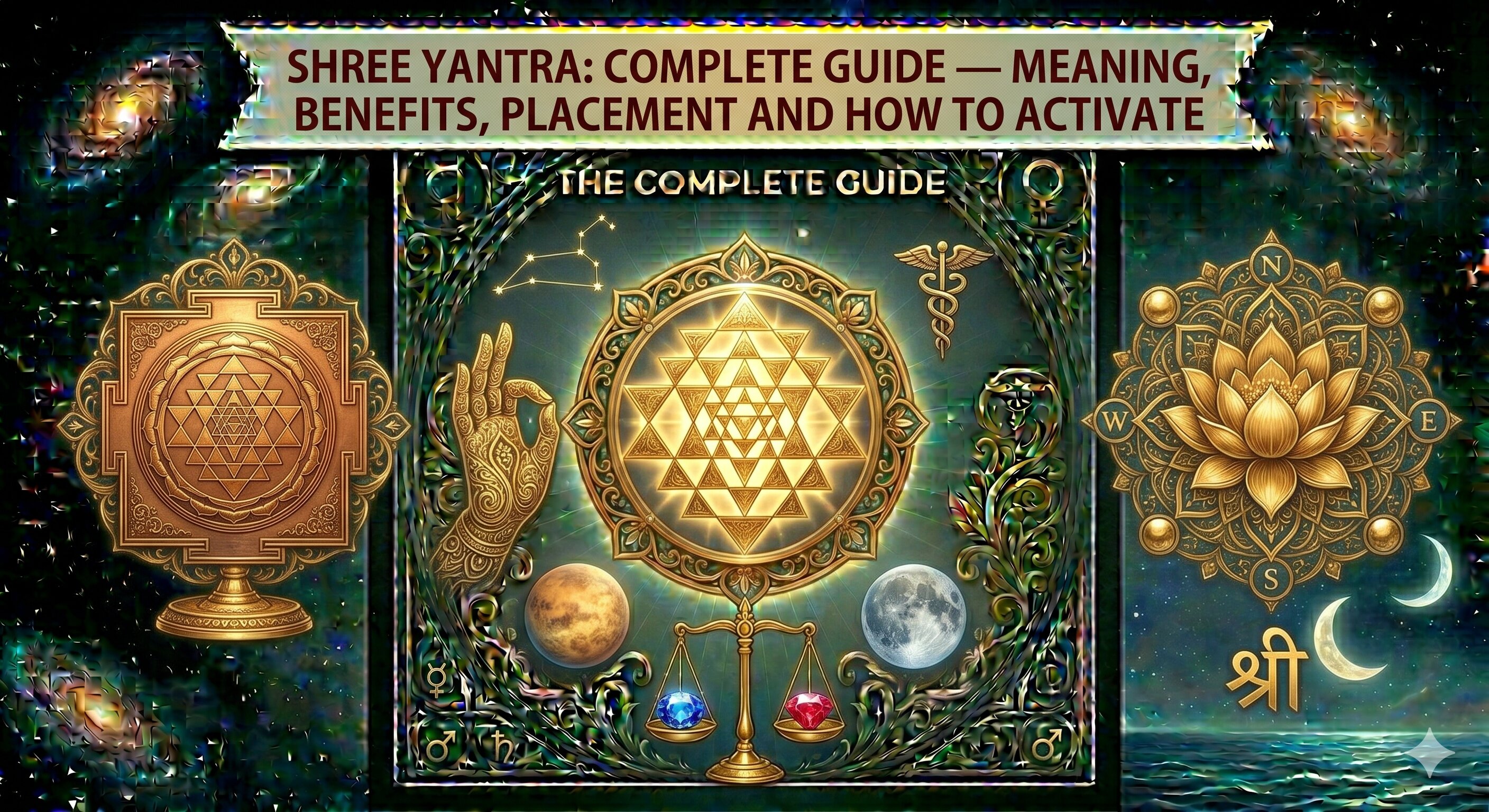
Geometrically, the Shree Yantra is formed by nine interlocking isosceles triangles arranged in concentric levels:
Surrounding the triangular core are two concentric rings of lotus petals -an inner ring of 8 petals and an outer ring of 16 petals -followed by three concentric circles, all enclosed within a square frame (Bhupura) with four T-shaped gates, representing a temple open to the four directions of the universe.
The nine circuits (Avaranas) of the Shree Yantra, from outer to inner, form a complete spiritual journey from material awareness to divine consciousness. Classical Navavarana Puja -the systematic worship of all nine circuits -is one of the most sophisticated ritual practices in the entire Vedic tradition.
| Classical Note -Scriptural Basis |
| The Shree Yantra is the central object of worship in the Shri Vidya school of Hindu tantra. The Saundarya Lahari ("Waves of Beauty"), composed by the great philosopher-saint Adi Shankaracharya in the 8th–9th century CE, provides the most celebrated devotional and philosophical framework for Sri Yantra meditation. Verse 11 of the Saundarya Lahari describes the Sri Chakra directly. Shankaracharya reportedly installed Sri Chakras in major temples across India, and his composition remains the authoritative text connecting the Shree Yantra to Advaita Vedanta -the non-dual understanding that worshipper, yantra, and deity are ultimately one. The Sri Sukta in the Rigveda and descriptions in the Brahmanda Purana (which contains the Lalita Sahasranama) also provide scriptural grounding for Shree Yantra worship. |
A key principle of Shree Yantra interpretation: it is simultaneously a macrocosm and a microcosm. The yantra maps the universe (9 levels of cosmic manifestation) and the human body (9 chakras in the subtle body). To meditate on the Shree Yantra is therefore to meditate on the identity of self and cosmos -the core insight of Advaita Vedanta.
The goddess who presides over the Shree Yantra is Tripura Sundari -whose name means 'She who is beautiful in the three worlds' (Bhuloka, Antarloka, and Svarloka -the physical, subtle, and causal planes). She is also known as Lalita, Rajarajeshvari, and Shodashi, and represents the supreme form of the Divine Mother in the Shri Vidya tradition.
Tripura Sundari is understood as the complete expression of Mahalakshmi -not merely as the goddess of material wealth, but as the goddess of all forms of abundance: wisdom, beauty, health, spiritual awakening, harmonious relationships, creative power, and liberation (Moksha). Her seat is the Bindu at the centre of the Shree Yantra. When a worshipper installs and activates a Shree Yantra, they are inviting Tripura Sundari to take residence in their home or workspace.
The Lalita Sahasranama -1,000 names of the Goddess -is directly associated with the Shree Yantra, and the Brahmanda Purana states that the Sri Yantra represents the cosmic body of Lalita Tripura Sundari in geometric form. Each of the 43 smaller triangles within the yantra is presided over by a specific Shakti or Yogini form of the Goddess.
The Shree Yantra is available in two primary forms, each with distinct properties and recommended uses:
| Feature | 2D Flat Shree Yantra | 3D Meru Shree Yantra |
|---|---|---|
| Form | Flat engraved plate (copper, gold-plated, silver, crystal slab) | Three-dimensional pyramidal form rising from a flat base |
| Symbolism | Sri Chakra -the cosmic diagram in two dimensions | Maha Meru -Mount Meru, the cosmic mountain at the centre of the universe |
| Energy Field | Radiates energy horizontally in 360° | Radiates energy in all three dimensions; considered more potent |
| Best For | Wall mounting, puja room altars, office placement, meditation focus | Central puja room installation, gifting, advanced practitioners |
| Materials | Copper (most common), Ashtadhatu, silver, gold-plated brass, Sphatik (crystal slab) | Sphatik (crystal quartz) -considered the most powerful; also Panchdhatu, Ashtadhatu |
| Recommended For Beginners | Yes -easier to clean and worship | Yes, if Sphatik; requires more careful handling |
| Classical Authority | Well established across all Shri Vidya schools | Specifically described in Kashmir Shaivism as the three-dimensional projection of the Sri Chakra |
For most households, the Sphatik (crystal quartz) Meru Shree Yantra is considered the gold standard -natural quartz amplifies and purifies energy, is self-cleansing to a degree, and the 3D Meru form generates a more complete energetic field. A copper flat Shree Yantra is an excellent and more affordable alternative, provided it is properly activated and regularly cleansed with Ganga Jal or clean water.
The Shree Yantra is not a transactional talisman -it is a living geometric altar whose benefits unfold proportionally to the consistency and sincerity of practice. The classical tradition and practitioner experience document the following domains of benefit:
| Domain | What the Shree Yantra Supports |
|---|---|
| Material Prosperity | Attracts wealth, removes financial obstacles, supports business growth, creates steadier income flow, and protects accumulated resources from sudden loss |
| Career & Leadership | Enhances authority, professional recognition, decision-making clarity, and removes invisible obstacles blocking career advancement |
| Mental Peace | Regular meditation on the Bindu reduces anxiety, improves focus, and calms obsessive thought patterns -the yantra's geometry has been documented to produce measurable meditative states |
| Health & Vitality | Aligns the subtle body's energy centres; practitioners report improved sleep, reduced chronic stress, and greater physical vitality |
| Harmonious Relationships | Balances masculine-feminine polarities (Shiva-Shakti) within the home environment, reducing conflict and improving marital and family harmony |
| Vastu Correction | A properly activated Shree Yantra in the Northeast can correct subtle Vastu imbalances without physical renovation, redirecting energy flow throughout the home |
| Spiritual Awakening | Deepens meditation, accelerates karmic resolution, and -for advanced practitioners -can become a gateway to Samadhi states and non-dual awareness |
| Protection | Creates a field of positive vibration that reduces the influence of negative energies, evil eye (Nazar Dosh), and psychic disturbances |
An important note on expectations: the Shree Yantra is not a wish-fulfillment device that produces immediate results. The classical tradition consistently recommends 40 to 90 days of sincere daily practice before expecting discernible shifts in material circumstances. Inner changes -clarity, calm, a sense of support -typically manifest earlier.
Correct placement of the Shree Yantra is considered as important as activation. The following Vastu guidelines represent the consensus of classical Shri Vidya texts and contemporary Jyotish and Vastu practitioners:
Place the Shree Yantra in the Northeast (Ishan Kon) corner of your home or puja room. The Northeast is the direction of divine wisdom and the most energetically receptive zone in Vastu Shastra. After sunrise, the first light of the sun enters from the northeast direction, naturally activating any sacred instrument placed there. This is the universally recommended primary placement.
The face (front) of the Shree Yantra should face West, so that you, the worshipper, face East while worshipping. Facing East while performing puja aligns you with the rising sun and the direction of Lord Kubera (North), both associated with prosperity and abundance.
Place the Shree Yantra at eye level -slightly below seated meditation eye level is ideal. The yantra should be at a height where you can comfortably focus on the Bindu point during meditation without straining. Avoid placing it on the floor.
Place the Shree Yantra on a fresh red cloth (symbolising Goddess Lakshmi's energy), a clean wooden platform, or a metal plate. The surface should be elevated -a dedicated altar or wooden pedestal is ideal. Red or yellow cloth is recommended for the foundation; avoid black cloth for the Shree Yantra.
| Vastu Placement Summary |
| Direction: Northeast (Ishan Kon) |
| Yantra Faces: West (you face East while worshipping) |
| Height: Eye level when seated for worship |
| Foundation: Red or yellow cloth on an elevated platform |
| Avoid: South and Southwest directions | Floor placement | Bedroom (unless puja space) | Near toilets or kitchen stoves |
| Companion: A Shiva Lingam placed nearby is said to amplify the Shree Yantra's energy, as Shiva and Shakti (the Yantra's core symbolism) are united |
For offices and commercial spaces: the Shree Yantra may be placed on the eastern or northeastern wall behind the primary workstation, facing west. The same directional principles apply.
A Shree Yantra purchased from a shop or received as a gift is an inert geometric form until it is activated through Pran Pratishtha -the ritual consecration that invites the Goddess's living presence into the yantra. Performing this ritual yourself with sincere devotion is completely valid; it does not require a pandit, though a qualified pandit's guidance is always beneficial for first-time practitioners.
The most auspicious days are Friday (the day of Venus and Goddess Lakshmi) or Monday (Shiva's day, honouring the Shiva-Shakti union within the yantra). The best time is Brahma Muhurta (approximately 90 minutes before sunrise) or early morning before 8 AM during Shukla Paksha (the waxing phase of the Moon). Auspicious occasions include Akshaya Tritiya, Dhanteras, Navratri, and Purnima (Full Moon).
Step 1 -Purify Yourself: Bathe and wear clean, preferably white, yellow, or red clothing. Sit facing East in your designated puja space.
Step 2 -Purify the Space: Light incense and the ghee lamp. Sprinkle Ganga Jal around the puja space and chant Om Namah Shivaya three times to cleanse the environment.
Step 3 -Clean the Yantra: Place the Shree Yantra on a copper plate. Gently wash it with Ganga Jal while chanting Om Aim Hreem Shreem. Then perform Panchamrit Abhishek -slowly pour the mixture of milk, curd, ghee, honey, and sugar over the yantra, followed by a final rinse with Ganga Jal or clean water. Wipe gently with a clean red or yellow cloth. (Note: For Sphatik/crystal yantras, use only Ganga Jal and rose water -Panchamrit can damage crystal over time.)
Step 4 -Apply Sacred Substances: Apply a small dot of sandalwood paste (chandan) and kumkum at the Bindu (centre) of the Yantra. Offer fresh red flowers around the base.
Step 5 -Invoke the Goddess (Avahana): With hands folded, close your eyes and sincerely invite Tripura Sundari to take her seat in the yantra. Visualise the Goddess as a radiant golden light at the Bindu point, expanding outward through every triangle, every petal, until the entire yantra glows. Hold this image for a few minutes.
Step 6 -Chant the Primary Mantra 108 Times: Using your Kamal Gatta or Rudraksha mala, chant the primary Shree Yantra mantra 108 times (see Section 7 below). Maintain focus on the Bindu point as you chant.
Step 7 -Complete the Puja: Offer additional flowers, light a camphor flame (Aarti), and conclude by touching the base of the yantra with both hands and bowing with the intention of gratitude and surrender to the Goddess.
Step 8 -Place in Designated Position: Now move the activated Shree Yantra to its permanent Vastu position in the Northeast, on the red cloth at eye level, facing West.
| Daily Worship After Activation | ||||||||||||||||
Once activated, the Shree Yantra requires daily attention to maintain its energy. Each morning, light incense and a ghee lamp before it. Chant the primary mantra at least 11 times (ideally 108 times). Offer fresh flowers once or twice a week -Friday is especially auspicious. Perform a full water or Ganga Jal cleansing every Friday, re-applying sandalwood paste and kumkum. Avoid skipping daily acknowledgment for extended periods, as this is understood to cause the energetic link to weaken over time.
Note on Panchadasi and Shodashi Mantras: The most potent Sri Vidya mantras -the 15-syllabled Panchadasi and 16-syllabled Shodashi -are traditionally transmitted only through a qualified guru via initiation (diksha). These are not mentioned in open guides as they require proper spiritual transmission to activate correctly. The mantra provided above is the widely practised, accessible, and equally powerful mantra suitable for all practitioners. |
Are you currently struggling with life phases like Astrology? Discover your precise chart insights now.
The Shree Yantra is not instant. The Vedic tradition is consistent in this teaching, and practitioners across lineages confirm it from experience. Here is what to realistically expect:
| Timeframe | What Practitioners Typically Report |
|---|---|
| Days 1–7 | A sense of increased calm and positive atmosphere in the home. Some practitioners notice sharper intuition or improved sleep. |
| Days 8–21 | Subtle shifts in circumstances -unexpected opportunities, reconnection with helpful people, a sense of greater clarity in decisions. |
| Days 22–40 | Tangible improvements begin to show in one or more life areas (financial, professional, relational) for consistent practitioners. |
| Days 40–90 | Significant, noticeable change is documented by most sincere practitioners in this window. The energetic field of the yantra is considered fully established by 90 days. |
| Beyond 90 Days | The Shree Yantra becomes a permanent source of positive influence in the home's energy field. Practitioner benefits compound over time with continued worship. |
The most important variables are consistency, sincerity, and correct placement. Missing days of practice -especially in the first 40 days -is understood to reset the accumulation of energy. Begin when you are confident you can maintain a daily practice.
| Related Articles on Nakshatraai.ai |
| [INTERNAL LINK PLACEHOLDER: Kaal Sarp Dosh -Complete Guide, 12 Types, and Proven Remedies → /blog/kaal-sarp-dosh-complete-guide] |
| [INTERNAL LINK PLACEHOLDER: Navagraha Shanti Puja -When to Perform and How It Works → /blog/navagraha-shanti-puja-guide] |
| [INTERNAL LINK PLACEHOLDER: Vastu Shastra for Home -Complete Northeast Corner Guide → /blog/vastu-shastra-northeast-corner] |
| [INTERNAL LINK PLACEHOLDER: Mahalakshmi Puja on Friday -Rituals, Mantras and Offerings → /blog/mahalakshmi-puja-friday-ritual] |
Yes. Sri Chakra and Shree Yantra are two names for the same sacred instrument. 'Sri Chakra' emphasises its circular, wheel-like (chakra) structure with concentric levels; 'Shree Yantra' emphasises its nature as a sacred instrument (yantra) of the Goddess. Both names are used interchangeably in Shri Vidya texts.
Yes, absolutely. The Shree Yantra is the geometric form of the Goddess -the Divine Feminine herself. Women are as entitled and encouraged to worship it as men. The Shri Vidya tradition has always included women practitioners at every level, from householders to initiates.
Classical guidance suggests installing one primary, properly activated Shree Yantra in the home's puja space. Installing multiple yantras of the same type can create competing energy fields rather than amplifying benefits. A single, well-maintained and lovingly worshipped Shree Yantra is vastly more powerful than several neglected ones.
The Lakshmi Yantra is a simpler geometric form specifically associated with Goddess Lakshmi's material blessings of wealth and prosperity. The Shree Yantra (Sri Chakra) is a far more complex and complete instrument that encompasses Mahalakshmi in her supreme form (Tripura Sundari), along with all 64 Yoginis and the complete pantheon of Shri Vidya deities. The Shree Yantra includes all of what the Lakshmi Yantra offers, and vastly more.
Shree Yantra ko ghar ke Northeast (Ishan Kon) mein, pooja ghar mein, aankhon ke star par rakhen. Yantra ka mukh Paschim (West) ki taraf ho, taaki aap pooja karte samay Purva (East) ki taraf mukh karke baithen. Lal kapde par ek uthhe hue manch (platform) par rakhein. South ya Southwest mein bilkul na rakhein.
Shree Yantra ko activate karne ke liye Pran Pratishtha karna zaroori hai: Shukravaar ya Somvaar ko Brahma Muhurta mein, Gangajal aur Panchamrit se Abhishek karein, lal phool chadhayein, aur Om Hreem Shreem Lakshmibhyo Namah mantra ko 108 baar Kamal Gatta mala par jaapen. Phir Northeast mein, aankhon ke star par, lal kapde par sthaapit karein.
Shri Vidya ki parampara aur anubhavi upasakon ke anusaar, 40 se 90 din ki niyamit, nishthapoorvak pooja ke baad prabhav spasht hone lagte hain. Pehle 7–21 dinon mein maanasik shanti aur ghar ka vatavaran acha lagta hai. Tangible (spashtay dikhnewale) parivartan zyaadatar 40 din ke baad milte hain. Sabse zaroori cheez hai -niyamitata aur shraddha.
The Shree Yantra is Vedic sacred science at its most complete -a geometric vision of the cosmos that is simultaneously a map of the universe, a portrait of the Goddess, a meditation device of unparalleled sophistication, and a living altar of divine abundance. The ancient tradition's description of it as yantraraj, the king of all yantras, is not hyperbole. No other yantra encompasses the totality of divine intelligence that the nine interlocking triangles of the Sri Chakra contain.
Yet its power is not magic -it is a relationship. The Shree Yantra responds to the quality of attention you bring to it. Adi Shankaracharya composed the Saundarya Lahari not as a ritual manual but as a love poem to the Goddess in her geometric form. That spirit of devotion, of genuine relationship with the sacred, is what activates the Shree Yantra far more than any ritual.
Place it correctly. Activate it with sincerity. Worship it consistently. Give it 40 to 90 days of daily practice. And approach it not as a mechanism for extracting results, but as a portal to the Goddess herself -who, once genuinely invoked, gives not only what you ask for, but what you most deeply need.
| Connect with a Jyotishi on Nakshatraai.ai |
| Generate your Kundali and explore your Shree Yantra compatibility: nakshatraai.ai/add-kundli |
| Speak with an expert Jyotishi or Shri Vidya pandit for a personalised Yantra consultation and activation guidance: nakshatraai.ai/astrologer |
Disclaimer: This article is for educational and informational purposes only. Yantra worship and Vedic ritual guidance does not substitute for consultation with a qualified Jyotishi or initiated Shri Vidya pandit who can evaluate your specific circumstances. Ritual procedures should ideally be performed under the guidance of a qualified pandit for first-time practitioners.