28 Oct 2026 | By Dr. Sanjoy Atri | 10 min read Look closely at the ancient symbol of the chariot. Most people see a warrior, horses, and a driver. They see a scene from a myth. They are wrong.
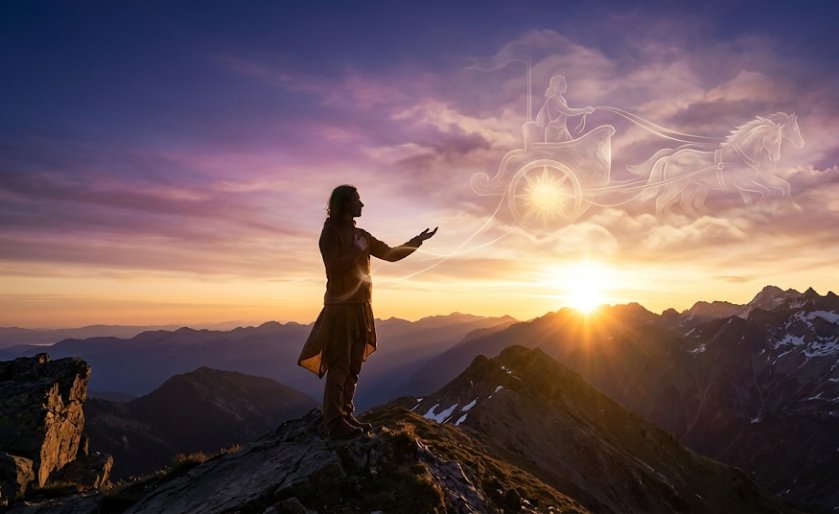
The Katha Upanishad, one of the most profound texts of Vedanta, reveals a different truth. It says: “Know the Self to be sitting in the chariot, the body to be the chariot, the intellect the charioteer, and the mind the reins. The senses are the horses, and the objects of the senses are their roads”.
This is not a story about a person. It is a map of you.
You are the one seated in the chariot. You are the observer. The body is the vehicle you inhabit. The intellect is the driver who must steer. The mind is the reins that must be held firm. The five senses are the horses—powerful, restless, and easily startled. If the driver is wise and the reins are steady, the chariot moves toward its destination. If the driver is foolish and the reins are loose, the horses bolt, and the chariot crashes.
This is the anatomy of consciousness. Awareness is the master. Mind is the instrument. Body is the vehicle. And when the master forgets who they are, the horses take over.
But there is another layer to this cosmic architecture. The chariot does not move in darkness. It moves under a light. And that light—the source of all vision, all vitality, all consciousness—is the Sun.
The Sun as the Cosmic Soul
In the Vedic vision, the Sun is not merely a celestial body. It is the visible form of the Divine. The Surya Upanishad and the Chandogya Upanishad describe the Sun as the inner Self, the witness of all, and the source of prana—the vital breath that animates every living thing. The Maitrayana Upanishad goes further: “He (the Self) bears the Self in two ways, as he who is Prana (breath), and as he who is Aditya (the sun). The Sun is the outer Self”.
This is not metaphor. It is a description of a fractal reality. The same principle that governs the macrocosm—the Sun radiating light, heat, and life across the solar system—governs the microcosm—the soul radiating awareness, vitality, and intelligence through the human being. The Sun outside and the soul inside are reflections of the same fundamental reality.
The Aditya Hridayam, the great hymn to the Sun from the Ramayana, makes this explicit. It describes the Sun as the source of energy, knowledge, protection, and inner consciousness, guiding individuals toward peace and success. The hymn is not a plea for favour from a distant deity. It is an invocation of the solar principle within—the light of awareness that dispels the darkness of ignorance.
And in Vedic astrology, the Sun is called the Atmakaraka—the significator of the soul itself. When the Sun is your Atmakaraka, your soul's lesson is to develop leadership, confidence, and integrity. You are here to shine, to inspire, and to step into your own power without arrogance. The Sun is not just what you are born under. It is what you are born to become.
The Quantum Biology of Light
Modern science is only now beginning to catch up with this ancient understanding. And what it is finding is extraordinary.
Every cell in your body contains mitochondria—the microscopic power plants that convert food and oxygen into energy. But mitochondria do more than generate ATP. They are sensitive to light. Specifically, they contain a protein called cytochrome C oxidase, which absorbs red and near-infrared light and uses it to enhance energy production.
This means that sunlight is not just hitting your skin. It is entering your cells and participating in the chemistry of life.
Even more remarkably, your cells emit light. This phenomenon, known as biophoton emission, is the release of ultra-weak photons from living tissues. Research in quantum biology suggests that these biophotons are not random noise. They are a form of cellular communication—a language of light that coordinates biological processes and may even be linked to consciousness itself.
The Sun, the external source of photons, and the soul, the internal source of awareness, are connected by this invisible web of light. When you stand in the morning sun, you are not just receiving vitamin D. You are recharging the quantum batteries of your cells. You are aligning your internal clock with the cosmic rhythm.
And that alignment has profound consequences for your health, your mood, and your mind.
The Neuroscience of Morning Light
There is a reason why the ancient traditions placed such emphasis on dawn. The Sandhyavandanam ritual, the Gayatri Mantra recited at sunrise, the practice of Surya Upasana—these are not arbitrary customs. They are precise protocols, designed to synchronise human biology with the most powerful photonic signal available: the first light of day.
Modern neuroscience has mapped exactly what happens when morning sunlight enters the eye. It activates a special class of cells called intrinsically photosensitive retinal ganglion cells (ipRGCs), which contain the pigment melanopsin. These cells do not create images. They measure light intensity and send signals to the brain’s master clock, the suprachiasmatic nucleus (SCN).
This signal triggers a cascade of effects:
Serotonin synthesis. Morning light stimulates the dorsal raphe nucleus to produce serotonin, the neurotransmitter associated with mood, well-being, and resilience. This is why a sunny morning feels different from a grey one.
Dopamine release. Light activates the retinal dopamine system and the melanopsin-striatal pathway, enhancing motivation and reward. This is not just about feeling good. It is about being driven to act, to create, to lead.
BDNF upregulation. Brain-derived neurotrophic factor—a protein that promotes the growth and survival of neurons—is increased by light exposure, especially when combined with movement. This is neuroplasticity in action. The brain literally rewires itself in response to light.
Melatonin regulation. Morning light suppresses melatonin production during the day and sets the timer for its release at night. This is the foundation of healthy sleep, which is the foundation of cognitive performance and emotional regulation.
The ancient rishis did not have access to this neuroscience. But they observed the effects. They saw that those who greeted the sun at dawn were healthier, happier, and more resilient. They encoded this observation into ritual. And the ritual, performed faithfully, produced the result.
Surya Namaskar: The Solar Circuit
The physical practice of Surya Namaskar—the Sun Salutation—is one of the most sophisticated technologies of human optimisation ever devised. It is a sequence of twelve postures, linked by breath, that systematically moves every major joint, stretches every major muscle group, and massages every major organ.
But it is also something more. The twelve postures correspond to the twelve names of the Sun, each representing a different aspect of solar energy. The practice is not just exercise. It is a dialogue. The body becomes a receiver, tuning into the frequencies of the solar principle.
The physiological benefits are well-documented: improved flexibility, increased metabolism, enhanced circulation, and mental clarity. But the deeper benefit is alignment. When you perform Surya Namaskar at sunrise, facing east, you are physically orienting your body with the source of life. You are acknowledging your dependence on the Sun. And in that acknowledgment, you are reminded of your own solar nature—your capacity to shine, to radiate, to lead.
The solar plexus, known in yoga as the Manipura Chakra, is the seat of personal power and will. Surya Namaskar directly stimulates this centre, activating the energy of confidence, courage, and decisive action. This is why the practice is recommended for leaders. It does not just strengthen the body. It strengthens the presence.
The Tantric Sun: Light, Sound, and the Bindu
In the tantric traditions, the Sun is understood as a gateway to the highest states of consciousness. The Sri Yantra, the most sacred geometric diagram of the Sri Vidya tradition, is composed of nine interlocking triangles surrounding a central point—the Bindu—from which the entire manifest universe emerges.
The Bindu is not a concept. It is a portal. It is the point of convergence between the individual soul and the cosmic soul. It is the Sun within the heart. The practice of Sri Vidya involves tracing the path of light from the outer circumference of the Yantra to the centre—from the multiplicity of the world to the singularity of pure awareness.
This is the same journey that the Sun itself travels each day. It rises, moves across the sky, and sets. But it never truly disappears. It simply withdraws to a place beyond the horizon, only to return. The soul, too, moves through the cycles of waking and sleep, birth and death, but its essential nature remains unchanged. The light is always there. We simply turn away from it.
The tantric path is the art of turning back. It is the discipline of reorienting the chariot of the body toward the sun of the soul. And when that reorientation becomes permanent, when every thought, word, and action is aligned with the light, the chariot becomes the Sun.
The Leadership of Light
What does all of this mean for the modern leader?
It means that leadership is not primarily a skill. It is a state of being. The most effective leaders are not those who have accumulated the most knowledge or developed the most sophisticated strategies. They are those who have aligned their internal light with the cosmic light. They are those who radiate clarity, confidence, and purpose, not because they are trying to impress, but because they cannot help it.
The Sun does not try to shine. It simply is. And because it is, everything around it is illuminated.
This is the solar leadership model. It is not about control. It is about presence. It is not about force. It is about radiance. When you align your body with the sun’s rhythms, your mind with the sun’s clarity, and your soul with the sun’s source, you become a source of light for others. You become the kind of person that people naturally want to follow.
And that is not a technique. It is a transformation.
The Practice of Solar Alignment
If you wish to embody this solar principle, begin with these simple, daily practices:
1. Greet the sun at dawn. For the first fifteen minutes after sunrise, expose your eyes (without looking directly at the sun) and your skin to natural light. This is the window when melanopsin activation is most potent and the circadian clock is most responsive.
2. Breathe with the light. As you stand in the morning sun, inhale deeply, imagining that you are drawing the light into your heart. Exhale slowly, imagining that you are radiating that light outward to everyone you will meet that day.
3. Move with intention. Practice Surya Namaskar—even a few rounds—as a physical prayer. Let each posture be an offering, each breath a connection to the source.
4. Face the light within. Throughout the day, pause. Turn your attention inward. Ask: Where is my attention? Is it lost in the horses, the reins, or the road? Or is it resting in the charioteer, the one who watches? Each time you return to the observer, you are returning to the Sun.
5. Radiate, do not react. When challenges arise, remember the Sun. The Sun does not argue with clouds. It simply continues to shine. Do not try to control the world. Control your own light. And let that light do its work.
6. Honour the cycles. The Sun rises and sets. It has its seasons. Honour your own. There is a time for action and a time for rest. There is a time for speaking and a time for silence. Wisdom is knowing which is which.
7. See the Sun in others. Every person you meet carries the same light within. When you recognise the solar principle in them, you call it forth. You become the mirror that helps them remember who they are.
The Return to the Source
The chariot is the body. The horses are the senses. The reins are the mind. The charioteer is the intellect. The one who sits in the chariot—the one who watches, who chooses, who leads—is the soul.
And the soul is not separate from the Sun. It is the Sun. Not the physical star, but the principle of light that the star represents. The principle of awareness that illuminates all experience. The principle of life that animates all beings.
When you know this, not as a concept but as a lived reality, you are free. The horses may still run. The road may still be rough. But you are no longer lost in the journey. You are the one who has chosen the destination. You are the one who holds the reins. You are the one who shines.
The Sun is calling. Not from the sky, but from within.
Answer it.
The Sun is not just in the sky. It is in your heart. The ancient rishis knew it. Modern science is proving it. You are the chariot, the horses, the reins—but above all, you are the light that guides them all.
#SolarSoul
#KathaUpanishad
#SunAsAtman
#Atmakaraka
#CircadianHealth
#Biophotons
#SuryaNamaskar
#ConsciousLeadership
#DrSannjay
#LightOfTheSoul