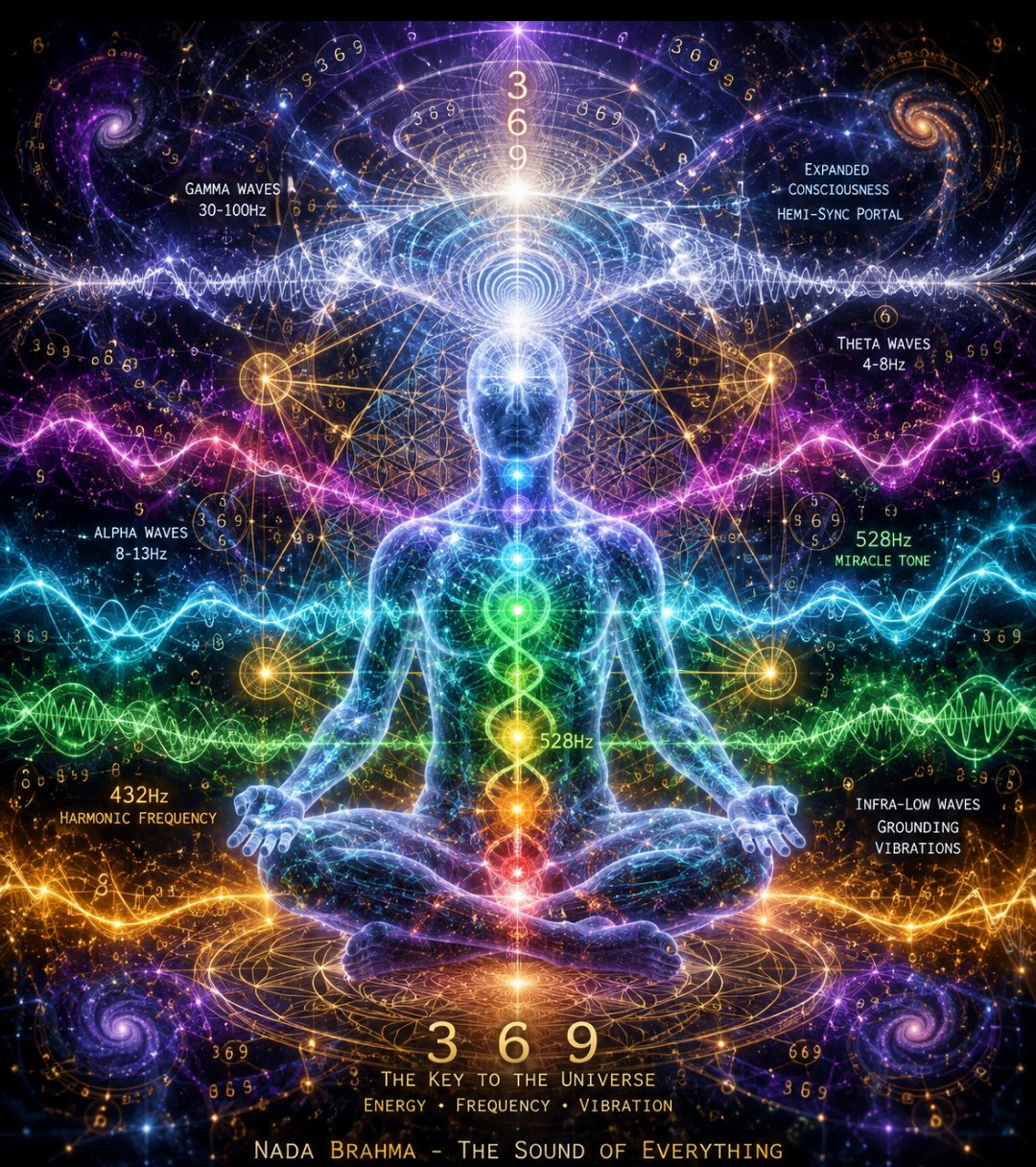
31 Aug 2026 | By Dr. Sanjoy Atri | 10 min read What if the entire universe — every star, every planet, every cell, every thought — is nothing more than a symphony of vibrations? What if the secret to health, wealth, and superconscious states is not hidden in a distant monastery or a classified government file, but is encoded in the very frequency of your breath, the rhythm of your heartbeat, and the resonance of the sounds around you?
Nada Brahma — the ancient Vedic principle that "Sound is God" — declares that the fundamental fabric of reality is vibration. The whole cosmos is permeated with that sound. This is not poetry. It is a scientific hypothesis that is being validated by modern neuroscience, quantum physics, and biomedical engineering.
Nikola Tesla, one of the greatest scientific minds in history, stated: "If you want to find the secrets of the universe, think in terms of energy, frequency, and vibration". Yogis intuited what Tesla discovered through experiment. Modern science now provides the data that bridges these two worlds.
This article is a journey into the science of sound — the fusion of ancient yogic wisdom and cutting-edge research on how vibration heals the body, expands the mind, and unlocks the hidden potential of human consciousness.
Nada Brahma — The Cosmic Symphony
The Vibration That Created the Universe
In yogic philosophy, Nada is the primordial vibration — the first sound from which all of creation unfolds. The sacred syllable "Om" is not merely a chant; it is described in the Upanishads as the seed vibration from which the universe was born. The practice of Nada Yoga teaches that by tuning into inner and outer sound — humming, chanting, or listening inwardly — one can align with the cosmic rhythm, bringing harmony to body and consciousness.
This concept finds a striking parallel in modern physics. The entire universe is in a state of constant vibration. Every atom oscillates. Every molecule resonates. Every cell has its own frequency. The human body is a symphony of vibrations — from the 1 Hz rhythm of deep sleep delta waves to the 40 Hz gamma waves of heightened awareness.
The Science of Resonance
Tesla's mechanical oscillator demonstrated that when a structure is vibrated at its natural frequency, even massive objects can resonate with unexpected intensity. In real terms, both Tesla and the Yogis pointed to a vibrational foundation of existence.
Modern research has confirmed that vibration is not just a metaphor — it has measurable, physiological effects. An MRI study on Om chanting revealed significant deactivation in the amygdala and other limbic regions — the areas involved in stress and anxiety. This pattern mirrors the effects seen in vagus nerve stimulation therapies, suggesting that chanting may lead to emotional regulation. In another experiment, mantra chanting naturally slowed breathing to six cycles per minute, synchronizing cardiovascular oscillations. Humming has been found to increase nasal nitric oxide levels by up to 15-fold compared to quiet exhalation — nitric oxide that increases immunity, dilates blood vessels, and enhances sinus health.
The Yogi's Sound Technology — Nada Yoga and Mantra
The Yoga of Sound
Nada Yoga is a branch of yoga philosophy that means "union through sound". The practice involves the resonance of energy centers in the body through specific sound frequencies. Using electro-photonic imaging (EPI), researchers found significant increases in energy levels at various chakra locations after just 45 minutes of Nada Yoga meditation.
The practice of Nada Yoga teaches that by tuning into inner and outer sound — humming, chanting, or listening inwardly — one can align with the cosmic rhythm. The classical Nada Yoga model of "inner listening" (anāhata nāda) applies ancient contemplative practices to modern sound meditation. The integration of traditional Nada Yoga principles with contemporary meditation structures represents a novel approach to making ancient contemplative practices accessible to modern populations.
Mantra as Medicine
The ancient rishis understood that specific sounds, when chanted with proper intonation and rhythm, could produce profound physiological and psychological effects. Modern research has confirmed these insights:
· Om chanting deactivates the amygdala — the brain's fear centre — by activating the prefrontal cortex.
· Mantra chanting naturally slows breathing to six cycles per minute, synchronizing cardiovascular oscillations.
· Humming increases nasal nitric oxide by up to 15-fold, boosting immunity.
Adequate scientific evidence is now available to prove that sounds heal.
The Chakra-Frequency Connection
Nada Yoga operates on the principle that different parts of the body resonate at different frequencies. The seven major chakras — subtle energy centers along the spine — correspond to specific sound frequencies and musical notes. By chanting specific mantras, practitioners can stimulate these centers, promoting physical healing, emotional balance, and spiritual awakening.
Using electro-photonic imaging (EPI), researchers found significant increases in energy levels at various chakra locations after just 45 minutes of Nada Yoga meditation.
The Science of Brainwave Entrainment — From Binaural Beats to Hemi-Sync
The Brain's Electrical Symphony
The human brain generates electrical activity that can be measured in frequencies, or cycles per second (Hz). These brainwave states correspond to different states of consciousness:
Brainwave Frequency State of Consciousness
Delta 0.5-4 Hz Deep sleep, healing, regeneration
Theta 4-8 Hz Deep meditation, creativity, memory consolidation
Alpha 8-13 Hz Relaxed alertness, calm focus
Beta 13-30 Hz Active thinking, concentration, anxiety
Gamma 30-100 Hz Peak performance, insight, expanded awareness
Brainwave entrainment is the process by which external rhythmic stimuli — such as sound — synchronize the brain's electrical activity to the frequency of the stimulus.
Binaural Beats: The Auditory Illusion
Binaural beats are an auditory illusion created when two tones of slightly different frequencies are presented simultaneously to each ear. The brain perceives a third tone — the difference between the two frequencies — and synchronizes its electrical activity to that frequency.
Emerging evidence indicates that brainwave entrainment, particularly within the gamma frequency range (30–100 Hz) , facilitates neural oscillatory patterns linked to relaxation, concentration, and memory, with 40 Hz showing promise for cognitive enhancement.
40 Hz: The Alzheimer's Breakthrough
The most significant finding in binaural beat research is the effect of 40 Hz gamma stimulation on cognitive function. A 2025 study on patients with early-stage Alzheimer's disease found that 30 one-hour sessions of 40 Hz auditory stimulation over three weeks significantly improved performance on cognitive flexibility and visuospatial working memory tests.
The findings showed that 40 Hz auditory brain stimulation significantly improved cognitive flexibility and visuospatial working memory in patients with early-stage Alzheimer's disease.
This research opens the door to non-invasive, non-pharmacological interventions for one of the most devastating neurodegenerative diseases of our time. Synchronized multisensory stimulation — combining auditory and visual inputs at gamma frequencies — has demonstrated potential in enhancing memory and supporting neural integrity, particularly in Alzheimer's disease.
Theta Waves: Pain and Anxiety Reduction
A 2026 systematic review and meta-analysis of 13 randomized controlled trials found that theta binaural beat therapy (4-8 Hz) may represent a promising, safe, and low-cost adjunct for pain modulation, anxiety reduction, and cognitive enhancement. Theta binaural beats were associated with a reduction in pain compared with controls, while anxiolytic effects were observed particularly in procedural and chronic pain contexts, and cognitive findings suggested that theta entrainment favoured episodic memory.
Hemi-Sync: The Gateway to Expanded Consciousness
Developed by the Monroe Institute, Hemi-Sync (Hemispheric Synchronization) is a sophisticated audio-guidance technology that uses binaural beat entrainment to synchronize the two hemispheres of the brain. The Gateway Process, declassified by the CIA in 1983, employed Hemi-Sync protocols to access expanded states of consciousness, including out-of-body experiences and remote viewing.
Modern researchers have interpreted Hemi-Sync protocols as "scalar-encoded oscillatory sequences engineered to guide brainwaves into phase-synchronized resonance" — enabling access to non-local consciousness. The cerebral ventricles have been identified as "resonant chambers" capable of sustaining acoustical standing waves, suggesting that the brain itself is a vibrational instrument.
The CIA's declassified report on the Gateway Process described a procedure that claimed to help people access the intuitive knowledge of the universe, as well as travel in time and commune with other-dimensional beings. Project Stargate operatives achieved 89.5% accuracy in remote viewing classified information.
The Lofi Revolution — Sound for Focus and Flow
The Rise of Functional Music
Lofi music — characterized by mellow melodies, ambient tape hiss, and muffled hip-hop beats — has become a global phenomenon, with millions turning to it for focus, study, and relaxation.
The science behind this is clear:
· Stress response decreases when listening to lofi music.
· Heartbeat synchronizes with the rhythm, shifting brainwaves into the alpha range — a state linked to calm concentration.
· Repetitive yet non-intrusive soundscapes help minimize distractions.
· Music aids in memory encoding.
Lofi creates the conditions for flow — that elusive state where time dissolves and performance peaks.
Lofi and ADHD
For individuals with ADHD, lofi music provides a non-intrusive auditory backdrop that lowers anxiety and enables memory encoding and time awareness. Soft beats and slow tempos shift brainwaves from a stimulated beta state to a calmer alpha state.
The Spotify Effect
A 2025 Georgetown University study on deep focus music found that the "lofi" playlist with deep focus music was instrumental, tranquil and ambient. Apple has enhanced pop songs with auditory beats or coloured noise to help encourage specific brain responses — gamma waves and white noise may help with focusing.
The Mozart Effect — Sound as Neuromodulation
Music as Medicine
The Mozart effect — the observation that listening to Mozart's music, particularly the "Sonata for Two Pianos in D Major" (K 448), can enhance cognitive performance — has been one of the most controversial and fascinating findings in neuroscience.
Recent research has revealed that the Mozart effect has genuine therapeutic applications, particularly in epilepsy. Mozart's "Piano Concerto No. 27" (K 595c) globally reduced interictal epileptiform discharges (IEDs) by 28% while listening to music (p = 0.0191) and 19% in the postmusic resting state (p = 0.0111). Mozart's music exhibits 10-60 second periodicity with low jitter values, distinguishing it from ineffective music.
This suggests that certain musical structures — not just any music — have the power to modulate brain activity and treat neurological conditions. The "Mozart effect" is not a myth. It is a phenomenon waiting to be understood at the level of neural resonance.
The Tailored Acoustic Approach
A 2025 study in the European Journal of Neurology titled "Toward a Tailored Acoustic-Based Approach in Music Neuromodulation in Epilepsy" points toward a future where music is prescribed like medicine — with specific compositions, frequencies, and durations tailored to individual patients.
Vibroacoustic Therapy — Sound Through the Body
The Dual Pathway of Healing
Vibration therapy encompasses both mechanical and acoustic stimulation. Mechanical vibrations affect cells and tissues through mechanotransduction, while acoustically delivered vibration (like music or sound therapy) influences brain function and mood.
Mechanical and acoustic vibrations are the two sides of the same coin — one works through the body, the other through the brain — but both aim to help people feel better and heal faster.
Clinical Applications
Low-magnitude, high-frequency vibrations help cells grow, tissues repair, and bones get stronger. Sound-based therapies affect hormones such as dopamine and cortisol, improving emotional well-being and reducing pain.
Vibroacoustic therapy has the potential to reduce acute stress response and improve cognitive well-being. Singing bowl meditation has been shown to influence heart rate variability and the autonomic nervous system. Multimodal vibroacoustic music therapy for functional neurological disorder has shown promise in clinical protocols.
The combination of mechanical and acoustic vibrations could be particularly useful in complex cases like postsurgical rehab or chronic pain.
Sound in Defense and Technology
The Military's Hidden Interest
The military and defense sectors have long recognized the power of sound and vibration. The CIA's Gateway Process represents one of the most documented examples of government interest in consciousness-altering sound technology.
Modern defense applications include:
· Acoustic metamaterials for sound insulation and vibration suppression.
· Acoustic counter-unmanned aircraft systems (C-UAS) that degrade camera images through acoustic vibrations.
· Underwater acoustic stealth and vibro-acoustic analysis.
· Acoustic-based wireless power transfer through metal structures.
The Future of Sound Technology
Emerging technologies are pushing the boundaries of what sound can do:
· AI-driven biofeedback that dynamically customizes musical complexity, entrainment frequencies, and multisensory components to individual physiological conditions.
· Transcranial magnetic stimulation (TMS) combined with auditory stimulation to enhance gamma (40 Hz) activity.
· Focused ultrasound for non-invasive modulation of deep brain circuits.
The Astrology of Sound — Planetary Frequencies and Mantra
The Music of the Spheres
The ancient concept of the "Music of the Spheres" — the idea that planetary movements produce a cosmic symphony — is finding modern validation. The sun plays the role of the "leading note" in planetary harmonics. The mapping of planetary orbits onto musical scales reveals a structured relationship between celestial mechanics and harmonic resonance.
Recent research on Astro Acoustic Entrainment examines planetary periodicities as quantitative signals rather than metaphorical patterns. Mantras' auditory construction can be linked to astronomical cycles and planetary rhythms.
Planetary Frequencies
Each planet in Vedic astrology is associated with specific sound frequencies